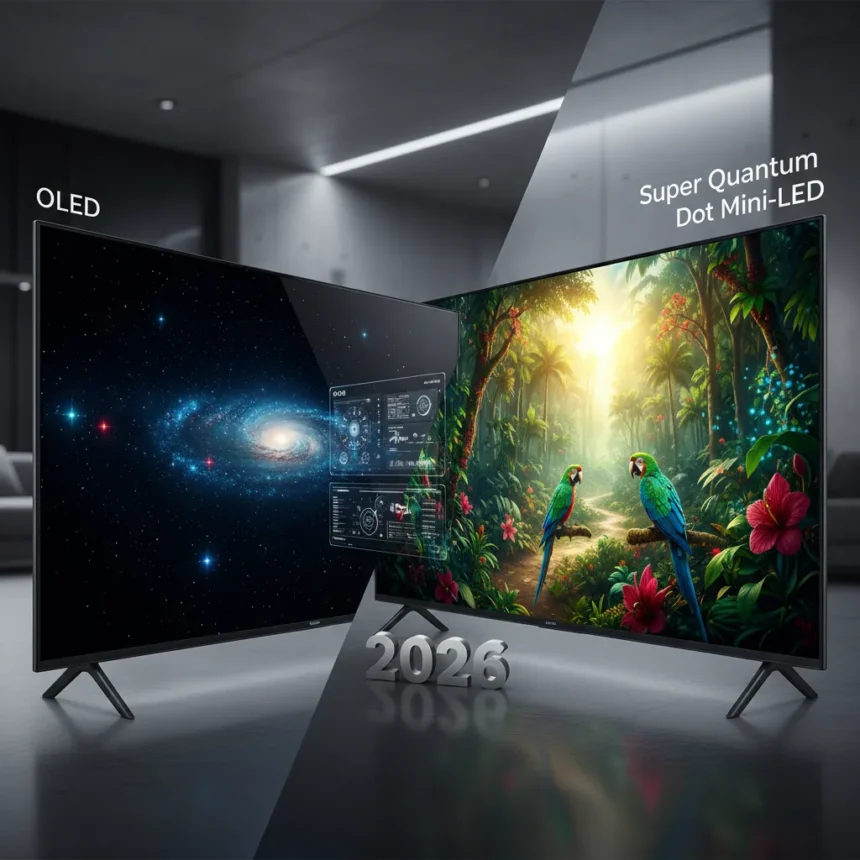
OLED vs Super Quantum Dot is shaping up to be the central buying decision for anyone shopping a high-end 4K TV in 2026. Super Quantum Dot, or SQD, is a new Mini-LED technology that TCL and other manufacturers are positioning as a lower-cost alternative to premium OLED displays. But the comparison is more nuanced than pure marketing. Both technologies deliver exceptional color and brightness, yet they excel in different scenarios. Understanding their strengths and trade-offs is essential before spending thousands on a TV.
Key Takeaways
- Super Quantum Dot Mini-LED TVs deliver QD-OLED-level color performance at lower prices than most premium OLED models
- OLED TVs offer perfect black levels and superior contrast that Mini-LED backlighting cannot fully match
- OLED panels risk burn-in with static images, while SQD Mini-LED avoids this issue entirely
- SQD is a 2026 buzzword designed to market enhanced Mini-LED brightness and color purity to mainstream buyers
- The better choice depends on your priorities: gamers favor OLED, HDR movie enthusiasts prefer Mini-LED
What Is Super Quantum Dot Technology?
Super Quantum Dot is a marketing term for TCL’s enhanced Mini-LED TVs that use quantum dot technology to achieve brighter, purer color than standard LED-backlit displays. The core innovation is not a revolutionary new panel type but rather optimized hardware that enables Mini-LED backlighting to match the color performance of QD-OLED without the brightness limitations of self-lit pixels. Quantum dots work by absorbing less light and allowing brighter images with more vivid colors. In SQD TVs, this efficiency gain is paired with Mini-LED’s traditional backlighting approach, creating a hybrid that borrows the best properties of both technologies.
The significance of SQD is not that it invented a new category but that it narrows the visual gap between budget-conscious buyers and those willing to pay premium prices. Tom’s Guide testing showed that TCL’s SQD TVs outperformed Samsung’s QD-OLED by a small margin in color performance, and they also surpassed TCL’s own earlier QM9K Mini-LED model. This is noteworthy because it suggests the technology is genuinely advancing, not just relabeling existing products with a catchier name.
OLED vs Super Quantum Dot: Black Levels and Contrast
The most significant technical advantage OLED holds over SQD Mini-LED is absolute black level performance. OLED TVs use self-lit pixels that turn off completely, producing perfect blacks and infinite contrast ratios. Mini-LED backlighting, even in enhanced SQD form, cannot fully replicate this because a backlight is always present behind the panel. This architectural difference is not a marketing claim—it is physics. When you watch a dark scene in a cinema or a space movie, OLED delivers a visual experience that Mini-LED simply cannot match.



That said, the practical difference matters less for certain viewing habits. If you primarily watch daytime TV, sports, or bright HDR content, the contrast advantage of OLED becomes less noticeable. SQD Mini-LED is actually positioned as a stronger choice for HDR movies precisely because its backlighting enables higher peak brightness. The trade-off is intentional: Mini-LED sacrifices perfect blacks for brighter, more vivid highlights. Whether that trade-off favors your viewing style depends on what you watch most.
Brightness, Color Purity, and Real-World Performance
OLED TVs typically limit their brightness to avoid heat-related panel degradation, making them dimmer than high-performance LED TVs. This is a genuine weakness in bright rooms or for HDR content that demands peak luminance. SQD Mini-LED and other high-end Mini-LED technologies address this by reaching brightness levels OLED cannot sustain. For reference, QLED TVs can reach upwards of 3,000 nits, and SQD aims to compete in that brightness tier while maintaining the color purity quantum dots provide.



Tom’s Guide places QD-OLED, RGB LED, and SQD Mini-LED among the TV types delivering the brightest, purest color in 2026. The distinction matters: all three are now viable for color-critical viewing. The old narrative—that OLED is the only path to premium color—has shifted. SQD represents a credible alternative, especially if you value brightness and affordability over perfect blacks. This is not a minor update to the TV market. It expands the number of viable options for buyers who want visual excellence without OLED’s price premium.
Burn-In Risk and Long-Term Durability
One persistent drawback of OLED is burn-in, where static images permanently damage the panel. A news ticker, a logo, or a video game HUD can etch into the display if left on screen long enough. OLED manufacturers have improved mitigation with pixel shifting and brightness limiting, but the risk remains. SQD Mini-LED avoids this entirely because its backlighting architecture does not suffer from pixel degradation in the same way. For gamers who play titles with static UI elements for hours, or for anyone planning to keep a TV for seven or more years, this is a meaningful advantage.
OLED is often marketed as the superior choice for gaming, and it has legitimate strengths: faster response times, zero input lag, and superior motion handling. But burn-in risk makes it a less safe long-term investment for heavy gaming. SQD Mini-LED offers a middle path—excellent brightness and color for gaming without the burn-in vulnerability. This is not a weakness of OLED; it is a consequence of the technology’s design. Buyers must decide whether the gaming benefits outweigh the durability risk.
Price and Value Proposition
SQD’s primary appeal is value. If you want a visually stunning TV for less than most QD-OLEDs or RGB LED TVs, SQD Mini-LED is positioned as the practical choice. Premium OLED models often command prices that push beyond $2,000 for 55-inch and larger sizes. SQD TVs, being Mini-LED with enhanced color tuning, should occupy a lower tier while delivering comparable color performance. This is the real innovation—not the technology itself, but the price-to-performance ratio it enables.



However, the SQD category is new enough that exact pricing and availability remain uncertain. The appeal is theoretical until models hit shelves and real-world prices are tested against actual OLED competitors. Manufacturers have an incentive to market SQD aggressively, so claims of superior color or near-OLED performance should be evaluated carefully. Tom’s Guide’s testing showed TCL SQD TVs outperformed QD-OLED by a small margin, but that margin was described as minimal. For most viewers, the difference would be imperceptible in a living room.
Which TV Technology Should You Choose?
The answer depends entirely on your priorities. Choose OLED if perfect blacks, superior contrast, and gaming performance matter most to you, and if you can afford the premium price and accept the burn-in risk. Choose SQD Mini-LED if you want excellent brightness, color purity, and durability at a lower cost, and if you primarily watch HDR movies or bright content. Neither is universally superior—they optimize for different strengths.
For most casual viewers, SQD Mini-LED represents a genuine upgrade to the TV market. It closes the color gap with OLED while staying affordable and avoiding burn-in risk. For enthusiasts and gamers, OLED remains the choice if budget allows, despite its drawbacks. The 2026 TV market will likely fragment along these lines: premium buyers choosing OLED for absolute image quality, practical buyers choosing SQD for value, and budget buyers sticking with standard LED. That fragmentation is healthy. It means more people can buy a TV that matches their actual needs and budget.
Is OLED vs Super Quantum Dot really a close call?
Not quite. OLED delivers objectively superior black levels and contrast due to its self-lit pixel architecture. SQD Mini-LED delivers objectively superior brightness and avoids burn-in risk. The question is not which is better in absolute terms but which trade-offs suit your viewing habits. If you watch mostly bright content, SQD wins. If you watch mostly dark scenes, OLED wins. Most viewers fall somewhere in the middle, making either choice defensible.
Will Super Quantum Dot replace OLED?
Unlikely. SQD is a marketing category designed to make Mini-LED more competitive, not to displace OLED entirely. OLED will remain the premium tier for buyers who prioritize image quality above all else. SQD will occupy the middle tier, offering excellent performance at a lower price. Standard LED and QLED will remain the budget options. The TV market will stratify further, which benefits consumers by offering more choices at different price points.
The real lesson of SQD is that OLED’s dominance in the premium segment is being challenged. That competition is healthy. It forces OLED manufacturers to justify their prices and innovation roadmap. For buyers shopping in 2026, it means you have more options than ever before. OLED vs Super Quantum Dot is not a battle to declare a winner—it is an opportunity to choose the technology that fits your lifestyle, budget, and viewing habits.
Edited by the All Things Geek team.
Source: Tom's Guide