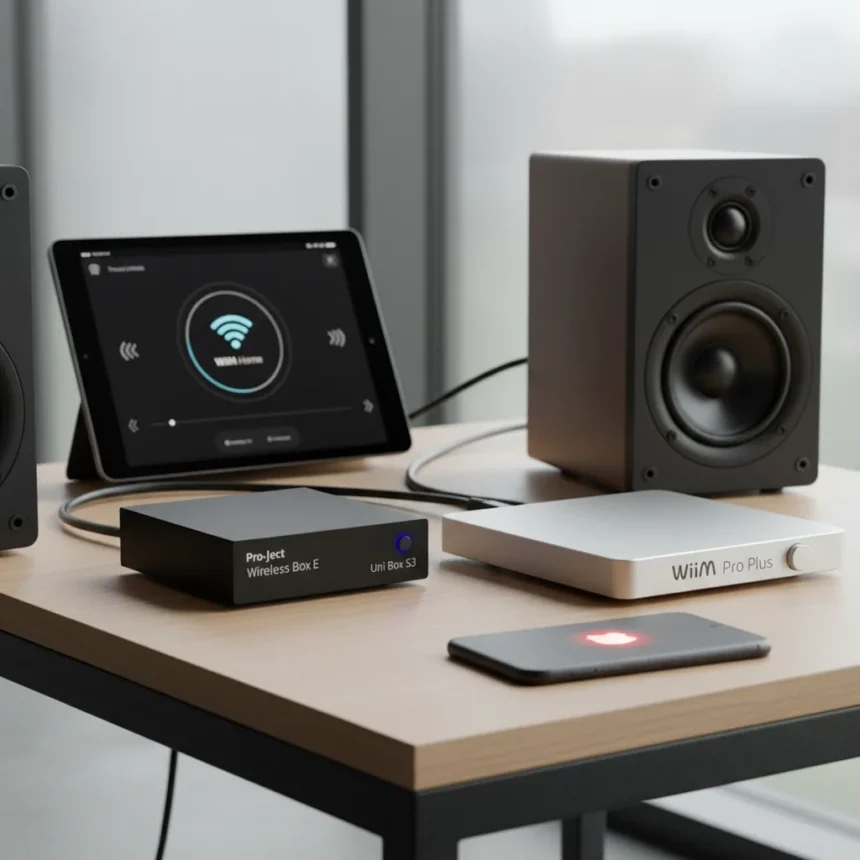
Pro-Ject Wireless Box E is a tiny dongle that attaches directly to passive speaker binding posts, turning any passive speakers wireless within the WiiM ecosystem. The Austrian audio maker just launched this device alongside the Uni Box S3, a streaming preamplifier that positions the WiiM platform as a genuine Sonos rival for audiophiles—but with a crucial caveat for Apple users that makes it a hard pass for the ecosystem-locked crowd.
Key Takeaways
- Wireless Box E attaches to passive speaker binding posts; launches later in 2025
- Uni Box S3 is a dual-mono streaming preamplifier made in the EU with fully analogue inputs
- 40W per channel into 4 ohms; Cirrus Logic CS4344 DAC supports 24-bit/192kHz
- Supports Spotify Connect, Tidal Connect, plus Qobuz, Deezer, Amazon Music via WiiM OS
- No Apple AirPlay support—a dealbreaker for iPhone and Mac users
What Pro-Ject Wireless Box E Actually Does
The Pro-Ject Wireless Box E solves a real problem: you have passive speakers you love, but they’re not wireless. Instead of replacing them or running cables across your room, you attach this tiny dongle to the speaker’s binding posts and suddenly they’re part of the WiiM streaming ecosystem. It integrates with existing WiiM devices like the Uni Box S3, Stream Box E, and Stream Box S3, creating a multi-room audio network without replacing your existing gear.
This is not a new concept—wireless speaker adapters have existed for years—but Pro-Ject’s approach is elegant. The device is genuinely small and works with any passive speaker, which matters if you’ve invested in quality passive monitors or vintage speakers. The Wireless Box E doesn’t arrive until later in 2025, so you cannot buy it today, but it fills a gap in the WiiM ecosystem that Sonos users have had for years.
Uni Box S3: EU-Made Streaming Amp That Keeps Analogue Analogue
The real story here is the Uni Box S3, a streaming preamplifier that Pro-Ject positions as fundamentally different from WiiM’s own Amp and Amp Pro. Where WiiM’s streaming amps digitize analogue inputs (turntables, CD players) before processing, the Uni Box S3 keeps analogue sources in the analogue domain. Pro-Ject’s press materials emphasize this: “Your analogue sources – like turntables – are not digitized, preserving their rich and lifelike sonic character. With a fully analogue pre- and power amp design, every nuance of your music is delivered with breathtaking punch and dynamic precision”.



The Uni Box S3 uses a dual-mono architecture similar to Pro-Ject’s MaiA S3 amplifier and delivers 40 watts per channel into 4 ohms (23W into 8 ohms). It includes a Cirrus Logic CS4344 DAC that handles 24-bit/192kHz streams. The device is made in the EU, a detail that matters to audiophiles skeptical of mass-market Chinese manufacturing. Inputs span analogue (two line-level RCA pairs, one MM phono), digital (two TOSLINK optical, one coaxial, one HDMI ARC), Bluetooth 5.1 (SBC/AAC codecs), and Wi-Fi streaming. Setup happens via the Pro-Ject Home app, which auto-detects the device and guides you through Wi-Fi configuration.
WiiM OS Powers the Ecosystem, But Apple Users Are Out
The Uni Box S3 runs WiiM OS, the same software platform that powers WiiM’s own streaming products. This gives you access to Spotify Connect, Tidal Connect, Qobuz, Deezer, Amazon Music, and TuneIn radio—a solid streaming lineup that rivals Sonos for breadth. You can stream from the Uni Box S3 to other compatible Pro-Ject and WiiM devices, building a multi-room system that competes directly with Sonos’s ecosystem.



Here is where the dealbreaker lands: there is no Apple AirPlay support. Not AirPlay 2, not basic AirPlay—nothing. If you own an iPhone, iPad, or Mac, you cannot simply tap a button to send music from Apple Music or any other app to the Uni Box S3. This is not a minor omission for Apple users, and Pro-Ject makes no secret of it—the headline of the original review warned that “Apple users should probably pass”. Sonos speakers support AirPlay 2 natively. WiiM’s own Amp Pro includes AirPlay 2. The Uni Box S3 does not, and that limitation is severe enough to eliminate it as an option for a significant portion of the global audio market.
How Pro-Ject Wireless Box E and Uni Box S3 Compare to Sonos
Sonos dominates the wireless speaker space because of ecosystem lock-in—if you start with Sonos, everything else integrates smoothly. WiiM, via Pro-Ject’s new hardware, is trying to build an equivalent ecosystem for hi-fi users who already own quality passive speakers or turntables. The advantage of the Wireless Box E and Uni Box S3 approach is flexibility: you keep your existing speakers and turntables, and add wireless capability without replacing them. Sonos forces you to replace or supplement with Sonos speakers, which costs significantly more upfront.
The disadvantage is ecosystem maturity. Sonos has been building its multi-room platform for two decades. WiiM, even with Pro-Ject’s hardware backing, is still building out compatibility and feature parity. The lack of AirPlay support is the most glaring gap—it is not a technical limitation but a business decision, and it locks out roughly 30% of the global premium audio market that uses Apple devices. For Android users and those invested in Spotify or Tidal, the Uni Box S3 is a genuine Sonos alternative. For Apple users, it is not.
Is the Pro-Ject Wireless Box E Worth Waiting For?
If you own passive speakers you love and you want to add wireless streaming without replacing them, the Wireless Box E is worth monitoring. It will not cost as much as buying new Sonos speakers, and it keeps your existing audio investment intact. The real question is timing—it does not ship until later in 2025, so you cannot buy it today. By then, WiiM may have added more features, or Pro-Ject may have released competing products.


The Uni Box S3 is more immediately relevant if you are building a hi-fi streaming system from scratch. It is EU-made, keeps analogue inputs undigitized, and integrates into the growing WiiM ecosystem. The price is not yet public, so you cannot compare value directly to Sonos or WiiM’s own Amp. Once pricing appears, the decision will depend on whether the analogue preservation and EU manufacturing justify the cost premium over digitizing competitors.
Does the Uni Box S3 work with turntables?
Yes. The Uni Box S3 includes an MM phono input that preserves the analogue signal from turntables without digitization, which is the core advantage over WiiM’s own streaming amps. You can also stream the turntable output to other compatible WiiM devices across your home.
Can you use Pro-Ject Wireless Box E with any speaker?
The Wireless Box E attaches to passive speaker binding posts, so it works with any passive speaker that has standard binding posts. It does not work with active (powered) speakers that already have built-in amplifiers.
Why does the Uni Box S3 not support Apple AirPlay?
Pro-Ject has not publicly explained the omission, but the lack of AirPlay support is a significant limitation for iPhone and Mac users. This is why the source review explicitly warned Apple users to look elsewhere.
Pro-Ject’s new Wireless Box E and Uni Box S3 represent a real attempt to challenge Sonos in the hi-fi space by letting audiophiles keep their existing gear and add wireless capability incrementally. For Android users and those committed to Spotify or Tidal, the approach is compelling. For Apple users, the missing AirPlay support is a non-starter. The Wireless Box E will not arrive until late 2025, so patience is required—but if you are willing to wait and you do not use Apple devices, this is the first genuinely flexible wireless speaker system that respects your existing audio investments.
Edited by the All Things Geek team.
Source: TechRadar