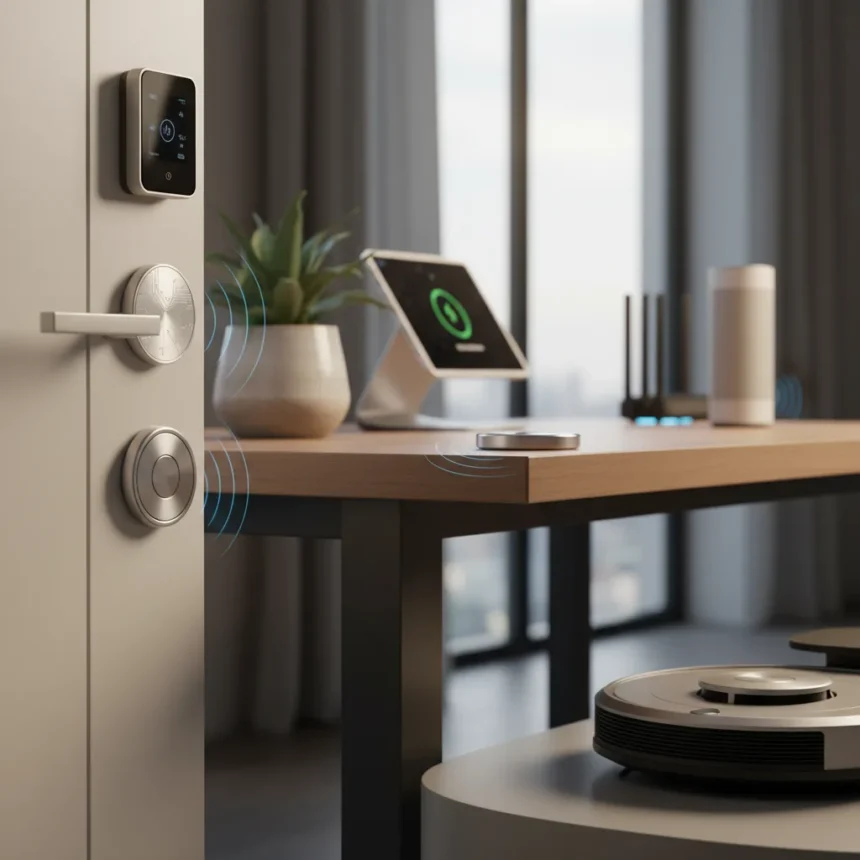
Battery-free metal tags developed by Georgia Tech researchers could eliminate the maintenance headache that plagues traditional smart home sensors. These penny-sized metal discs use ultrasonic pulses to detect everyday actions—door openings, drawer movements, gym repetitions—without batteries, charging, or the privacy vulnerabilities of conventional IoT devices. The technology represents a fundamental shift in how we approach activity tracking, trading power consumption and constant upkeep for simplicity and inherent privacy.
Key Takeaways
- Battery-free metal tags cost only a few cents each and require no charging or maintenance
- Ultrasonic pulses are inaudible to humans and travel only ~1 meter, making tracking inherently private
- Each tag’s unique shape creates a distinct ultrasonic fingerprint for reliable activity recognition
- Scalable design supports at least 100 unique tags, potentially thousands with optimization
- Mounted using 3D-printed bases; a small tab on doors or drawers triggers the pulse when moved
How Battery-Free Metal Tags Actually Work
The mechanics are deceptively simple. A metal disk—shaped like a flat washer with cutouts along the outer edge—sits mounted on a stationary surface using a 3D-printed base. A small tab attached to a moving part, like a door or drawer, strikes the disk when opened. That impact generates a brief ultrasonic pulse whose frequency and pattern depend entirely on the disk’s shape. A nearby wearable device or microphone detects and logs the pulse, translating it into actionable data about what just happened.
What makes this clever is the scalability. Yibo Fu, the robotics Ph.D. student who led development, explained that researchers have validated 20 to 100 unique disk designs that work reliably. But the real potential lies in expansion. “With more careful design, I think the total number of available tags can be very, very large—easily thousands—because the ultrasound frequency range is very broad,” according to co-researcher Deng. Each unique shape produces its own acoustic fingerprint, allowing a single monitoring system to distinguish between dozens of different sensors simultaneously.
Why Ultrasonic Frequencies Beat Traditional Sensors
Battery-free metal tags rely on ultrasound rather than radio or Bluetooth, and that choice solves multiple problems at once. Ultrasonic pulses are imperceptible to human ears, making the system completely silent—no chirps, no beeps, no audible interference. In noisy environments like factories or busy offices, ultrasound cuts through ambient noise more effectively than lower-frequency signals. But the most compelling advantage is privacy. Because ultrasonic signals travel only about one meter, they cannot be detected by anyone more than a few feet away. That means your activity data stays local, detectable only by devices you control. Unlike WiFi or Bluetooth sensors that broadcast across an entire home or building, these tags create a privacy perimeter by default.


Fu emphasized this point directly: “That makes the devices inherently private, because other people wouldn’t detect any activity unless they were within a meter or so.” This architectural advantage eliminates the privacy trade-offs that plague conventional smart home systems, where sensor data travels wirelessly across networks and potentially beyond.
Real-World Applications Beyond Smart Homes
The use cases extend far beyond tracking whether a cabinet door opened. Researchers have demonstrated activity recognition for gym workouts—counting repetitions during exercise—and monitoring bathroom use for elderly relatives who live independently. In an office, these tags could log how often conference room doors open or track equipment usage in shared spaces. In manufacturing, they could detect when machines start or stop without adding power infrastructure to every device.



The cost advantage compounds the appeal. At only a few cents per tag, deploying dozens of sensors across a home or facility becomes economically feasible. Traditional battery-powered sensors cost dollars each and require periodic replacement—a maintenance burden that scales painfully as deployments grow. Battery-free metal tags eliminate that friction entirely.
How This Compares to Existing Smart Home Sensors
Most smart home tracking systems rely on wireless sensors powered by coin-cell batteries or rechargeable packs. These require maintenance: replacing dead batteries, charging drained units, managing firmware updates. They also broadcast over WiFi or Bluetooth, creating privacy concerns as data travels across networks. Some systems use passive RFID tags, but those typically measure static properties like temperature or location rather than dynamic activity like motion or impact. Battery-free metal tags occupy a different niche—they detect specific mechanical events silently and privately, without the maintenance overhead or broadcast vulnerabilities of powered alternatives.
What Still Needs to Happen
The research is still in prototype phase. Georgia Tech announced the technology in April 2026, but no commercial products exist yet. Scaling from laboratory validation to mass manufacturing will require solving production challenges, integrating the wearable receiver technology, and proving reliability across diverse real-world environments. The researchers’ claim that thousands of unique designs are theoretically possible has not yet been empirically tested—only 100 designs have been validated so far.
Can these tags work in any environment?
Battery-free metal tags work best in environments where ultrasonic signals can propagate clearly. Extremely noisy industrial settings or spaces with significant ultrasonic interference might present challenges, though ultrasound’s frequency range offers broad flexibility. The one-meter detection range means you need a receiver device positioned reasonably close to the tags you want to monitor.



How many different tags can you deploy at once?
At least 100 unique designs have been validated reliably. Researchers believe optimization could push that number into the thousands due to the broad ultrasound frequency spectrum, though this remains theoretical rather than empirically proven.
What makes battery-free metal tags more private than other smart home sensors?
Ultrasonic signals travel only about one meter, so activity data cannot be detected remotely. Unlike WiFi or Bluetooth sensors that broadcast across an entire home or building, battery-free metal tags create a natural privacy boundary—only nearby devices you control can detect them.
Battery-free metal tags represent a genuine rethinking of how IoT sensors should work. By eliminating batteries, they remove the maintenance burden that has plagued smart home adoption. By using ultrasonic frequencies, they solve privacy and noise problems simultaneously. The technology is not yet commercially available, but the research validates a compelling principle: the best sensor might be one that does nothing but sit there, waiting to be struck, asking nothing from the grid or the user. For anyone tired of replacing batteries in wireless sensors, that vision should feel genuinely revolutionary.
Edited by the All Things Geek team.
Source: TechRadar