





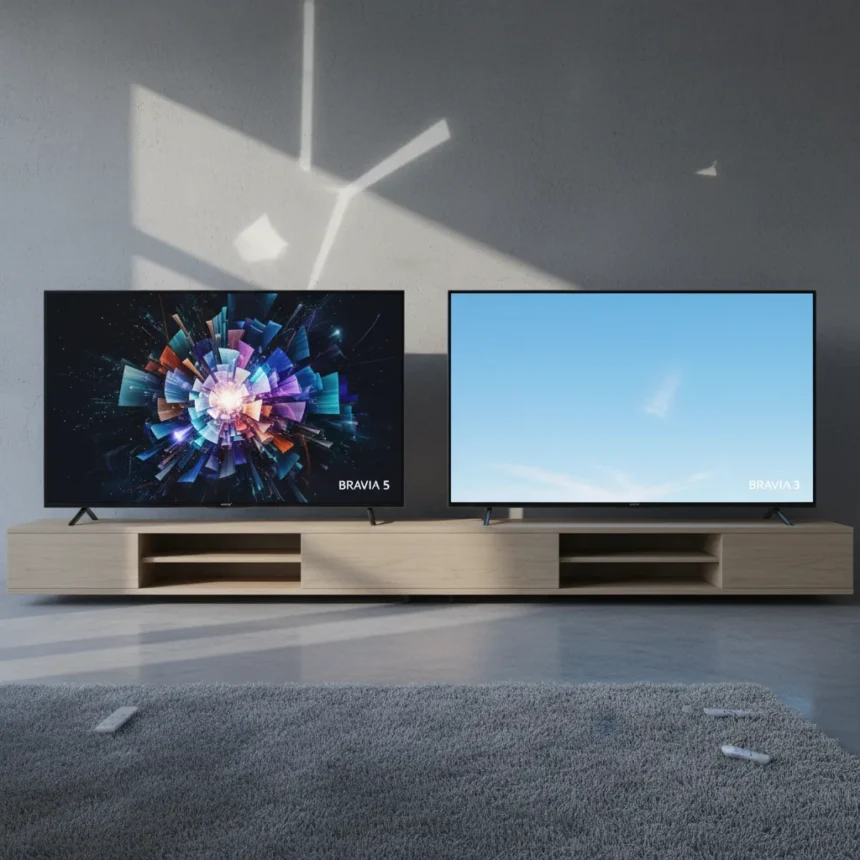
Sony Bravia 5 vs Bravia 3 is the question anyone shopping Sony’s 2025 lineup should ask first. These two televisions sit at opposite ends of Sony’s affordable spectrum—one a stripped-down entry point, the other a genuine mid-range performer with technologies previously locked behind premium price tags. The difference in picture quality is substantial, but whether it justifies the extra cost depends entirely on what you actually watch and how much you care about gaming.
Key Takeaways
- Bravia 5 features Mini LED with full-array local dimming; Bravia 3 uses basic Direct LED backlight
- Bravia 5 supports 120Hz refresh rate and HDMI 2.1; Bravia 3 maxes out at 60Hz
- Bravia 5 delivers superior contrast, HDR brightness, and motion handling across all content types
- Bravia 3 offers entry-level Sony picture processing at a significantly lower price point
- Both TVs run Google TV and deliver reliable Sony color accuracy across their size ranges
Picture Quality: Where the Bravia 5 Pulls Ahead
The Sony Bravia 5 is a significantly better TV than the Bravia 3 when it comes to picture quality. The Bravia 5 delivers substantially better contrast and dynamic range thanks to its full-array local dimming system—a feature that lets the TV control brightness independently across hundreds of lighting zones. The Bravia 3, by contrast, uses a simpler Direct LED backlight with basic zone control. This architectural difference shows immediately in dark scenes: the Bravia 5 holds deeper blacks while maintaining detail in shadow areas, whereas the Bravia 3 produces a flatter, less dimensional image.
HDR content reveals the gap most clearly. The Bravia 5 steps things up with Mini LED backlighting and the Cognitive Processor XR, alongside the powerful XR Backlight Master Drive. This processing engine—previously found only in Sony’s premium models—delivers more realistic HDR highlights and better tone mapping. When watching a film with bright explosions against dark skies, the Bravia 5 maintains separation and impact. The Bravia 3 handles HDR respectably for an entry-level set, but highlights feel less punchy and the overall sense of depth suffers.
Low-quality streaming content and upscaling is where Sony’s processing advantage becomes undeniable. The Bravia 5’s advanced upscaling smooths compression artifacts and adds perceived detail to 1080p streams, making older shows look sharper than they should. The Bravia 3 upscales adequately but without the same refinement.



Gaming and Motion: The Bravia 5 Owns This Category
If you own a PS5 or Xbox Series X|S, the Bravia 5 is the clear winner. The primary difference between these models is that the Bravia 3 is an entry-level LED TV with a 60Hz refresh rate, while the Bravia 5 features Mini LED backlighting and the XR Processor with 120Hz refresh rate and HDMI 2.1 features like Variable Refresh Rate (VRR). Both ports 3 and 4 on the Bravia 5 support 4K 120Hz with ALLM (Auto Low Latency Mode), meaning you get full next-gen console support with zero compromise.
The Bravia 5’s game mode responsiveness is noticeably faster than the Bravia 3’s. Input lag is lower, motion handling is smoother, and VRR eliminates the screen tearing that plagues the Bravia 3 during fast-paced gameplay. The 120Hz refresh rate also makes a genuine difference when gaming at high frame rates—scrolling menus, panning cameras, and action sequences all feel more fluid. The Bravia 3 locks you to 60Hz, which is adequate for single-player story games but frustrating if you play competitive shooters or racing titles.



For casual gamers or anyone primarily watching movies and TV, this advantage matters less. But for anyone serious about gaming, the Bravia 5 is the only sensible choice between these two.
What Both TVs Get Right
Don’t mistake the Bravia 5’s superiority for a condemnation of the Bravia 3. Both TVs are 4K UHD sets running Google TV, offering reliable Sony color accuracy and a full complement of 4x HDMI ports. The Bravia 3 replaces the Sony X75WL and brings affordable access to Sony’s picture processing heritage. If you’re upgrading from a ten-year-old 1080p set, the Bravia 3 will astound you with its color volume and sharpness.
The Bravia 3 makes sense for bedrooms, kitchens, or secondary viewing spaces where you’re not staring at the screen for hours. It’s also the right choice if your budget is genuinely tight—a 43-inch Bravia 3 costs significantly less than the same size in Bravia 5, and the gap widens at larger sizes. Sony’s smart TV platform is identical on both, so streaming apps, voice control, and smart home integration work the same way.
Pricing and Availability in 2025
The Bravia 3 arrived in the UK in 2025 as a new entry point for Sony’s lineup, having been available in the US and Australia previously. The Bravia 5 replaces the Sony X90L and sits in the true mid-range, offering the technologies that made the X90L popular at a slightly lower price.



Pricing varies by region and size. In India, the 65-inch Bravia 3 S30B starts around ₹87,990, while the equivalent Bravia 5 costs ₹1,39,990—a significant gap that reflects the engineering differences. US and UK retailers typically offer free shipping and returns, making it easier to demo both models at home before committing.
Sony Bravia 5 vs Bravia 3: Which Should You Buy?
Buy the Bravia 5 if you game, watch premium content, or care about picture quality. The Mini LED backlight, local dimming, and advanced processing justify the premium for anyone who spends more than a few hours a week in front of the screen. The 120Hz support and HDMI 2.1 are genuine future-proofing for gaming, and the motion handling is noticeably smoother across all content.
Buy the Bravia 3 if you’re budget-conscious and primarily watch broadcast TV, streaming shows, and casual content. You’ll get Sony’s color science and basic picture processing without paying for technologies you won’t use. It’s a competent 4K TV that won’t embarrass you—it just won’t impress you the way the Bravia 5 does.
Does the Bravia 5 have better black levels than the Bravia 3?
Yes, significantly. The Bravia 5’s full-array local dimming system controls hundreds of independent lighting zones, allowing it to produce deeper blacks while maintaining shadow detail. The Bravia 3’s simpler Direct LED backlight cannot achieve the same contrast.
Can the Bravia 3 handle 120Hz gaming?
No. The Bravia 3 maxes out at 60Hz refresh rate and lacks HDMI 2.1 support, making it unsuitable for next-gen console gaming at high frame rates. The Bravia 5 supports 120Hz with VRR on ports 3 and 4.
Which Sony TV should I buy if I mostly watch streaming services?
The Bravia 5 will deliver noticeably better picture quality due to superior upscaling and contrast, but if budget is your primary concern, the Bravia 3 handles streaming respectably. The choice depends on whether you value picture quality enough to justify the extra cost.
The Sony Bravia 5 vs Bravia 3 decision ultimately comes down to your priorities. The Bravia 5 is the better television by nearly every measure—sharper contrast, brighter HDR, smoother motion, and full gaming support. But the Bravia 3 is a legitimate value play for anyone who wants Sony’s color science without the premium price. Neither is a bad choice; they’re just built for different audiences.
Where to Buy
£759 at Amazon | £1,199 at Amazon
Edited by the All Things Geek team.
Source: What Hi-Fi?




