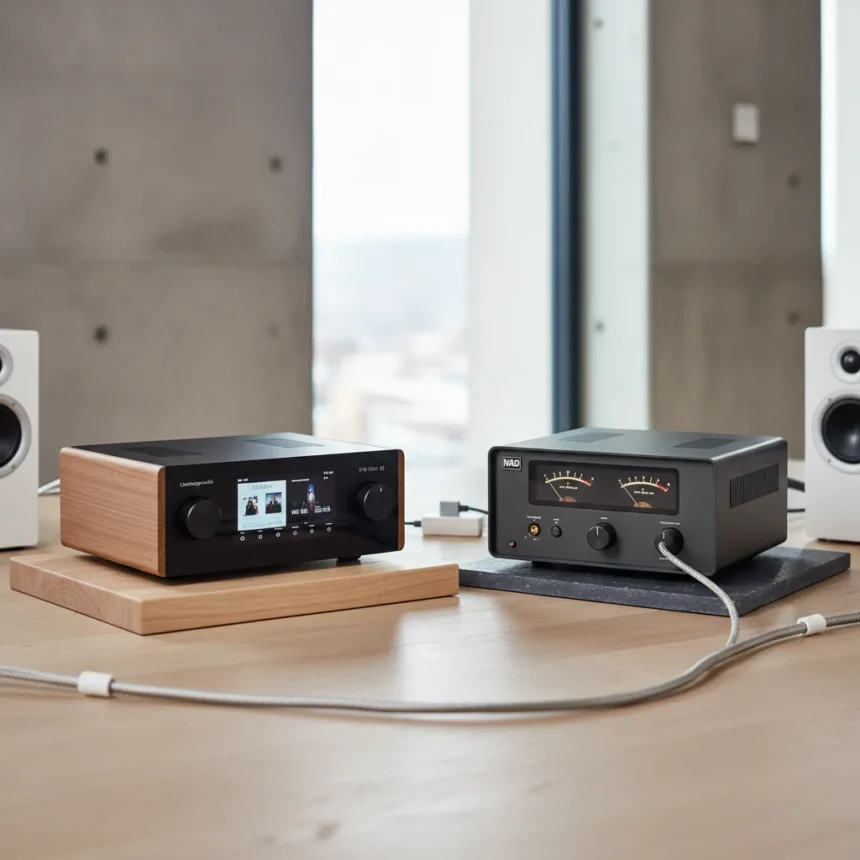
The streaming amplifier comparison between the Cambridge Audio Evo 150 SE and the NAD C 3050 with MDC2 BluOS-D module represents one of the most interesting showdowns in mid-to-high-end audio right now. Both units promise to deliver serious sound quality while handling your entire music library wirelessly. But which streaming amplifier truly deserves the crown?
Key Takeaways
- Cambridge Audio Evo 150 SE and NAD C 3050 are both talented streaming amplifiers in direct competition.
- The NAD C 3050 uses the MDC2 BluOS-D module to add streaming and control capabilities.
- A direct streaming amplifier comparison requires evaluating design philosophy, connectivity, and sonic priorities.
- Both units target listeners who want integrated amplification plus modern streaming in one chassis.
- The choice between them depends on your existing ecosystem and sonic preferences.
What Defines a Modern Streaming Amplifier
A streaming amplifier is an integrated amplifier that combines built-in streaming capability, digital-to-analog conversion, preamplification, and power amplification in a single unit. The Cambridge Audio Evo 150 SE and NAD C 3050 (with its MDC2 BluOS-D module) both fit this definition, though they approach the problem from slightly different angles. One integrates streaming from the ground up; the other adds it via a modular upgrade. This fundamental difference shapes how each unit performs and integrates into your system.
The streaming amplifier comparison matters because these devices have become the centerpiece of modern audio setups. Listeners no longer want separate components scattered across a rack. They want simplicity, connectivity, and sound quality in one footprint. The Cambridge Audio Evo 150 SE and NAD C 3050 both promise this, but the execution differs in ways that matter for long-term satisfaction.
Cambridge Audio Evo 150 SE: Integrated Streaming From the Start
The Cambridge Audio Evo 150 SE takes a cohesive approach to the streaming amplifier challenge. Its design philosophy centers on building streaming capabilities directly into the amplifier’s architecture, rather than bolting them on afterward. This approach typically results in fewer compromises in terms of thermal management, component placement, and signal path optimization. The unit handles streaming, conversion, and amplification as an integrated whole rather than as separate functional blocks forced to coexist.



When evaluating a streaming amplifier like the Cambridge, you’re assessing how well the manufacturer has thought through the interaction between digital inputs, analog conversion, and power delivery. A purpose-built design can allocate resources more efficiently than a modular retrofit. The Evo 150 SE’s architecture reflects this philosophy throughout.
NAD C 3050 with MDC2 BluOS-D: The Modular Approach
The NAD C 3050 takes a different path in the streaming amplifier marketplace. The base amplifier is a high-quality integrated amp, and the MDC2 BluOS-D module adds streaming and control capabilities. This modular approach offers flexibility—you can upgrade an existing C 3050 or purchase the complete package. It also means NAD can optimize the amplifier section independently from the streaming section, potentially offering advantages in power delivery or thermal design.



The streaming amplifier comparison becomes more nuanced here. The NAD C 3050 with the MDC2 BluOS-D module is technically a complete streaming solution, but it’s built from two separate components working in concert. Some listeners prefer this modularity; others find it less elegant than a fully integrated design. The MDC2 BluOS-D module itself brings BluOS connectivity, which is NAD’s ecosystem for streaming and multi-room audio.
Streaming Amplifier Connectivity and Ecosystem
Both units offer modern wireless streaming, but through different platforms. The Cambridge Audio Evo 150 SE uses its own ecosystem, while the NAD C 3050 with MDC2 BluOS-D leverages BluOS. This is a crucial distinction in the streaming amplifier comparison because your choice locks you into a particular ecosystem for multi-room expansion, app control, and future upgrades.
If you already own NAD equipment with BluOS, the C 3050 with MDC2 BluOS-D module integrates smoothly. If you’re building a new system and prefer Cambridge’s approach, the Evo 150 SE offers a cleaner, single-brand experience. Neither streaming amplifier is objectively superior here—it depends on your existing infrastructure and long-term plans.
The Real Streaming Amplifier Shootout: Which Wins?
The streaming amplifier comparison ultimately hinges on your priorities. If you value integrated design, thermal efficiency, and a cohesive signal path, the Cambridge Audio Evo 150 SE makes a compelling case. If you prefer modular flexibility, BluOS ecosystem compatibility, or already own NAD equipment, the C 3050 with MDC2 BluOS-D module is the logical choice.



Neither streaming amplifier is a compromise. Both deliver serious sound quality and modern connectivity. The winner in any streaming amplifier comparison is the unit that aligns with your system, your ecosystem, and your listening habits. Test both if you can. Listen to familiar music through each. The streaming amplifier that feels right to your ears is the king of your system.
Which streaming amplifier offers better modularity?
The NAD C 3050 with MDC2 BluOS-D module wins on modularity. You can upgrade an existing C 3050 or purchase them separately. The Cambridge Audio Evo 150 SE is a fixed, integrated design—you cannot swap or upgrade individual components in the same way.
Can I use the Cambridge Audio Evo 150 SE in a multi-room setup?
Yes, the Cambridge Audio Evo 150 SE supports wireless streaming and can integrate into a multi-room system through its native platform. The NAD C 3050 with MDC2 BluOS-D module offers similar multi-room capability via BluOS, which is NAD’s dedicated ecosystem for this purpose.
Is the streaming amplifier comparison really about sound quality alone?
No. While sound quality matters, the streaming amplifier comparison also involves design philosophy, ecosystem fit, modularity, and long-term upgrade potential. Two excellent amplifiers can be the right choice for different listeners based on these factors, not just sonic performance.
The Cambridge Audio Evo 150 SE and NAD C 3050 with MDC2 BluOS-D module are both legitimate answers to the question of which streaming amplifier to buy. Your answer depends on whether you value integrated simplicity or modular flexibility, whether you’re committed to a particular streaming ecosystem, and how you plan to expand your system in the future. Neither unit is a mistake—only the wrong choice for your specific needs would be.
Where to Buy
Edited by the All Things Geek team.
Source: What Hi-Fi?