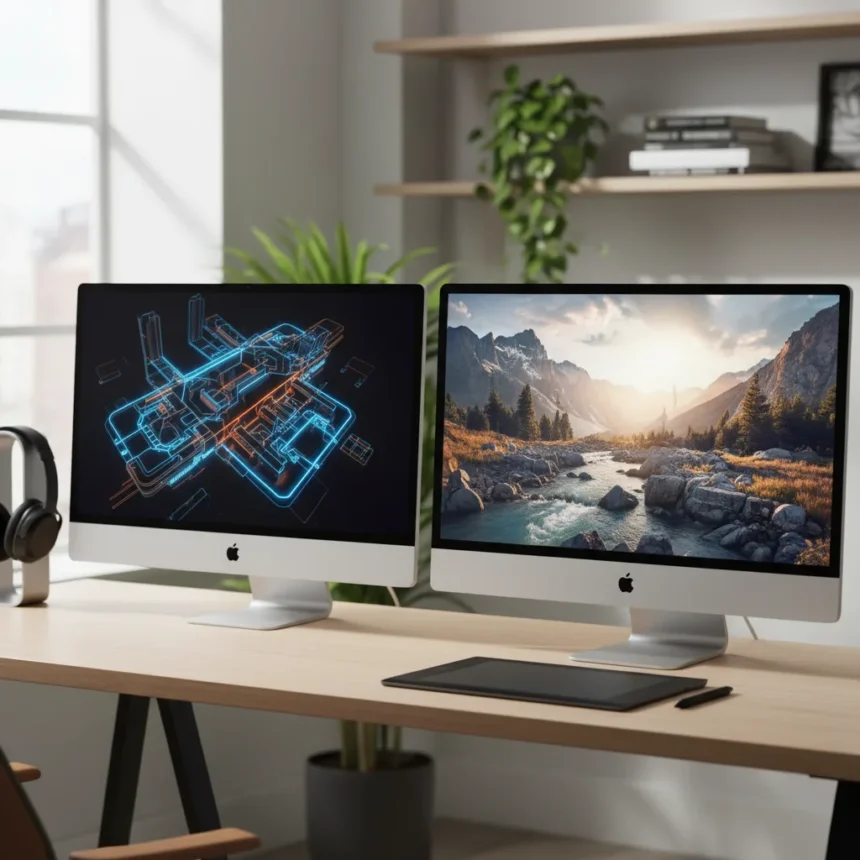
The Apple Studio Display XDR nano-texture fundamentally changed my decade-long stance against glossy screens. After spending a week working across dual nano-texture XDR displays, I realized I had been conflating two entirely different problems: reflections caused by glossy glass, and the reflections themselves. Apple’s etched glass solution separates them in ways that matter for creators working in bright rooms.
Key Takeaways
- Nano-texture is etched glass, not a coating, reducing reflections without sacrificing contrast ratio.
- Apple Studio Display XDR features mini-LED backlight with 2,304 local dimming zones and 1,000,000:1 contrast.
- Nano-texture upgrade costs $300 extra but eliminates glare that standard glossy glass cannot handle.
- Text sharpness loss is measurable but minimal compared to glare reduction benefits in real-world creative work.
- The XDR model delivers spectacular HDR performance with no stutter, a massive leap from the 2022 standard display.
What Makes Nano-Texture Glass Different
Nano-texture is not a coating you apply. Apple etches the glass surface at a microscopic level, scattering light diffusely across the panel rather than reflecting it straight back at you. This distinction matters more than marketing language suggests. A standard glossy display bounces your room’s light directly into your eyes. Nano-texture breaks that path. The result: you see the screen content, not your reflection or your window behind you.
Greg Benz, a photographer who tested the XDR, called the nano-texture finish amazing for reducing reflections in real-world shooting scenarios. The Sweet Setup noted the finish feels soothing on the eyes compared to ultra-sharp glossy displays, evoking the older matte Cinema Displays from the early 2000s without their resolution limitations. That comparison is apt—you get modern sharpness with a surface that does not assault your eyes in bright light.
The trade-off is real but acceptable. Nano-texture introduces a slight halo effect around black text on white backgrounds and faint fuzziness on text edges. In my experience reviewing similar surfaces, this matters most in low-reflection rooms where you are not fighting ambient light. For the studio, home office, or any space with windows, the glare reduction outweighs the minor sharpness loss.


XDR Performance: Where the Real Upgrade Lives
The nano-texture surface grabbed headlines, but the XDR model itself represents a generational leap from the 2022 Studio Display. The standard model topped out at 600 nits with no HDR support and a modest contrast ratio. The XDR delivers 1,000,000:1 contrast ratio thanks to a mini-LED backlight array with 2,304 local dimming zones. That architecture eliminates the haloing and blooming you see on cheaper HDR displays. When you render dark scenes with bright UI elements, the display does not crush blacks or blow out highlights—it handles both simultaneously.
PetaPixel praised the nano-texture glass as outstanding for rejecting glare, but the real value proposition is the combination. You get a display that handles HDR content without stutter or judder, paired with a surface that lets you actually see that content in a lit room. For video editors, photographers, and designers working on color-critical projects, that pairing is rare at any price point.



The Glossy Screen Myth I Believed
I spent years defending matte finishes as objectively superior. My reasoning was simple: glossy screens reflect light, matte screens do not. Therefore, matte wins. What I ignored was the actual working environment. In a perfectly dark room with controlled lighting, that logic holds. In the real world—where sunlight exists, where overhead lights bounce off surfaces, where you have a window behind your desk—glossy glass becomes a mirror. Matte finishes scatter that light, but older matte displays also scattered the image itself, reducing sharpness and color accuracy.
Nano-texture splits the difference. It scatters reflections without scattering pixels. The Pro Display XDR, Apple’s professional reference monitor, lacks nano-texture and shows noticeably more reflections and red/blue fringing on text when compared side-by-side. That is the comparison that broke my argument. A $6,000 reference monitor looks worse in real-world lighting than a nano-texture XDR because of surface finish alone.
Build and Practical Details
The XDR sits in a brushed aluminum enclosure with rounded edges and a robust stand that tilts and adjusts height. A VESA mount option exists for those who prefer wall mounting. Apple includes a polishing cloth specifically for nano-texture cleaning, which is necessary—dust and fingerprints show more readily on an etched surface than glossy glass.
The nano-texture upgrade costs $300 on top of the XDR’s base price. That is not trivial, but for anyone working in a room with natural light or multiple light sources, it is the difference between a beautiful display and a frustrating one. The standard glossy XDR remains an option for darker studios or those budget-conscious, but nano-texture is the version that solves the problem most people actually face.



How Nano-Texture Compares to Other Solutions
LG UltraFine displays and prior 27-inch iMac models offered matte finishes, but reviewers reported more eye strain and harsher visual experiences compared to nano-texture’s soothing effect. Those displays prioritized glare reduction over everything else. Nano-texture prioritizes clarity while solving glare. A Dell nano-textured monitor showed promise in challenging lighting, but the XDR’s superior color accuracy and contrast under the same conditions proved the advantage of Apple’s implementation.
OLED and QD-OLED displays offer infinite contrast and pure blacks compared to the XDR’s LCD architecture with its 1,000,000:1 ratio. They remain superior for absolute black levels, but they lack the brightness and sustained brightness of mini-LED, and they are not available in a nano-texture finish. For HDR work where you need both deep blacks and bright highlights without blooming, the XDR remains the more practical choice.
Is Nano-Texture Worth the Extra Cost?
If you work in a room with any ambient light—sunlight, overhead fixtures, desk lamps—nano-texture is worth the $300. If you work in a pitch-black studio with carefully controlled lighting, standard glossy glass is fine. Most creatives fall into the first category. A week with dual nano-texture XDRs confirmed what reviewers like Greg Benz and The Sweet Setup already knew: the surface finish is the game changer that makes the entire display practical in real-world conditions.
The XDR’s HDR capabilities and contrast ratio matter for color-critical work, but they only matter if you can actually see the screen without fighting reflections. Nano-texture solves that problem in a way that glossy glass cannot and matte finishes from the past could not without sacrificing sharpness.
Does nano-texture reduce text sharpness noticeably?
Yes, there is a measurable loss. Black text on white backgrounds shows slight halos and faint fuzziness at the edges. In low-reflection rooms, this can be distracting for text-heavy work. In bright environments, the glare reduction outweighs the sharpness trade-off. Test it yourself if possible before committing to the $300 upgrade.
How does the XDR model compare to the 2022 Studio Display?
The 2022 model maxed out at 600 nits with no HDR support and poor contrast. The XDR delivers 1,000,000:1 contrast with mini-LED backlighting and 2,304 local dimming zones, enabling true HDR without blooming or haloing. For HDR content and color-critical work, the XDR is substantially superior.
Can you use nano-texture with the standard glossy XDR?
No. Nano-texture is a surface finish option available only on the XDR model. You choose either nano-texture or standard glossy glass at purchase. The polishing cloth comes included with nano-texture units to manage dust and fingerprints on the etched surface.
A week with dual nano-texture XDRs demolished a bias I held for years. Glossy screens were not the problem—reflections were. Apple’s etched glass surface solves reflections without sacrificing the sharpness and contrast that creatives demand. That is a meaningful innovation, not just a marketing story. If you spend your days in a lit room editing photos, video, or design work, nano-texture is no longer optional.
Edited by the All Things Geek team.
Source: Tom's Guide