





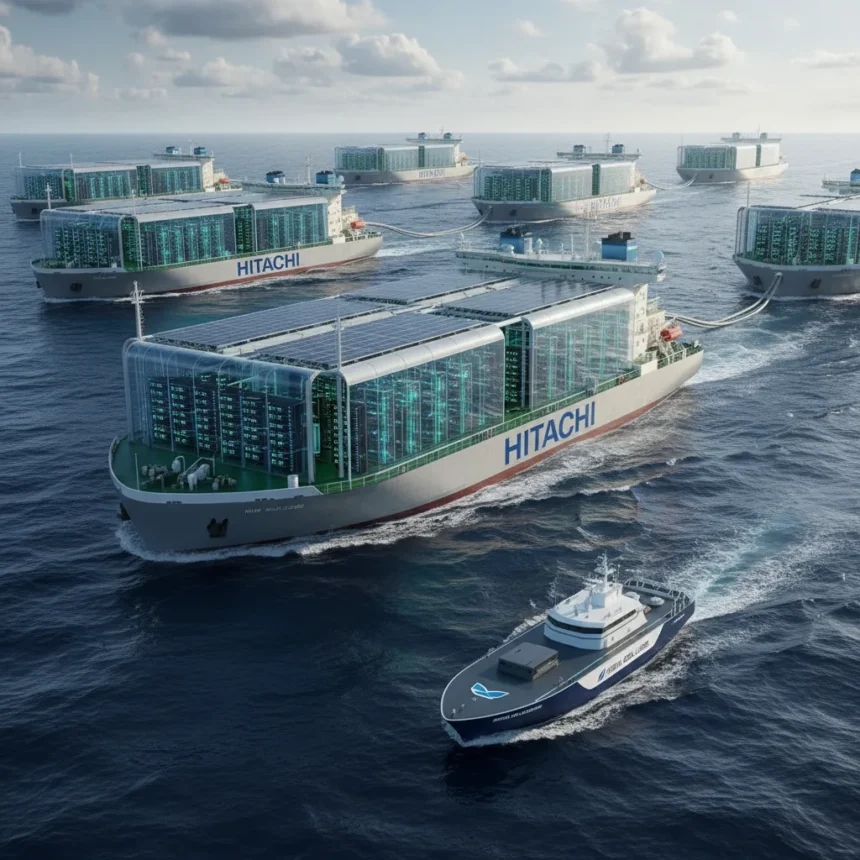
Floating data centers have long existed in the realm of speculative infrastructure projects, but a major partnership announced in March 2026 suggests the concept is finally moving from theory to execution. Mitsui OSK Lines (MOL) and Hitachi announced plans to jointly study the conversion of retired ships into floating data centers, marking a significant shift in how the industry views offshore computing infrastructure.
Key Takeaways
- Hitachi and Mitsui OSK Lines announced a partnership in March 2026 to study floating data centers.
- The initiative focuses on repurposing retired ships as offshore computing infrastructure.
- Floating data centers could address data center cooling challenges and geographic constraints.
- The partnership represents a shift from theoretical exploration to practical feasibility studies.
- First operational floating data center deployment is targeted for 2027.
Why Floating Data Centers Matter Now
The data center industry faces mounting pressure from three directions: physical space constraints in major metropolitan areas, escalating cooling costs driven by power-hungry AI workloads, and regulatory scrutiny over water consumption. Floating data centers offer a potential solution to all three. By positioning computing infrastructure offshore, operators can leverage seawater for cooling, eliminate competition for scarce urban real estate, and potentially reduce their environmental footprint compared to land-based facilities.
The timing of the Hitachi-MOL partnership reflects growing industry recognition that offshore data center concepts deserve serious engineering attention. This is not mere speculation—Hitachi, one of Japan’s largest conglomerates, does not typically commit resources to purely theoretical ventures. The company’s involvement signals that the technical and operational challenges of floating data centers are solvable at scale.
The Hitachi-MOL Partnership: From Study to Deployment
Hitachi and Mitsui OSK Lines announced their collaborative research initiative in March 2026, with a stated goal of launching operational floating data centers by 2027. The partnership leverages MOL’s expertise in maritime operations and vessel management alongside Hitachi’s data center engineering and infrastructure capabilities. Rather than building new ships, the companies plan to repurpose retired vessels, transforming aging maritime assets into computing infrastructure.


This approach offers multiple advantages. Retired ships are available immediately, reducing development timelines compared to custom construction. Vessel repurposing also addresses maritime industry challenges around aging fleets and decommissioning costs, creating a secondary use case for ships that might otherwise face scrapping. The partnership structure—pairing a shipping company with a technology conglomerate—demonstrates that floating data centers require both maritime expertise and computing infrastructure knowledge to succeed.
How Floating Data Centers Compare to Traditional Infrastructure
Land-based data centers operate within geographic and regulatory constraints. They require proximity to power grids, cooling water sources, and fiber optic networks. They also consume vast quantities of water for cooling—a growing concern in water-stressed regions. Floating data centers eliminate several of these constraints by positioning themselves at sea, where cooling water is abundant and geographic boundaries become less relevant.



However, floating data centers introduce their own operational complexities. Offshore facilities must withstand maritime weather, manage saltwater corrosion, handle network latency from submarine fiber connections, and navigate international maritime regulations. Traditional data centers, by contrast, operate in controlled terrestrial environments with established supply chains and regulatory frameworks. The Hitachi-MOL initiative must solve these engineering and operational problems to prove that floating data centers can match or exceed the reliability standards of conventional facilities.
What the 2027 Timeline Means for the Industry
A 2027 deployment target is ambitious but credible given the partners involved. Hitachi and MOL are not startups experimenting with novel concepts—they are established companies with capital, engineering resources, and operational experience. The timeline suggests the feasibility study phase will be relatively compressed, with conversion and testing occurring in 2026 and operational deployment following in 2027.
If the 2027 launch succeeds, floating data centers could shift from curiosity to viable alternative infrastructure within the next two to three years. This would open new possibilities for data center operators seeking to reduce cooling costs, expand capacity without competing for urban real estate, or position computing infrastructure closer to oceanic submarine cable landing points. The success or failure of the Hitachi-MOL project will likely determine whether other companies and consortiums pursue similar initiatives.
What Are Floating Data Centers Exactly?
Floating data centers are computing facilities housed within ships or purpose-built offshore platforms, anchored in international waters or coastal zones. They function identically to land-based data centers—processing data, running applications, storing information—but leverage the maritime environment for cooling and eliminate geographic constraints imposed by terrestrial real estate markets. The concept has existed in academic and venture capital discussions for years, but actual deployment has remained elusive until now.



When Will Floating Data Centers Actually Launch?
The Hitachi-MOL partnership targets 2027 for the first operational floating data center. This timeline assumes the feasibility study progresses without major technical obstacles and regulatory approvals proceed as anticipated. Actual deployment dates often slip, but the fact that two major industrial companies have committed to a specific year suggests serious intent rather than exploratory research.
Could Floating Data Centers Replace Traditional Data Centers?
Floating data centers will likely serve specific use cases rather than replace traditional facilities entirely. They excel for applications requiring massive cooling capacity, geographic flexibility, or proximity to submarine cable infrastructure. However, they introduce operational complexity and regulatory uncertainty that make them unsuitable for all workloads. The most realistic scenario is a hybrid infrastructure model where floating and land-based data centers coexist, each optimized for different requirements.
The Hitachi-MOL partnership represents a genuine inflection point for floating data center technology. What was once dismissed as speculative infrastructure is now the subject of serious engineering and capital commitment from major industrial players. Whether 2027 delivers an operational facility or faces delays, the industry’s trajectory toward offshore computing infrastructure is now unmistakable. The question is no longer whether floating data centers will exist, but how quickly they will scale and what role they will play in the global data center ecosystem.
Edited by the All Things Geek team.
Source: TechRadar




