





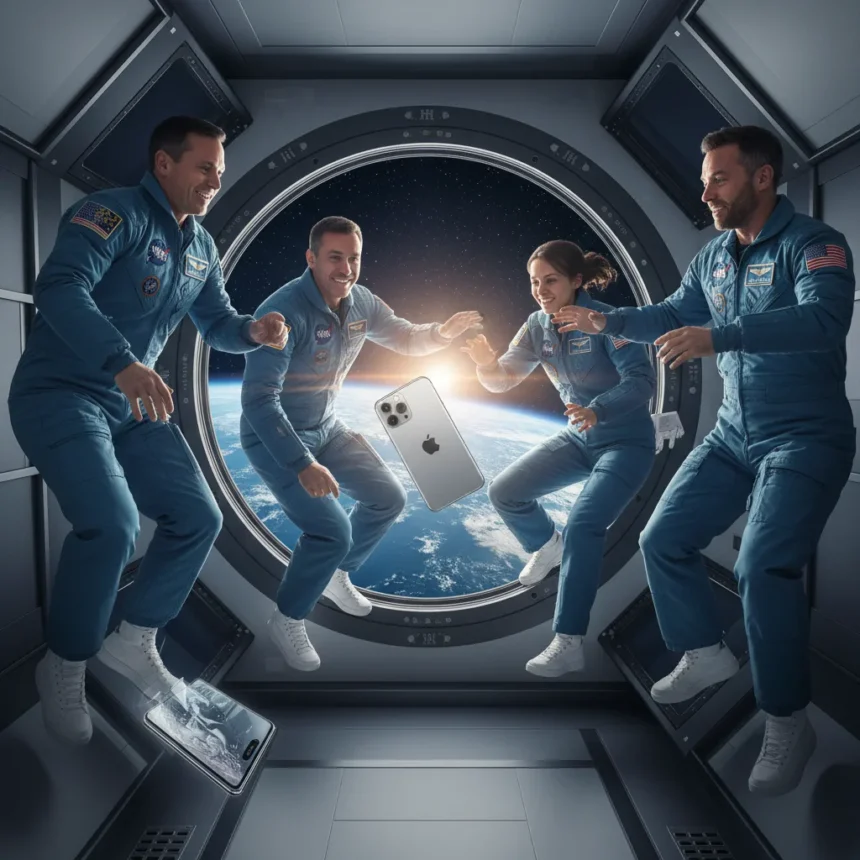
An iPhone space milestone just happened, and nobody is talking about it the right way. While tech media obsesses over rumors of an iPhone Fold, the Artemis II crew threw an iPhone around in zero gravity—and that moment matters far more than any foldable device ever will.
Key Takeaways
- Artemis II crew used an iPhone 17 Pro Max in space, photographing Earth and testing durability in zero gravity.
- iPhone space milestone represents real-world proof of device toughness that marketing claims cannot match.
- Foldable phones remain unproven in extreme conditions, while this space test validates iPhone engineering.
- Photos and videos from the mission showcase iPhone capability beyond terrestrial use cases.
- This achievement redefines what flagship phones can accomplish outside Earth’s environment.
Why the iPhone space milestone beats foldable hype
Let’s be direct: an iPhone space milestone is infinitely more valuable than a thinner phone that bends. The Artemis II crew didn’t just use an iPhone 17 Pro Max—they threw it around in microgravity, capturing images and video in an environment where most electronics would fail catastrophically. This is not marketing theater. This is proof. When you can document that your device survives and functions in space, every durability claim you’ve ever made becomes credible in ways that focus-grouped design narratives simply cannot match.
Foldable phones are engineering compromises dressed up as innovation. They require thicker bezels, trade battery capacity for complexity, and introduce new failure points at the hinge. A foldable iPhone would be Apple hedging its bets on thinness, betting that consumers care more about form factor than reliability. The iPhone space milestone proves the opposite: people want devices that work everywhere, not devices that fold in half and cost extra.
The iPhone 17 Pro Max becomes the first smartphone tested in space
The iPhone space milestone is historic because it answers a question nobody else dared to ask: what happens when you take the world’s most refined smartphone and put it in the harshest environment humans can access? The answer, from the Artemis II mission, is that it works. The crew captured stunning Earth photos and video with the device, then turned one of those images into a wallpaper—practical tasks that prove the iPhone wasn’t just surviving in space, it was performing.


This is not theoretical durability testing. This is real astronauts, real zero gravity, real consequences if something goes wrong. No foldable phone has been tested this way. No Samsung Galaxy Z Fold or any other competitor has earned the right to claim space-rated performance because none of them have been there. The iPhone 17 Pro Max now holds a credential that no other phone can match: it has been used for actual work in space.
What the iPhone space milestone means for Apple’s future
The iPhone space milestone changes how we should think about smartphone innovation. For years, the industry has chased thinness, foldability, and marginal camera improvements. Apple just proved that durability and reliability in extreme conditions matter more than any of those things. When NASA chooses your device for a crewed space mission, you have transcended consumer electronics marketing. You have become infrastructure.



This achievement also exposes the weakness in the foldable narrative. Foldables are solutions searching for problems. Space exploration is a problem that actually exists, and the iPhone just solved it. The next time someone tells you that the iPhone Fold is the future of smartphones, ask them: has it been to space? Has it been tested by astronauts? Has it taken photos of Earth from orbit? The answer is no, and it probably never will be, because foldables are a distraction from the real work of making phones that function everywhere, in every condition, at every scale of human ambition.
How does the iPhone 17 Pro Max compare to previous space missions?
The iPhone 17 Pro Max is the first consumer smartphone to be used operationally in space during a crewed mission. Previous space missions relied on specialized equipment designed specifically for the harsh environment, not consumer electronics adapted for extreme use. This represents a fundamental shift: the gap between what astronauts need and what consumers can buy has narrowed to almost nothing.
Why foldable phones will never match this achievement
A foldable iPhone, if it ever exists, cannot claim what the iPhone 17 Pro Max now claims: proof of function in space. The foldable would be thicker, more complex, and less reliable than a traditional slab phone. It would also cost more and break more easily. The iPhone space milestone is not just a marketing win—it is a technical validation that traditional smartphone design, when refined to Apple’s standards, outperforms experimental form factors in the environments that matter most.
Is the iPhone space milestone just marketing?
No. Marketing would claim the phone survived space; reality shows it thrived there, capturing professional-quality images and performing practical tasks for the Artemis II crew. There is a meaningful difference between surviving an extreme environment and actually working in it. The iPhone space milestone represents the latter.
Will other phones ever match the iPhone space achievement?
Possibly, but only if another manufacturer convinces NASA to include their device on a crewed mission. That is an extraordinarily high bar. NASA does not choose phones based on marketing claims or technical specs—it chooses devices that have proven reliability and performance. The iPhone 17 Pro Max earned that trust through years of refinement and the durability that the iPhone space milestone has now validated in the most extreme possible conditions.
The iPhone space milestone matters because it proves that real innovation is not about chasing the next form factor or the next gimmick. It is about building devices so reliable, so capable, and so well-engineered that they can function when it counts—even 250 miles above Earth. Foldables will come and go. The iPhone that went to space will be remembered.
Edited by the All Things Geek team.
Source: TechRadar




