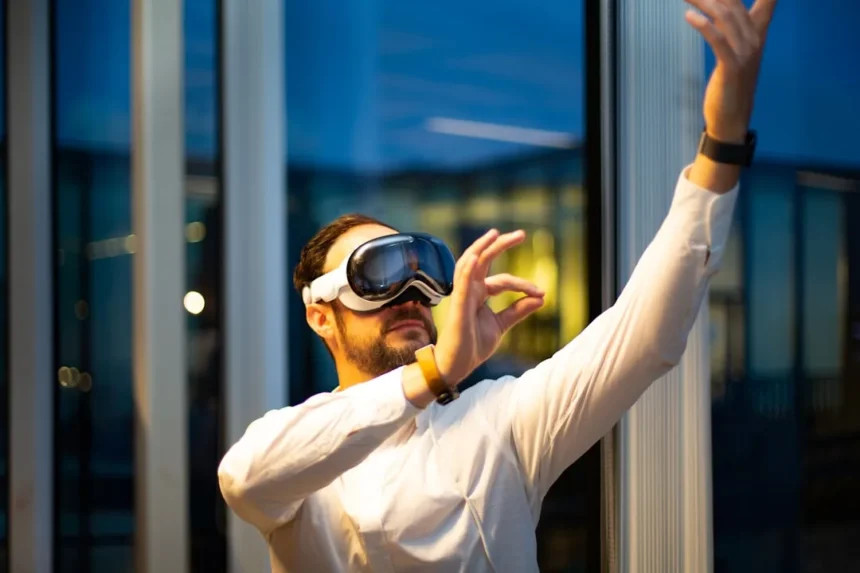
Apple Vision Pro remains the most sophisticated, powerful, and coolest hardware Apple has ever built—yet nobody can agree whether it is alive or dead as a commercial product. Sales have disappointed. The device is heavy. The battery drains fast. And still, the engineering inside matters far more than the quarterly earnings.
Key Takeaways
- Apple Vision Pro is the most sophisticated hardware Apple has engineered to date, regardless of commercial performance.
- The device’s technological foundation will power future lightweight Apple glasses, transforming spatial computing accessibility.
- Vision Pro’s commercial uncertainty does not diminish its role as a critical stepping stone in Apple’s AR roadmap.
- John Ternus, Apple’s SVP of Hardware Engineering, is driving innovations that Vision Pro pioneered toward everyday wearables.
- Vision Pro proves that failed products can still reshape entire product categories through their engineering legacy.
Why Apple Vision Pro Matters Beyond Sales Numbers
The real story of Apple Vision Pro is not about whether it sells well—it is about what comes after. Apple’s most ambitious hardware projects often fail commercially while succeeding strategically. Vision Pro belongs in that category. The device represents Apple’s most comprehensive attempt to miniaturize spatial computing, pack processing power into a wearable form factor, and deliver the kind of immersive experience that justifies the engineering complexity. Those breakthroughs do not disappear when quarterly sales disappoint.
Vision Pro’s engineering achievements establish the technical foundation for the glasses that will follow. Apple did not build this device to be the final form—it built it as the proving ground. Every sensor, every optical component, every thermal management solution inside Vision Pro is a prototype for lighter, faster, more practical devices. The company’s SVP of Hardware Engineering, John Ternus, is already using these innovations to shape what comes next.
The Vision Pro Blueprint for Apple’s Glasses Future
Apple’s roadmap for spatial computing depends entirely on what Apple Vision Pro taught the company. The current device is too heavy for all-day wear, too bulky for social acceptance, and too expensive for mass adoption. But those constraints were never the point. Vision Pro was the laboratory. It proved that Apple could integrate high-resolution displays, sophisticated eye-tracking, hand gesture recognition, and spatial audio into a single device. It demonstrated the thermal, optical, and power challenges that lightweight glasses will have to solve.


The glasses that follow will be fundamentally different from Vision Pro. They will be lighter, cheaper, and designed for everyday use rather than immersive sessions. But they will not exist without Vision Pro’s engineering foundation. Every miniaturization breakthrough, every component integration, every software architecture decision made for Vision Pro accelerates the timeline for those glasses. Vision Pro is not a failed product—it is a necessary intermediate step that only a company with Apple’s resources could afford to take.
What Vision Pro Proved About Apple’s Hardware Ambition
Dismissing Apple Vision Pro as dead misses the larger point: Apple is willing to spend billions on hardware that loses money in the short term if the engineering breakthroughs serve a larger vision. That is the opposite of most tech companies, which optimize for quarterly returns. Vision Pro cost Apple significant resources and delivered modest sales. Most executives would kill the project and move on. Instead, Apple is using Vision Pro as the foundation for the next phase of spatial computing.



This approach carries risk. The glasses that follow could also disappoint commercially. But Apple has already demonstrated that it understands the difference between a failed product and a failed strategy. Vision Pro may be commercially uncertain, but as an engineering achievement and a stepping stone to lighter, more practical devices, it is undeniably successful. The company’s hardware engineering team, led by Ternus, is already proving that the innovations developed for Vision Pro translate into practical advantages for everyday wearables.
Can Vision Pro Succeed as a Bridge Product?
The honest answer is that Apple Vision Pro exists in an awkward middle ground. It is too advanced to be a casual accessory, yet too clunky to be a daily driver for most users. That tension is not a design failure—it is the inevitable result of building the first device in a new category before the technology has matured enough for mass-market form factors. Vision Pro had to be sophisticated because Apple needed to understand what spatial computing could do. It had to be powerful because the company needed to stress-test the thermal and processing limits. And it had to be expensive because Apple was building a laboratory, not a consumer product meant for everyone.
The glasses that follow will be different. They will be lighter, cheaper, and designed explicitly for everyday use. But they will carry forward every hard-won engineering lesson from Vision Pro. The current device is the bridge between what spatial computing was and what it will become. Whether Vision Pro sells in large numbers is almost irrelevant to that historical role.
Does Vision Pro prove spatial computing is the future?
Vision Pro proves that Apple believes spatial computing is the future—not that the technology is ready for mass adoption today. The device is too expensive, too heavy, and too niche for mainstream use. But it demonstrates that the underlying technology works, that the user experience can be compelling, and that the engineering challenges are solvable. Those are the three things Apple needed to prove before investing in the glasses that will follow.



Will Apple’s next glasses replace Vision Pro?
Yes, but not directly. Apple’s next glasses will be fundamentally different in form factor, weight, and use case. They will be designed for everyday wear rather than extended immersive sessions. Vision Pro is the engineering foundation, not the template. The company will take what worked in Vision Pro and miniaturize it, while discarding the design choices that made the current device impractical for daily use.
Is Apple Vision Pro worth buying today?
Only if you understand what you are buying: a sophisticated piece of hardware that is ahead of its time and expensive relative to what it can do right now. Vision Pro is not a consumer product for most people. It is a device for early adopters, developers, and anyone who wants to experience where spatial computing is heading. The real value proposition arrives with the glasses that follow.
Apple Vision Pro’s commercial fate remains uncertain, but that uncertainty is beside the point. The device is already succeeding at its true purpose: serving as the technological foundation for the lightweight glasses that will eventually make spatial computing accessible to everyone. In that sense, Vision Pro is not alive or dead—it is evolving into the next chapter of Apple’s hardware ambition. The company is not abandoning spatial computing; it is using Vision Pro’s engineering breakthroughs to build the devices that will define the category for the next decade.
Edited by the All Things Geek team.
Source: TechRadar