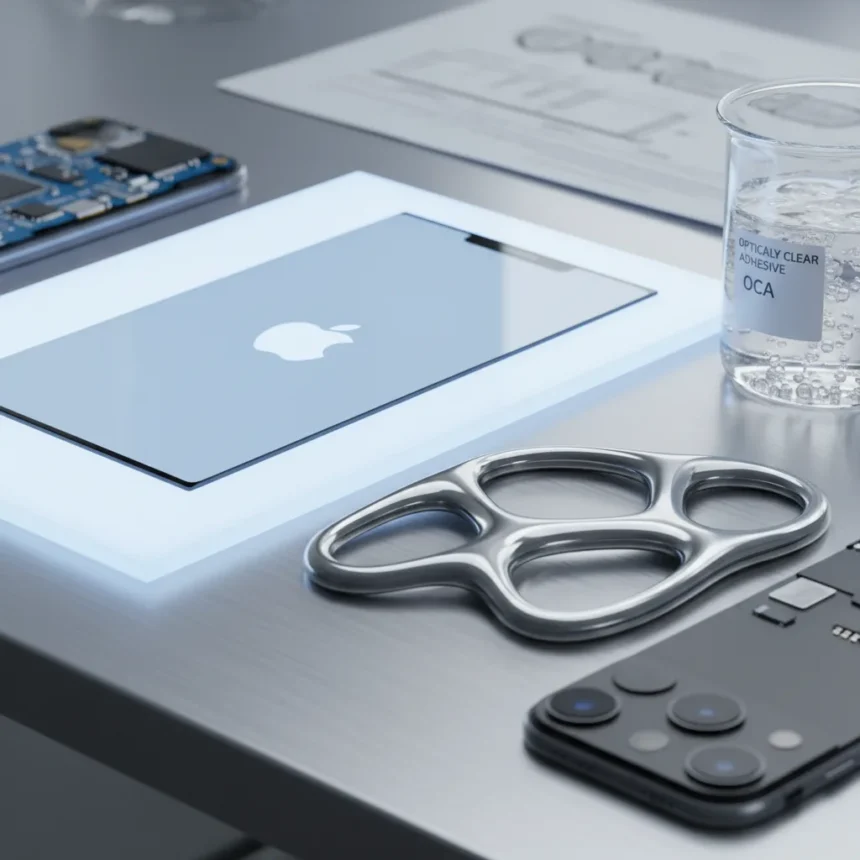
The iPhone Fold crease elimination has been Apple’s biggest engineering challenge since deciding to build a foldable phone. Unlike Samsung’s Galaxy Z Fold and other existing foldables that show a visible crease along the hinge, Apple is reportedly deploying three distinct technologies to make that line disappear entirely—or at least make it imperceptible to the human eye.
Key Takeaways
- Apple uses ultra-thin glass with variable thickness to reduce crease visibility and improve durability.
- Optically clear adhesive fills microscopic gaps and distributes stress across the folding area.
- Liquid metal hinges coupled with specialized glass support structures enable creaseless design.
- iPhone Fold expected to launch in 2026 with iPhone 18 Pro models at $2,000–$2,500.
- Around 100 prototype units produced after Apple achieved breakthrough in crease elimination.
Ultra-Thin Glass With Variable Thickness
The first pillar of Apple’s iPhone Fold crease elimination strategy is next-generation ultra-thin flexible glass (UFG) engineered with uneven thickness. The folding area is deliberately thinned to allow the glass to bend without deforming, while regions away from the hinge remain thicker to resist impact and maintain structural rigidity. This asymmetric design distributes bending stress evenly across the fold, making any remaining crease visually imperceptible rather than the pronounced ridge that plagues current foldables. According to a TrendForce report reviewed by industry sources, the variable thickness approach combined with chemical strengthening represents a fundamental shift in how foldable glass is engineered. Existing foldables use uniform ultra-thin glass (UTG) that inevitably deforms along the hinge, creating the crease problem Apple is now solving.
Apple is actively testing UFG panels for manufacturing reliability and durability ahead of the 2026 launch. The challenge lies not in the material science alone but in production consistency—making thousands of panels with precise thickness variations without defects is a manufacturing problem that has held back foldable phones for years.
Optically Clear Adhesive That Fills Microscopic Gaps
The second technology driving iPhone Fold crease elimination is optically clear adhesive (OCA) glue engineered to remain fluid enough to fill the microscopic gaps that cause visible light scattering and crease visibility. Unlike standard adhesives that harden completely, Apple’s OCA maintains micro-flow characteristics that allow it to settle into microscopic irregularities created by repeated folding and unfolding cycles. This prevents the glass from settling into permanent deformation patterns that worsen the crease over time. The adhesive also distributes stress across the folding area rather than concentrating it at the hinge, enabling thinner glass without sacrificing durability.


The crease itself originates from fatigue stress—the repeated mechanical deformation of glass as users fold and unfold the device thousands of times. By using an adhesive that actively compensates for this stress and fills gaps as they form, Apple addresses the root cause rather than just masking the symptom. This approach is particularly important for a product expected to last several years of daily folding.
Liquid Metal Hinges and Integrated Support Structures
The third technology is a specialized liquid metal hinge coupled with a unique glass support structure designed to minimize crease visibility. Apple has redesigned both the panel structure and the fold mechanism itself, moving beyond traditional hinge designs used by competitors. The company is also integrating key bearing components shared with suppliers New Rixing and Amfeno to create an integrated panel-and-bearing assembly that prevents permanent creases from forming.



Samsung supplies the inner display panel for the iPhone Fold, but Apple designed the panel structure, material processing, and laminated pressing techniques—essentially controlling every variable except the base glass substrate. Apple rejected multiple Samsung samples before the display supplier delivered panels that met the company’s crease-elimination standards. This level of control over the manufacturing process is typical of Apple’s approach to critical components and explains why the iPhone Fold has taken years longer to develop than competitors’ foldables.
When Will the iPhone Fold Actually Launch?
Apple is expected to debut the iPhone Fold in 2026 alongside the iPhone 18 Pro models. The device will feature a book-style design with a 5.3- to 5.5-inch outer display and a 7.8-inch inner screen. Pricing is projected at $2,000–$2,500, making it Apple’s most expensive iPhone to date. As of late 2025, around 100 prototype units had been produced after Apple achieved what it describes internally as a breakthrough in crease elimination.
The timeline suggests Apple is confident enough in the technology to move from prototyping into production planning. However, the company’s history of delaying foldable announcements means this 2026 date should be treated as an estimate rather than a guarantee.
How does the iPhone Fold compare to Samsung’s Galaxy Z Fold?
Samsung’s Galaxy Z Fold series remains the gold standard for foldable phones, but it has never solved the crease problem—users can see and feel a pronounced ridge along the hinge even on the latest models. Apple’s iPhone Fold crease elimination approach targets this exact weakness. If Apple delivers on its engineering claims, the iPhone Fold would be the first mainstream foldable phone to make the crease nearly invisible.



Will the iPhone Fold have a different design than Samsung’s?
Yes. Apple’s book-style design with a 7.8-inch inner screen differs from Samsung’s approach, and the use of liquid metal hinges and variable-thickness glass represents a fundamentally different engineering philosophy. Apple designed the panel structure and material processing itself rather than simply using Samsung’s existing foldable technology, giving it a distinct architecture.
What makes Apple’s approach to iPhone Fold crease elimination unique?
Apple’s combination of three technologies—variable-thickness ultra-thin glass, micro-flow optically clear adhesive, and liquid metal hinges with integrated support structures—represents a comprehensive engineering solution rather than a single fix. No competitor has publicly deployed all three approaches together, and the level of control Apple maintains over manufacturing suggests the company is willing to invest in complexity to eliminate the crease entirely.
The iPhone Fold crease elimination strategy reveals Apple’s engineering philosophy: solve the problem completely or do not solve it at all. After years of watching competitors launch flawed foldables, Apple is betting that users will pay a premium price for a foldable phone that actually works like a traditional phone when unfolded. Whether the company can deliver on these ambitious engineering goals in 2026 will determine whether the iPhone Fold becomes a category-defining device or another example of Apple’s perfectionism delaying innovation.
Where to Buy
Edited by the All Things Geek team.
Source: Tom's Guide