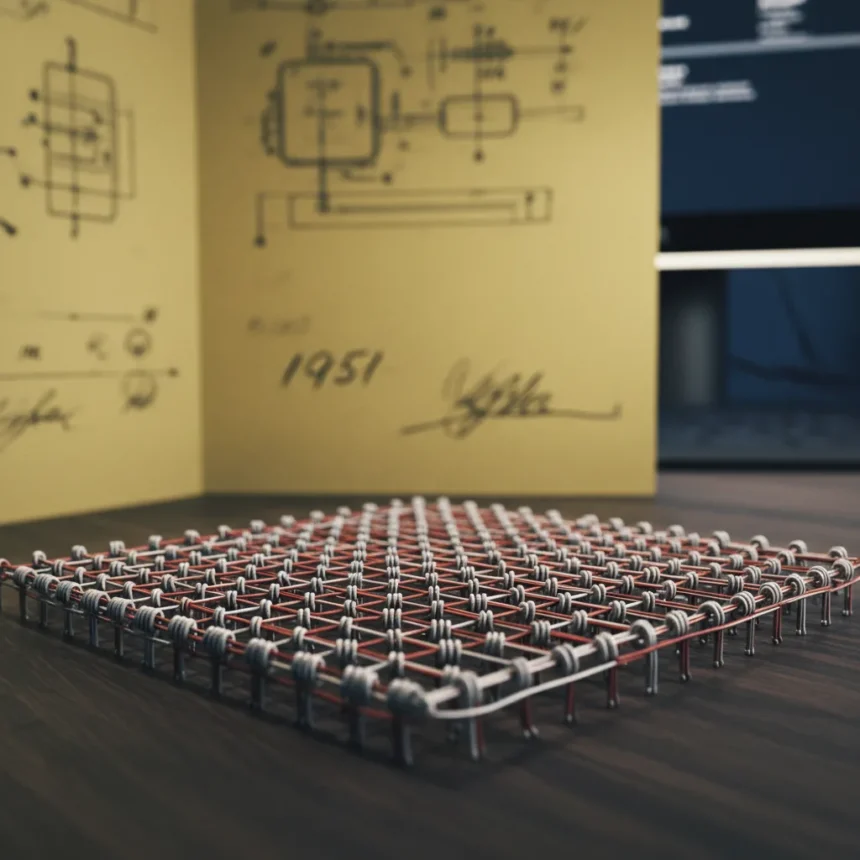
Magnetic core memory patent history marks a turning point in computing. Jay Forrester filed the first practical computer RAM patent on May 11, 1951, a milestone that led to U.S. Patent 2,736,880 five years later. This invention emerged from MIT’s Project Whirlwind and became the dominant random-access memory technology for computers from roughly 1955 to 1975.
Key Takeaways
- Forrester filed the magnetic core memory patent on May 11, 1951, with the patent granted February 28, 1956
- The technology evolved from Whirlwind, MIT’s real-time aircraft control computing project
- Magnetic core memory became the standard computer memory for approximately 20 years until solid-state RAM replaced it
- IBM paid MIT $13 million in 1964 for rights to the patent, the largest settlement of its time
- The coincident-current system enabled 3D memory arrays storing several million bits
Why Forrester’s Magnetic Core Memory Patent Mattered
The magnetic core memory patent solved a critical problem in early computing. Whirlwind, originally designed to use cathode-ray tube (CRT) memory, suffered from slow speeds and unreliability that made real-time aircraft calculations impossible. Forrester’s system used rings of magnetic material arranged in three-dimensional arrays, where a small number of wires could control a large number of cores. This architecture enabled computers to store millions of bits reliably.
The invention’s timing was crucial. Military and aviation applications demanded dependable memory systems for real-time flight calculations. Forrester’s approach delivered both speed and durability, making it the obvious choice for defense contractors and research institutions building the next generation of computers. Within a few years, magnetic core memory became the industry standard.
The Patent Battle and IBM Settlement
The path from filing to widespread adoption involved significant legal wrangling. Although Forrester filed in 1951, the patent was not granted until February 28, 1956, after five years of examination. The delay reflected the novelty and complexity of the invention—examiners needed time to understand a technology that had no clear precedent.


The real financial vindication came in 1964 when IBM paid MIT $13 million for rights to Forrester’s patent, described as the largest patent settlement to that date. Forrester himself received $1.5 million from that settlement. The enormous sum reflected how thoroughly magnetic core memory had become embedded in the computer industry—IBM could not build its growing mainframe business without licensing the technology.
Magnetic Core Memory Patent vs. Earlier Alternatives
Before Forrester’s magnetic core memory patent, computers relied on slower, less reliable technologies. CRT memory used electrostatic charges on cathode-ray tubes but offered poor performance for real-time applications. Other inventors, including Frederick Viehe, An Wang, and Jan Rajchman, worked on core-memory concepts around the same period, but Forrester’s practical, patented system became the commercial standard.



Solid-state semiconductor memory eventually displaced magnetic core in the mid-1970s, offering faster access times and smaller physical footprints. However, core memory retained advantages in specialized applications—it preserved its contents when power was shut off, making it valuable for critical systems where data loss posed unacceptable risks. Some specialized environments continued using core memory well into the 1980s.
The Legacy of Forrester’s Innovation
Forrester’s magnetic core memory patent represents more than a technical achievement—it illustrates how military and aerospace needs drive computing innovation. The requirement for reliable real-time calculations on aircraft in flight created the pressure that led to his invention. Without that specific demand, the timeline for developing practical RAM might have stretched much longer.
The technology’s two-decade dominance shaped how an entire generation of engineers thought about computer architecture. Magnetic core memory became so standard that younger computer scientists today encounter it primarily in history courses. Yet every modern computer owes a conceptual debt to Forrester’s insight that three-dimensional magnetic arrays could solve the memory problem that plagued earlier machines.
Did Forrester invent magnetic core memory alone?
Multiple inventors contributed to core-memory development during the late 1940s and early 1950s. Forrester’s achievement was creating the first practical, patentable system that could scale to production. His coincident-current approach became the commercial standard, but the broader invention involved several parallel efforts by different researchers.



How long did magnetic core memory remain in use?
Magnetic core memory dominated computer memory from approximately 1955 to 1975, roughly 20 years. Solid-state semiconductor RAM gradually replaced it as manufacturing costs fell and performance improved. Some specialized applications continued using core memory into the 1980s because it retained data when power was cut.
Why was the IBM settlement so large?
IBM paid $13 million in 1964 because magnetic core memory had become essential to its mainframe business, and Forrester’s patent covered the fundamental technology. The settlement represented the enormous value that a single foundational patent could command in the computer industry during the early 1960s.
Seventy-five years after Forrester filed the magnetic core memory patent, the invention remains a landmark moment in computing history. It proved that solving specific, urgent problems—in this case, reliable real-time memory for aircraft—could yield technologies that transformed an entire industry. Modern RAM may use different physics, but the architectural principles Forrester pioneered still influence how computers organize and access memory today.
Edited by the All Things Geek team.
Source: Tom's Hardware