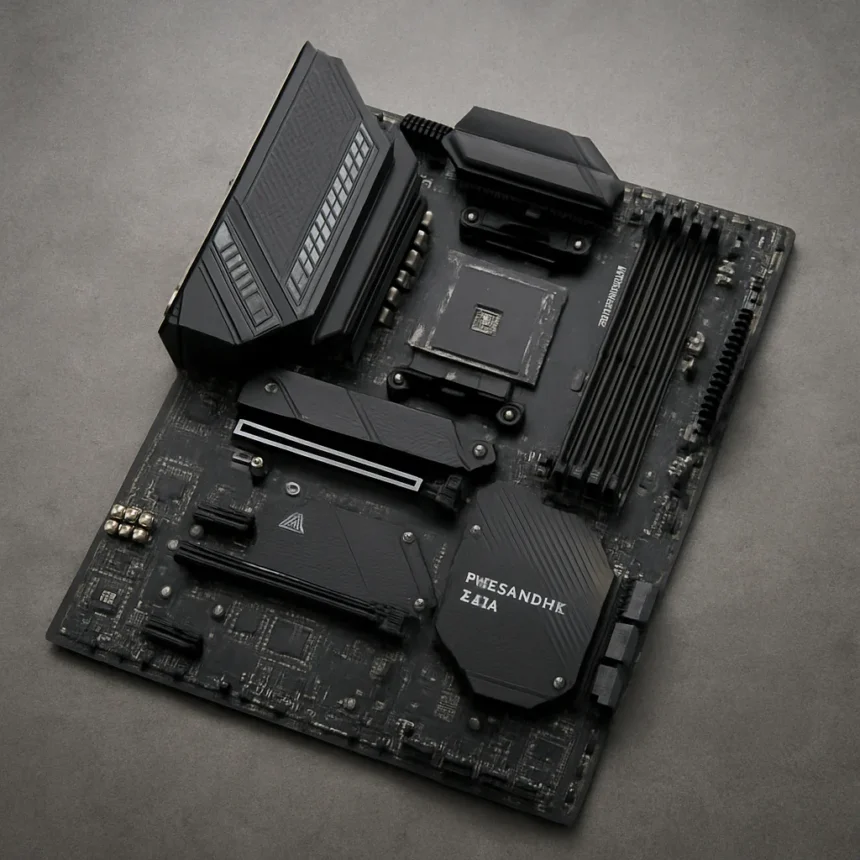
The MSI MAG B850 Tomahawk Max Wifi II is an ATX motherboard built on the AMD B850 chipset, supporting AMD Ryzen 9000, 8000, and 7000 series desktop processors on Socket AM5 (LGA 1718). It arrives as a direct successor to the MSI MAG B850 Tomahawk Max Wifi released roughly a year prior, carrying forward the same core identity but adding a 64MB BIOS chip, the MSI OC Engine, a minor aesthetic refresh, and a small price increase. The question worth asking is whether those additions justify a new SKU, or whether MSI is simply polishing an already capable board and calling it a sequel.
What the MSI MAG B850 Tomahawk Max Wifi II Actually Brings to the Table
The headline additions are modest but meaningful for enthusiasts who care about overclocking headroom. The MSI OC Engine chip and the expanded 64MB BIOS give the board more room to store microcode updates and tuning profiles, which matters more than it sounds as AMD’s AM5 platform continues to evolve with AGESA updates. MSI also notes up to a 12% memory latency reduction with BIOS versions after AGESA 1.2.0.2b, which is a tangible real-world benefit for DDR5 users pushing high-frequency kits.
On the storage side, the board ships with five M.2 sockets in total: two PCIe 5.0 x4 slots running at up to 128 Gbps, two PCIe 4.0 x4 slots at 64 Gbps, and one PCIe 4.0 x2 slot at 32 Gbps, all supporting drives up to 110mm or 80mm depending on slot. That is a meaningful upgrade for a board in this segment, giving builders genuine flexibility without forcing compromises between fast storage and GPU bandwidth. The primary PCIe 5.0 x16 slot runs at full bandwidth from the CPU with no lane splitting, which is the right call for a gaming-focused platform.
Power Delivery and Build Quality on the B850 Tomahawk Max Wifi II
The power delivery setup is genuinely strong for a B850 board. MSI uses a 17-phase Duet Rail Power System — that is a 14+2+1 configuration — with 80A SPS MOSFETs handling Vcore, backed by dual 8-pin CPU power connectors and an 8-layer PCB with 2oz thickened copper. That is server-grade material language, and while MSI’s own promotional framing should be taken with some skepticism, the underlying spec sheet is credible for sustained loads with high-core-count Ryzen processors. Steel Armor II reinforces the primary PCIe slot, and the board includes a supplemental PCIe power connector for high-draw GPUs — a thoughtful addition as cards like the Radeon RX 9070 XT push power consumption higher.


Connectivity is well-rounded for the price tier. The rear I/O includes three USB 3.2 Gen 2 Type-C ports running at 10 Gbps, two additional USB 3.2 Gen 2 Type-A ports, and HDMI 2.1 for integrated graphics output. Networking covers Wi-Fi 7 and 5 GbE wired LAN, which puts it ahead of boards that still ship with 2.5 GbE in 2025. Audio Boost 5 handles onboard sound. It is a complete package without obvious omissions.
How the MSI MAG B850 Tomahawk Max Wifi II Compares to Its Rivals
Benchmark performance between the MSI MAG B850 Tomahawk Max Wifi II and the MSI MAG B850 Gaming Plus Max WiFi — tested with an AMD Ryzen 7 7700X, Corsair Vengeance DDR5 32GB at 6000 MT/s, and an ADATA Legend 970 Pro Gen5 NVMe — sits within the margin of error, meaning there is no measurable performance difference between the two boards in practice. That is not a knock on either board; it reflects the reality that B850 chipset boards at this tier are largely differentiated by features and build quality rather than raw throughput.



The ASUS ROG Strix B850-A Gaming WiFi is the more direct premium challenger, offering a 14+2+2 power stage configuration, thick metal heatsinks, PCIe 5.0 M.2, Wi-Fi 7 with a dedicated antenna solution, and Aura Sync RGB — positioning it as a step up in both aesthetics and overclocking credentials for Ryzen 9000 builds. The Tomahawk Max Wifi II counters with its own five-slot M.2 configuration and the OC Engine, but buyers who prioritise visual customisation or want the most aggressive VRM setup will find the ASUS offering more compelling.
Is the MSI MAG B850 Tomahawk Max Wifi II Worth Buying?
For builders starting fresh on AM5 with a Ryzen 9000 or 7000 series processor, the Tomahawk Max Wifi II is a well-specified board that does not cut obvious corners. The five M.2 slots, full-bandwidth PCIe 5.0 x16, Wi-Fi 7, and 5 GbE LAN make it genuinely competitive at its price point. The OC Engine and 64MB BIOS are useful additions for anyone who intends to push memory speeds or update firmware regularly as AMD refines AGESA.
For existing owners of the original MSI MAG B850 Tomahawk Max Wifi, the calculus is different. As The FPS Review noted, the changes amount to a 64MB BIOS chip, the OC Engine, and a minor facelift — hardly a compelling reason to pull the board and start over. The performance delta between the two generations is negligible. This is a board for new builds, not upgrades.
What processors does the MSI MAG B850 Tomahawk Max Wifi II support?
The MSI MAG B850 Tomahawk Max Wifi II supports AMD Ryzen 9000, 8000, and 7000 series desktop processors via Socket AM5 (LGA 1718). It does not support older AM4 processors, so buyers migrating from Ryzen 5000 or earlier will need a new CPU as well.



How many M.2 slots does the B850 Tomahawk Max Wifi II have?
The board includes five M.2 slots in total: two PCIe 5.0 x4 slots capable of up to 128 Gbps, two PCIe 4.0 x4 slots at 64 Gbps, and one PCIe 4.0 x2 slot at 32 Gbps. All five support RAID 0, 1, and 10 configurations.
Is the MSI MAG B850 Tomahawk Max Wifi II a good board for overclocking?
It is a capable overclocking platform for a B850 board. The MSI OC Engine chip and 64MB BIOS provide more headroom for tuning and firmware updates, and the 17-phase power delivery with 80A MOSFETs handles sustained loads reliably. Memory overclocking is well-supported, with DDR5 speeds rated at 8400+ MT/s in optimal single-rank configurations.
The MSI MAG B850 Tomahawk Max Wifi II is exactly what it looks like: a refined version of a board that was already good, made modestly better without reinventing itself. That is not a failure — it is a sensible iteration. For anyone building a new Ryzen 9000 system who wants a full-featured B850 board without paying premium X670E prices, the Tomahawk Max Wifi II earns its place on the shortlist. Just do not expect it to outrun its own predecessor in any meaningful way.
Edited by the All Things Geek team.
Source: Tom's Hardware