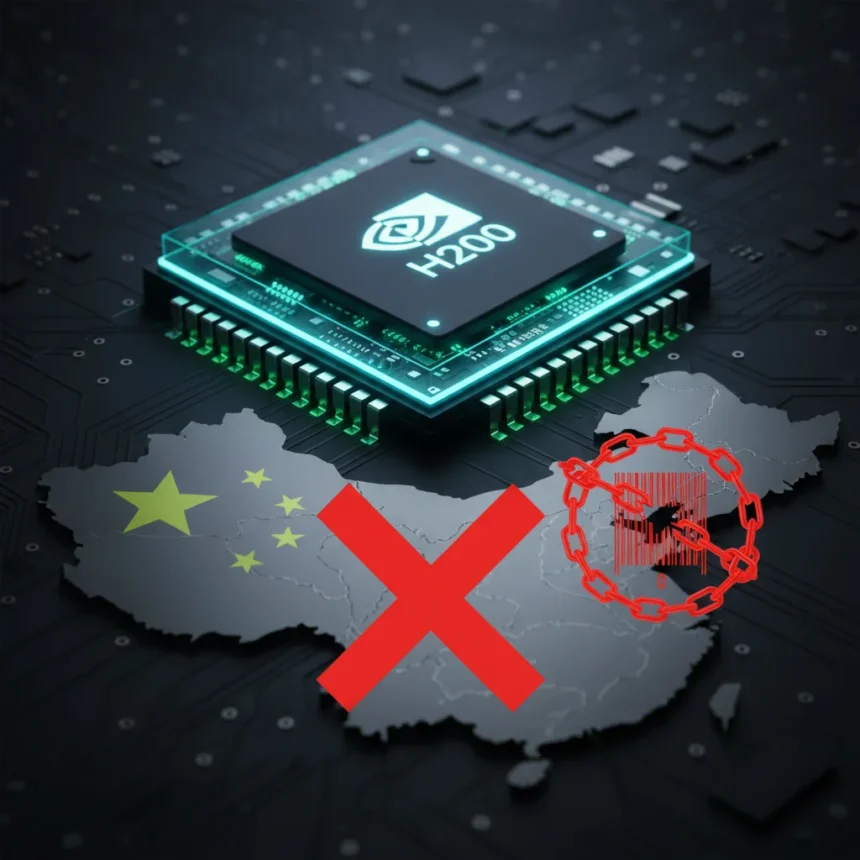
Nvidia H200 sales to China remain stuck at zero despite the Trump administration lifting the U.S. export ban four months ago, according to statements from U.S. Commerce officials during a House Foreign Affairs Committee hearing. The H200 is Nvidia’s full-fat Hopper generation AI GPU, far more powerful than the downgraded H20 model created under earlier restrictions. Yet Beijing is deliberately blocking imports to fortify its domestic semiconductor industry, creating a standoff that threatens billions in potential revenue.
Key Takeaways
- U.S. Commerce officials confirmed zero H200 units approved for sale to China as of the hearing
- Chinese government approved imports but then ordered tech firms to pause purchases pending review
- Nvidia CEO Jensen Huang stated the company has received purchase orders from many Chinese customers and is restarting manufacturing
- ByteDance reportedly plans a $14 billion H200 purchase in 2026, though unconfirmed
- U.S. may impose a 75,000 GPU per-customer export cap, limiting total China revenue
The China Ban Lift That Changed Nothing
When the Trump administration lifted export restrictions on high-end AI accelerators in December, Nvidia and investors expected a flood of Chinese orders. Assistant Secretary for Export Enforcement David Peters told Representative Sydney Kamlager-Dove during the hearing that the reality is far different: “My understanding is that so far, none” have been approved for sale to China. This contradiction between U.S. policy and actual Chinese purchasing reflects a deliberate strategy by Beijing to block the world’s most advanced AI chips while pushing domestic alternatives.
Nvidia CEO Jensen Huang painted a rosier picture at GTC 2026, stating: “We’ve been licensed for many customers in China for H200. We have received purchase orders from many customers and we are in the process of restarting our manufacturing”. Yet Huang’s optimism collides with the Commerce Department’s confirmation that zero units have actually shipped. The gap between licenses issued and sales completed reveals the real obstacle: the Chinese government itself.
Beijing’s Import Block: Strategy Over Supply
China’s government approved H200 imports but then held an emergency meeting with domestic tech firms and instructed them to pause purchases while deliberating. This is not bureaucratic delay—it is deliberate industrial policy. By blocking the H200, Beijing forces companies like ByteDance and Alibaba to either wait for Chinese domestic GPUs to mature or accept performance compromises. The strategy buys time for homegrown alternatives to close the capability gap and reduces dependency on U.S. technology in a critical sector.


The irony is stark: China once generated 13% of Nvidia’s total revenue. That relationship is now fractured by geopolitical competition over AI dominance. Nvidia stopped H200 production under the previous ban but has restarted manufacturing after receiving the licenses and orders Huang mentioned. Yet without Chinese government approval for actual sales, those factories will struggle to find customers.
The Revenue Trap and Export Caps
Analysts estimate H200 sales to China could contribute $6 billion to $10 billion annually to Nvidia, depending on U.S. volume limits and a 25% import tax China has imposed. But the U.S. government may cap exports at 75,000 GPUs per individual Chinese customer, including Nvidia and competitor AMD chips. This would severely restrict Nvidia’s upside even if Beijing suddenly reversed course and allowed purchases.



ByteDance is reportedly planning a $14 billion purchase of H200 GPUs in 2026 to add to its AI stockpile, but that figure remains unconfirmed and contingent on Beijing lifting its informal block. If that deal materializes, it would signal a dramatic shift in Chinese policy. Until then, Nvidia’s H200 sits in limbo—licensed but not sold, manufactured but not shipped, desired but not approved.
Domestic Chips vs. the H200
Chinese domestic GPUs are less capable than the H200, but they are improving. By blocking Nvidia’s most advanced chip, Beijing forces its own semiconductor industry to accelerate development. Companies have no choice but to innovate faster or accept inferior performance. This creates a protected market for domestic alternatives and reduces the technological gap that currently favors U.S. suppliers.
Nvidia is preparing non-downgraded versions of other chips for China, including offerings focused on AI inference tasks like answering questions and writing code. But the H200 remains the flashpoint in U.S.-China AI competition, and as long as Beijing blocks it, Nvidia cannot convert licenses and orders into actual revenue.
What happens if the U.S. tightens export caps further?
If the 75,000 GPU per-customer limit becomes official policy, Nvidia’s China revenue ceiling would drop dramatically even if Beijing lifts its import block. A single customer like ByteDance could only purchase 75,000 units annually, far below what reports suggest they need. This would force Chinese companies to spread purchases across multiple legal entities or abandon plans entirely.



Could Nvidia sell H200 to China through third countries?
Circumventing export restrictions through intermediaries is illegal and heavily monitored by U.S. authorities. Nvidia cannot route H200 sales through Hong Kong, Singapore, or other hubs without violating U.S. law. The company has already faced scrutiny over export compliance and cannot risk its business by attempting workarounds.
Why doesn’t China just build its own H200 equivalent?
Chinese semiconductor firms lack access to advanced chip manufacturing equipment due to U.S. export controls on tools from companies like ASML. Developing a competitive GPU requires both design expertise and latest fabrication capacity. China has the talent but not the manufacturing infrastructure, which is why Beijing continues blocking Nvidia imports—it buys time for domestic fabs to mature while pressuring companies to invest locally.
The H200 sales standoff reveals the true nature of U.S.-China AI competition: it is not just about technology, but about controlling who builds it and where. Nvidia has the product. The U.S. government has lifted the ban. But Beijing has the customers, and it is using that leverage to reshape its entire semiconductor ecosystem. Until China reverses its import block, the H200 will remain a licensed ghost in the Chinese market—powerful, desired, and completely unavailable.
Edited by the All Things Geek team.
Source: Tom's Hardware