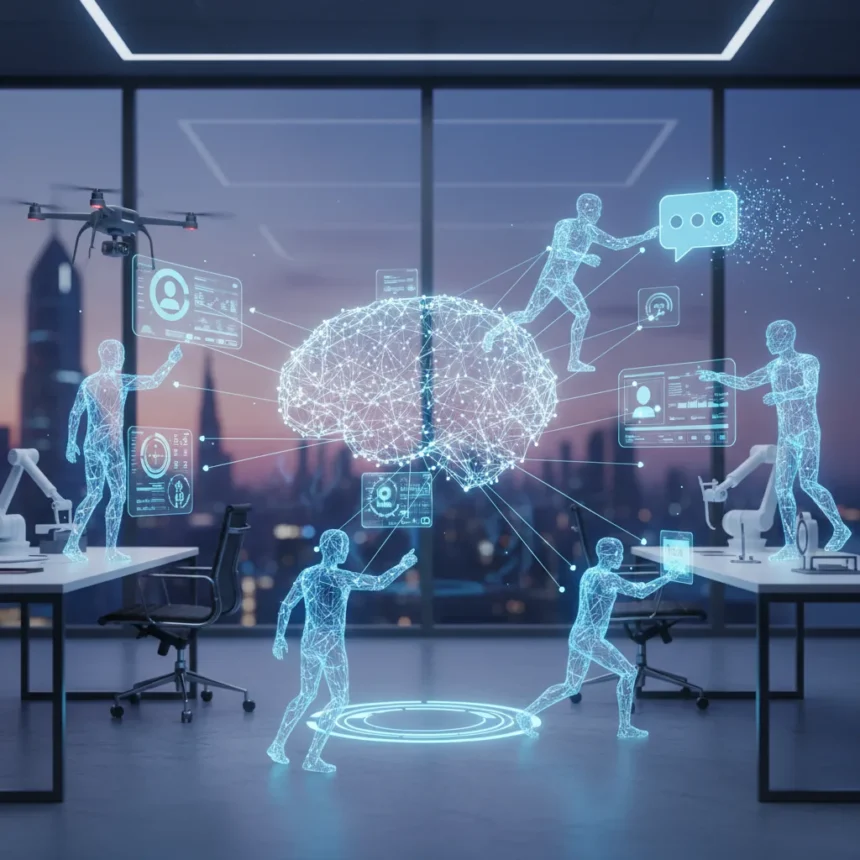
AI agents autonomous decision-making represents a fundamental departure from the chatbot era. These systems operate independently, make real-time decisions, and execute complex task sequences without waiting for human approval. Unlike conversational AI that answers questions, agents actively drive outcomes, handling ambiguity and collaborating with other agents to accomplish goals that would otherwise require human intervention.
Key Takeaways
- AI agents autonomously execute complex workflows and make decisions in real time, moving beyond query-response chatbots.
- Multi-agent systems divide specialized tasks—like chip design—among focused agents for faster, smarter results.
- Microsoft’s 2026 strategy bets on narrow, task-specific agents rather than one all-purpose assistant.
- Real-world deployments include network security systems that remediate vulnerabilities and IT helpdesks that anticipate problems.
- Security risks demand dedicated agent accounts and scoped credentials to prevent unauthorized access.
How AI agents autonomous decision-making differs from traditional automation
Traditional robotic process automation and legacy SaaS handle structured, repetitive workflows. AI agents autonomous decision-making tackles messier problems. They learn from context, adapt to ambiguity, and make judgment calls in real time—capabilities that older systems cannot match. A network monitoring agent, for instance, detects a security vulnerability and immediately patches it without escalating to a human analyst. That’s not automation; that’s delegation.
The shift matters because enterprises are drowning in context-chasing work. Employees spend hours pulling together meeting briefs, hunting through emails for document updates, and reformatting rough notes into presentable slides. Microsoft sees this gap and is building agents to handle exactly these tasks. Each agent focuses narrowly—one prepares the brief, another gathers updates, a third polishes the notes. This division of labor mirrors how human teams work, except agents never sleep and never miss context.
Single-model AI systems process entire workflows end-to-end, which sounds efficient until tasks grow complex. Multi-agent architectures distribute the load. When designing a computer chip, one agent handles layout, another runs simulations, and a third optimizes performance. Splitting work this way produces faster iterations and smarter results than forcing one model to juggle everything.



Where AI agents are already operating at scale
Autonomous agents are not theoretical. They are already embedded in security operations, customer support, and IT helpdesks. Network monitoring systems autonomously identify and remediate vulnerabilities without human review. AI-powered IT helpdesks anticipate issues before users report them, proactively resolving problems based on system patterns and historical data. These deployments prove that agents can operate reliably in high-stakes, always-on environments.
The scope is expanding rapidly. Document management systems use agents to organize, tag, and retrieve files. Customer support workflows route inquiries to specialized agents that resolve issues without handoff. Workflow orchestration platforms coordinate multi-step business processes across teams. Mobile applications leverage agents to book flights, sort photos, and handle appointment scheduling. Wearables like smart glasses use agents to identify plants and objects in real time. Home assistants and autonomous vehicles represent the frontier—navigation, object detection, and decision-making happening at machine speed.



Microsoft’s vision for 2026 workplace AI emphasizes specialized agents over broad assistants. Rather than one all-purpose Copilot handling everything, the strategy deploys focused tools built for specific jobs. An agent prepares meeting briefs. Another pulls document and email updates. A third refines notes into polished presentations. This narrower approach sidesteps the brittleness of generalist systems and aligns agents with actual work patterns.
The security and trust problem with AI agents autonomous decision-making
Autonomous agents introduce a new attack surface. An agent with access to your primary inbox and root cloud credentials becomes a single point of failure. If compromised, it can send emails, modify files, and escalate privileges at machine speed, causing damage faster than any human attacker. Security teams must rethink access control for agentic AI.
Best practices include creating dedicated accounts for agents, isolating them from primary inboxes and critical credentials, and using scoped service accounts that limit what each agent can access. Monitoring is essential—you need visibility into what agents are doing, what decisions they are making, and which resources they are touching. This is not optional. An unmonitored agent is a liability.
Beyond technical security, there is a trust question. AI-to-AI transactions—where agents buy from other agents—create new risks. Who is responsible if an agent makes a bad deal? What happens when two agents disagree on terms? These scenarios are no longer hypothetical. As agents proliferate, governance frameworks will become as important as encryption.



What does this mean for workers and enterprises?
The honest answer: it depends on the job. Roles built around context-chasing, repetitive workflows, and routine decision-making face the most disruption. An agent can prepare meeting briefs faster than a human assistant. It can sort through emails, surface relevant documents, and draft summaries without fatigue. These are not glamorous jobs, but they are common, and agents will handle them better than humans do.
Enterprises win by compressing work categories. Instead of hiring three people to manage IT helpdesk triage, you deploy agents to handle 80 percent of cases autonomously. Instead of analysts chasing context all day, agents gather and synthesize information in seconds. The efficiency gains are real, which is why PwC and other consulting firms emphasize that agents are advancing to make autonomous decisions at scale. This requires responsible AI foundations—transparency, auditability, and governance—to maintain trust as agents take on more responsibility.
For workers, the shift is less about job loss and more about job redefinition. Humans will focus on judgment calls, relationship-building, and creative problem-solving—tasks agents still struggle with. But that transition requires training, organizational change, and honest conversations about where agents add value and where they create risk.
Can AI agents actually handle real-world complexity?
Agents excel at tasks with clear decision trees and abundant training data. Network security, IT support, and document workflows fit this profile. They are less reliable when ambiguity is high, context is sparse, or the stakes are extreme. An agent booking a flight is low-risk; an agent making hiring decisions is not.
The gap between agent capability and enterprise hype is real. Vendors market agents as trusted partners driving unparalleled efficiency, but current systems still require human oversight for high-stakes decisions. This will improve, but claims of full autonomy are premature. Agents are powerful tools, not replacements for human judgment in critical domains.
Is your organization ready for AI agents?
Readiness means more than deploying software. You need governance frameworks, security controls, monitoring systems, and clear policies about what agents can and cannot do. You need to audit decisions agents make and understand why they made them. You need to train teams to work alongside agents rather than against them. Organizations that skip these steps will deploy agents that fail spectacularly and damage trust in AI broadly.
How do multi-agent systems divide complex work?
In multi-agent architectures, specialized agents handle different parts of a workflow. For chip design, one agent manages layout, another runs simulations, and a third optimizes performance. Each agent focuses on what it does best, then passes results to the next agent. This division is faster and smarter than forcing a single model to handle all three tasks. Finance, customer service, software development, and R&D all benefit from this approach.
What’s Microsoft’s strategy for workplace AI agents?
Microsoft is betting that 2026 workplace AI will not be one all-purpose assistant, but a growing cast of narrow, task-specific agents. One agent prepares meeting briefs. Another pulls together updates from documents and emails. A third turns rough notes into presentable content. This approach aligns agents with actual jobs and sidesteps the brittleness of generalist systems. Agents are digital workers for repetitive tasks like context-chasing and drafting—not replacements for human creativity or judgment.
The shift from chatbots to autonomous agents is already underway. Enterprises deploying agents in security, IT, and customer support are seeing real efficiency gains. The next wave will bring agents into finance, R&D, and software development. Success depends on treating agents as tools requiring governance, security, and oversight—not as magic solutions. Organizations that get this right will compress work categories and free humans to focus on judgment and creativity. Those that skip the governance piece will deploy agents that fail and damage trust in AI broadly. The choice is yours.
Edited by the All Things Geek team.
Source: TechRadar