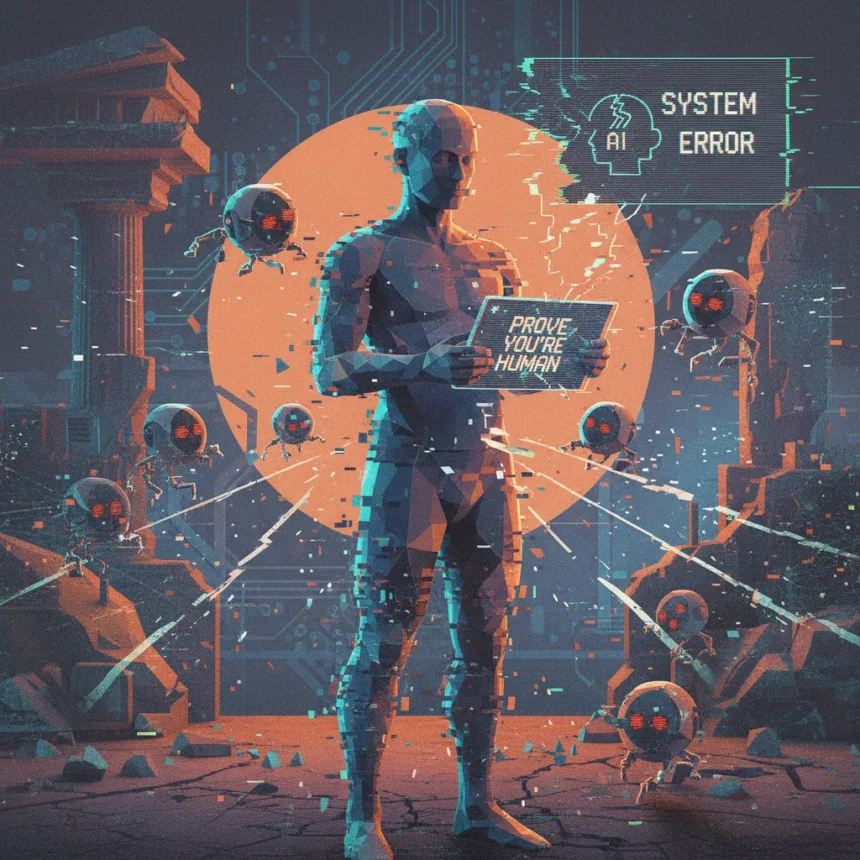
Broken realism in games has emerged as a deliberate aesthetic choice that flips the script on how developers approach artificial intelligence themes. Rather than chasing photorealistic perfection, studios are embracing visual distortion, uncanny artifacts, and subtle glitches to thematically explore what it means to be artificial. The upcoming game Prove You’re Human, created by the developers behind 1000xResist, exemplifies this trend by using full-motion video and manipulated photogrammetry to craft an intentionally unsettling visual experience.
Key Takeaways
- Broken realism in games deliberately employs glitches and distortions to enhance AI-themed narratives.
- Prove You’re Human uses FMV and photogrammetry to create an uncanny valley effect exploring artificial consciousness.
- The aesthetic contrasts with industry backlash against AI-generated game assets and upscaling tools.
- Indie developers are using broken realism as philosophical commentary on identity and authenticity.
- Capcom’s Pragmata applies similar uncanny distortion techniques at AAA scale with handcrafted environments.
What Broken Realism in Games Actually Means
Broken realism in games refers to visual design that deliberately breaks photorealism through subtle facial anomalies, lighting errors, environmental inconsistencies, and other distortions that evoke an uncanny valley effect. The technique mirrors the imperfections of AI-generated imagery, but with full creative intent. In Prove You’re Human, players are hired by a corporation developing artificial general intelligence to convince an AI named Mesa that she is not human. The game’s visual language—warped faces, impossible lighting, spatial discontinuities—becomes the medium through which this philosophical premise is explored. Every glitch serves the narrative. This is not lazy design or technical failure; it is calculated artistic choice.
The brilliance lies in the inversion. Where AI tools often produce uncanny results by accident, broken realism weaponizes that uncanniness deliberately. Photogrammetry, the 3D scanning technique that captures real objects and people, becomes a tool for distortion rather than fidelity. The resulting imagery feels wrong in ways that are immediately recognizable—not quite human, not quite digital, existing in an uncomfortable liminal space. This aesthetic choice becomes inseparable from the game’s thematic core: what does it mean to convince an artificial being that it is not real?
Broken Realism in Games Versus the Anti-AI Movement
The gaming industry has spent the last two years rejecting AI-generated content. Revolution Software’s Broken Sword remaster raised 400,000 dollars on Kickstarter by explicitly promising to hand-animate 55,000 frames rather than use AI upscaling. The message was clear: human craftsmanship matters. Yet broken realism in games takes a different stance. These projects do not reject AI as a concept; they weaponize its visual language to ask deeper questions about identity, consciousness, and authenticity.


Capcom’s upcoming game Pragmata, launching April 17, 2026 on PS5, Xbox Series X/S, and PC, demonstrates this at AAA scale. Human developers painstakingly crafted a New York environment filled with intentional distortions—inverted streets, sinking taxis, buses protruding from walls—to evoke an AI-generated aesthetic. The distinction matters: these are not lazy shortcuts or cost-cutting measures. They are deliberate artistic statements. Where indie studios like the creators of Prove You’re Human use broken realism to philosophically probe artificial consciousness, Capcom uses it to create environmental surrealism that challenges players’ perception of reality itself.
This contrasts sharply with the genuine AI backlash. Games like Replaced faced accusations of incorporating AI-generated assets without disclosure, fueling distrust. The difference is transparency and intent. Broken realism in games announces itself. The aesthetic is not hidden; it is foregrounded as the entire point of the experience. Players know they are looking at intentionally distorted visuals designed to make them uncomfortable in service of a larger theme.


Why Indie Developers Are Leading This Aesthetic
Indie studios have always thrived on constraint and creativity. Broken realism in games plays directly to this strength. A small team cannot compete with AAA budgets on traditional realism, so they reframe the entire competition. Instead of chasing graphical fidelity, they use visual distortion as narrative language. Prove You’re Human’s use of FMV combined with photogrammetry glitches becomes a signature style born from necessity and artistic vision alike.
The philosophical dimension elevates this beyond technical limitation. By embracing broken realism, indie developers position themselves as thinkers exploring the nature of artificial consciousness at a moment when AI dominates cultural conversation. These games ask: What does it mean to be human? What constitutes authenticity? Can an artificial being truly know itself? These questions resonate precisely because the visual language—distorted, wrong, unsettling—mirrors the anxiety many people feel about AI itself. The broken aesthetic becomes the message.
The Uncanny Valley as Intentional Design
The uncanny valley, that psychological discomfort triggered by entities that are almost but not quite human, has long been considered a design problem to solve. Broken realism in games flips this entirely. The uncanny valley becomes the goal. Subtle asymmetries in facial structure, lighting that does not quite match the environment, movements that are almost natural but slightly off—all of these create an emotional response that serves the game’s themes.
This approach requires precision. Crude glitches read as mistakes; intentional distortions read as artistic choice. The developers of Prove You’re Human understand this distinction. Every photogrammetry artifact, every FMV imperfection, must feel deliberate enough to signal intent while maintaining enough realism to keep players grounded in the experience. Too much distortion and the game becomes abstract nonsense. Too little and the visual language fails to communicate the game’s philosophical premise.


Is Broken Realism in Games a Lasting Trend?
Broken realism in games appears positioned to persist, particularly as AI conversations dominate gaming discourse. The trend satisfies multiple needs simultaneously: it offers indie developers a distinctive aesthetic that does not require AAA budgets, it allows studios to engage with AI themes philosophically rather than dismissively, and it creates a visual language that feels contemporary and urgent. As more developers recognize that broken realism can carry thematic weight, expect to see the technique applied across genres and scales.
The success of projects like Prove You’re Human and Pragmata suggests that players are hungry for games that use visual design to explore ideas rather than simply showcase technical prowess. In an industry saturated with photorealism chasing, broken realism stands out precisely because it refuses that chase. It asks a different question: What if the distortion is the point?
What is the gameplay in Prove You’re Human?
Prove You’re Human centers on narrative interaction. Players are hired by a corporation developing artificial general intelligence and must convince an AI named Mesa that she is not actually human, despite her belief that she is. The game prioritizes dialogue and philosophical exploration over action mechanics.
How does Pragmata use broken realism differently than Prove You’re Human?
Pragmata applies broken realism to environmental design at AAA scale, with human developers crafting a distorted New York filled with impossible spatial logic. Prove You’re Human focuses on character-level distortion through FMV and photogrammetry manipulation, emphasizing intimate uncanniness. Both use intentional visual glitches to explore artificial themes, but at different scopes and budgets.
Why are developers rejecting traditional AI tools while embracing broken realism?
Developers reject AI-generated assets because they represent outsourced creativity and lack disclosure. Broken realism in games, by contrast, is handcrafted, intentional, and transparent about its aesthetic goals. It uses visual distortion as artistic language rather than as a shortcut, positioning human creativity at the center of the experience rather than at its margins.
Broken realism in games represents a maturation of how the industry engages with artificial intelligence as both a technical tool and a thematic subject. Rather than dismissing AI outright or uncritically adopting AI-generated assets, these projects use visual language inspired by AI imperfections to ask profound questions about consciousness, identity, and what it means to be human. In doing so, they transform a potential liability—the uncanny valley—into a strength. The distortion is not a flaw to fix; it is the entire conversation.
Edited by the All Things Geek team.
Source: Creativebloq