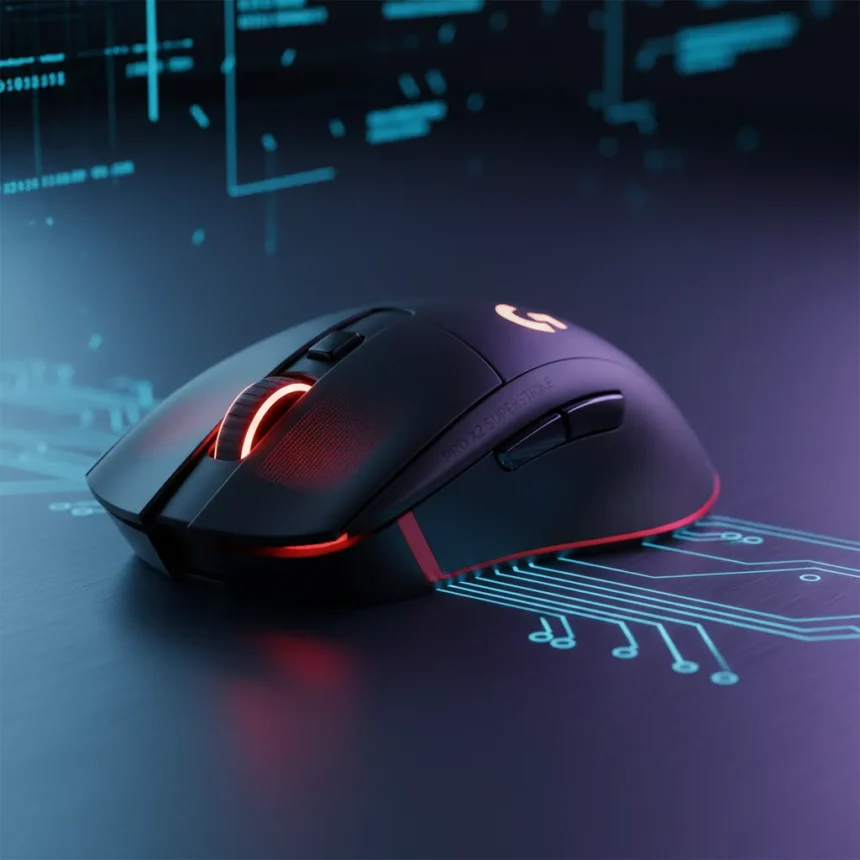
The Logitech G PRO X2 SUPERSTRIKE is a gaming mouse that abandons mechanical switches entirely, replacing them with a haptic induction trigger system that fundamentally changes how competitive players interact with their hardware. This shift marks a genuine departure from the standard gaming mouse formula, and it is already turning heads in esports communities and among players who demand precision and speed above all else.
Key Takeaways
- The G PRO X2 SUPERSTRIKE uses HIT (Haptic Induction Trigger) system instead of traditional mechanical switches
- Rapid trigger functionality enables sub-millisecond actuation speeds for competitive advantage
- Tested and validated in high-demand titles including CS2, Deadlock, TF2, and Cyberpunk
- Haptic feedback replaces mechanical feedback, offering a completely different tactile experience
- Designed specifically for esports players who prioritize responsiveness over traditional switch feel
What Makes the Logitech G PRO X2 SUPERSTRIKE Fundamentally Different
The Logitech G PRO X2 SUPERSTRIKE eliminates the mechanical switch architecture that has defined gaming mice for two decades. Instead, Logitech’s HIT (Haptic Induction Trigger) system uses electromagnetic actuation to register clicks without the physical snap of a mechanical switch. This architectural shift is not merely cosmetic—it changes the entire tactile and performance profile of the device.
Traditional mechanical switches require physical contact and travel distance to register. The haptic induction system bypasses this entirely, allowing for actuation without the mechanical friction that slows down conventional designs. Rapid trigger functionality means the G PRO X2 SUPERSTRIKE can register inputs at speeds that mechanical switches simply cannot match. For competitive players in games where milliseconds determine victory, this difference is measurable and game-changing.
The haptic feedback system also means players feel confirmation through vibration and electromagnetic response rather than the tactile click of a mechanical switch. This takes adjustment—players accustomed to the satisfying snap of Cherry MX or Razer switches will initially find the experience foreign. But once adapted, many users report the precision and speed advantage outweighs the loss of traditional tactile feedback.

Real-World Performance Across Competitive Titles
The Logitech G PRO X2 SUPERSTRIKE has been tested extensively in the games where competitive precision matters most. CS2, Deadlock, Team Fortress 2, and Cyberpunk all demand rapid, accurate input—and the haptic induction system delivers measurable advantages in these environments. In CS2, where weapon accuracy and spray control depend on millisecond-level input timing, the rapid trigger functionality eliminates the input lag that can cost rounds. In Deadlock and TF2, where aim and reaction time determine survival, the sub-millisecond actuation speed becomes a tangible competitive edge.
Cyberpunk testing reveals that the haptic system excels in both combat scenarios and precision aiming tasks. The lack of mechanical resistance means smoother cursor tracking and faster response to player input. Unlike traditional gaming mice that register clicks after physical switch actuation completes, the G PRO X2 SUPERSTRIKE registers input almost instantaneously, giving players a documented advantage in fast-paced environments.

How the Haptic Induction Trigger System Compares to Mechanical Switches
Mechanical switches have dominated gaming mice because they offer tactile feedback, satisfying feel, and proven reliability. The Logitech G PRO X2 SUPERSTRIKE trades that familiar experience for speed and precision. A mechanical switch requires the user to physically depress a button, which introduces travel distance and actuation delay. The haptic system eliminates both, achieving faster registration without any physical switch mechanism to slow it down.
This means the G PRO X2 SUPERSTRIKE is faster than even the fastest mechanical gaming mice—but at the cost of losing the tactile confirmation that many gamers love. Players switching from a traditional gaming mouse will experience a learning curve. The haptic feedback is different; it is not a click, but a vibration-based confirmation. For some users, this is immediately superior. For others, it takes weeks of play to stop reaching for that familiar mechanical snap.
The durability argument also shifts. Mechanical switches can wear out after millions of clicks—typically 50 million to 100 million actuations before degradation. The haptic induction system has no moving parts in the switch mechanism itself, theoretically offering longer lifespan and fewer failure points.
Why Competitive Players Are Adopting the Logitech G PRO X2 SUPERSTRIKE
Esports players are notoriously conservative about equipment changes—a new mouse can disrupt muscle memory and consistency. Yet the G PRO X2 SUPERSTRIKE is overcoming that resistance because the speed advantage is undeniable. In games where frame-perfect inputs determine outcomes, even a few milliseconds of improvement compounds into measurable win-rate increases over dozens of matches.

Professional CS2 teams have been among the earliest adopters, testing the device in scrimmages and official matches. The rapid trigger system allows for spray control patterns that are simply impossible with traditional mechanical mice. In Deadlock, where quick ability activation and precise aiming overlap, the haptic system’s responsiveness becomes a strategic advantage. These are not marginal improvements—they are fundamental changes to what is physically possible at the input level.
Is the Logitech G PRO X2 SUPERSTRIKE Right for You?
The Logitech G PRO X2 SUPERSTRIKE is not a mouse for everyone. Casual gamers and productivity users will likely find the haptic system disorienting compared to mechanical switches. The lack of tactile feedback feels wrong to players accustomed to traditional mice, and that learning curve can take weeks to overcome.
But for competitive players in fast-paced shooters, MOBAs, and fighting games, the speed advantage justifies the adjustment period. If you play CS2, Deadlock, TF2, or any title where input latency directly impacts performance, the G PRO X2 SUPERSTRIKE deserves serious consideration. The haptic induction trigger system is not a gimmick—it is a genuine technological shift that enables faster, more precise input than mechanical switches allow.
Does the Logitech G PRO X2 SUPERSTRIKE require software to function?
The haptic induction trigger system operates at the hardware level and does not require software to deliver its core functionality. Logitech’s software allows customization of haptic feedback intensity, rapid trigger sensitivity, and button mapping, but the mouse functions immediately out of the box without any driver installation.
How long does it take to adapt to haptic feedback instead of mechanical switches?
Most players report a learning period of 1-3 weeks before the haptic system feels natural. Some adapt within days; others take longer. The adjustment is primarily psychological—your fingers expect the click, and haptic vibration feels wrong at first. Muscle memory adapts quickly once you accept that the feedback mechanism is different, not inferior.
Can you use the Logitech G PRO X2 SUPERSTRIKE on any gaming platform?
The G PRO X2 SUPERSTRIKE connects via USB and works with any platform that supports standard mouse input—PC gaming is the primary use case. Console gaming support depends on whether your console accepts USB gaming peripherals; most modern consoles do, but wired mice are less common in console esports than in PC competitive gaming.
The Logitech G PRO X2 SUPERSTRIKE represents a genuine inflection point in gaming mouse design. It abandons the mechanical switch standard not out of novelty, but out of engineering necessity—haptic induction is objectively faster. For competitive players willing to invest in the adaptation period, the speed advantage is real and measurable. For everyone else, it remains a fascinating glimpse into where gaming peripherals are headed.
Where to Buy
Edited by the All Things Geek team.
Source: T3