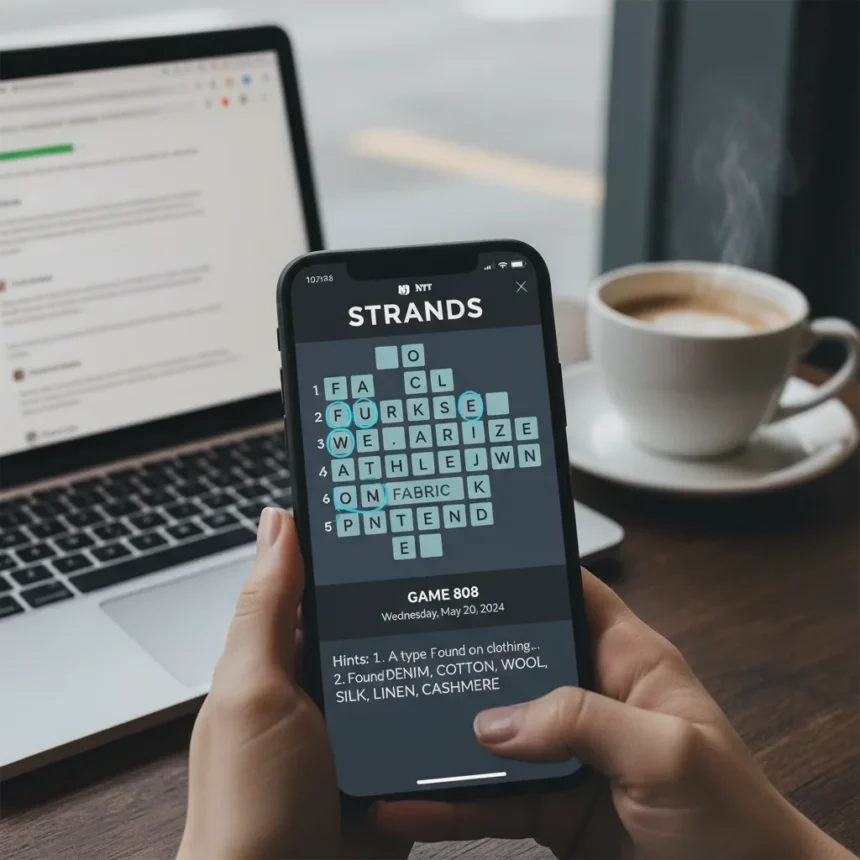
NYT Strands game 808 for Wednesday, May 20 is live, and if you are staring at a blank board wondering where to start, you are not alone. This daily word puzzle challenges players to find hidden words and unlock a larger spangram that ties the theme together. Whether you want a gentle nudge or the full solution, here is everything you need to crack today’s board.
Key Takeaways
- NYT Strands game 808 launches Wednesday, May 20 with a fresh theme and board layout
- The puzzle includes clue words that unlock hints when found
- A spangram connects all theme words and spans the entire board
- Hints are available before you commit to guessing
- Full answers are provided if you want to skip straight to the solution
What Is NYT Strands Game 808?
NYT Strands game 808 is the New York Times word puzzle for Wednesday, May 20. Like every daily Strands game, it presents a grid of letters where you must identify hidden words related to a specific theme. The challenge is finding connections between seemingly random letters and understanding what ties them together thematically. Once you find certain words, the game rewards you with hints that make the puzzle easier to complete.
The core mechanic of Strands rewards pattern recognition and lateral thinking. You are not just looking for any words—you are hunting for words that fit a hidden theme. Identify enough theme words, and the spangram reveals itself. The spangram is the ultimate word that connects all the theme words and runs across the board in a single continuous path.
How to Approach NYT Strands Game 808
Start by scanning the board for common letter patterns and short words you recognize immediately. Three and four-letter words are often easier to spot than longer ones, and finding even one theme word unlocks the hint system. Once you have a hint, use it to reframe your search—hints often describe the theme in a way that makes other words jump out at you.


Do not rush to guess. Strands penalizes wrong answers by removing letters temporarily, which shrinks your search space. If you are unsure whether a word fits the theme, check it against the hint first. The hint system is your ally, not a crutch. A well-timed hint can shift your perspective on the entire board and lead you to multiple answers in quick succession.
Look for the spangram last, not first. Once you have found most or all of the theme words, the spangram path usually becomes obvious. It often weaves through the board in an unexpected pattern, so do not assume it runs straight across or down.



NYT Strands Game 808 Hints Without Spoilers
If you want to solve the puzzle yourself but need a nudge, focus on the theme first. Think about what connects the words you have found so far. Is there a category? A wordplay pattern? A shared characteristic? The theme is always the key to unlocking Strands, and once you understand it, the rest of the puzzle falls into place much faster.
Look for words that seem out of place or unusual for a word puzzle. Strands often hides theme words in plain sight by using less common words or words that do not immediately feel thematic. If you spot an uncommon letter combination or a word that feels slightly off, it might be exactly what you are looking for.
Full Answers for NYT Strands Game 808
If you are ready for the complete solution, the full answer list for NYT Strands game 808 is available on TechRadar, along with the spangram and its board position. The article also includes the theme clue that ties all the answers together, so you can understand the logic behind the puzzle even after you have solved it.
Checking the full answers is not cheating—it is learning. Understanding why certain words fit the theme and how the spangram connects them teaches you patterns to recognize in future puzzles. Many regular Strands players use answer guides not just to solve the current puzzle but to sharpen their skills for tomorrow’s game.


Why NYT Strands Matters to Daily Players
Strands has become a beloved companion to the daily crossword and Wordle for millions of New York Times Games subscribers. Unlike Wordle, which resets every 24 hours with a single word, Strands offers a richer puzzle experience with multiple solutions and a larger board. Unlike the crossword, which requires specific knowledge and vocabulary, Strands relies on pattern recognition and thematic thinking—skills that improve with every puzzle you solve.
The game strikes a balance between accessibility and challenge. A casual player can enjoy finding a few words and learning the theme. A dedicated solver can hunt for the spangram and unlock all the hints. There is no single way to play, which is why Strands has attracted such a devoted audience since its launch.
Comparing Strands to Other NYT Games
NYT Strands differs from Wordle in scope and structure. Wordle gives you one word and six chances to guess it. Strands gives you dozens of possible words and rewards you for finding theme-related ones. Wordle is about deduction and pattern matching on a single target. Strands is about exploration and thematic understanding across a larger space. Both are excellent daily habits, but they exercise different parts of your puzzle-solving brain.
The crossword, by contrast, is knowledge-heavy. Solving a crossword requires vocabulary, cultural awareness, and sometimes obscure trivia. Strands requires none of that. You only need to recognize words that are already on the board and understand how they connect thematically. This makes Strands more accessible to new players while still offering depth for experienced solvers.
Is It Okay to Use Hints and Answers?
Absolutely. The New York Times built the hint system directly into Strands, which means using hints is part of the intended experience. Some players treat Strands as a pure puzzle to solve alone. Others use hints liberally. Neither approach is wrong. The game is designed to accommodate different skill levels and play styles.
Using answer guides like the one on TechRadar is equally valid. If you are stuck, frustrated, or simply curious about the solution, checking the answers is a legitimate way to move forward. You learn the theme, understand the spangram, and you are ready for tomorrow’s puzzle. There is no penalty for using external help.
When Does NYT Strands Game 808 Release?
NYT Strands game 808 goes live on Wednesday, May 20 at midnight Eastern Time. If you are in a different time zone, adjust accordingly. The puzzle remains available for 24 hours, after which game 809 takes its place. You can play at any time during that window—there is no rush to solve it immediately.
Can You Replay Old Strands Games?
Yes. The New York Times Games app and website allow you to replay any previous Strands puzzle. If you want to revisit game 808 after May 20, you can access it in the archive. This is useful for practicing, testing yourself, or simply enjoying a puzzle you particularly liked.
What Happens If You Get Stuck on NYT Strands Game 808?
If you are genuinely stuck, the hints are your first resort. Find one theme word, unlock the hint, and use that information to guide your next moves. If hints are not enough, the full answer list on TechRadar will show you every word and the spangram. There is no shame in checking—thousands of players do it every day.
NYT Strands game 808 is a solid Wednesday puzzle that rewards both casual play and deep solving. Whether you crack it yourself, use hints to guide your way, or check the answers outright, the goal is the same: understand the theme, find the words, and enjoy the mental workout. Tomorrow brings a fresh board and a new challenge. Today, use whatever tools you need to finish strong.
Where to Buy
21 Amazon customer reviews | $4.99 | $9.99 | $12.99
Edited by the All Things Geek team.
Source: TechRadar