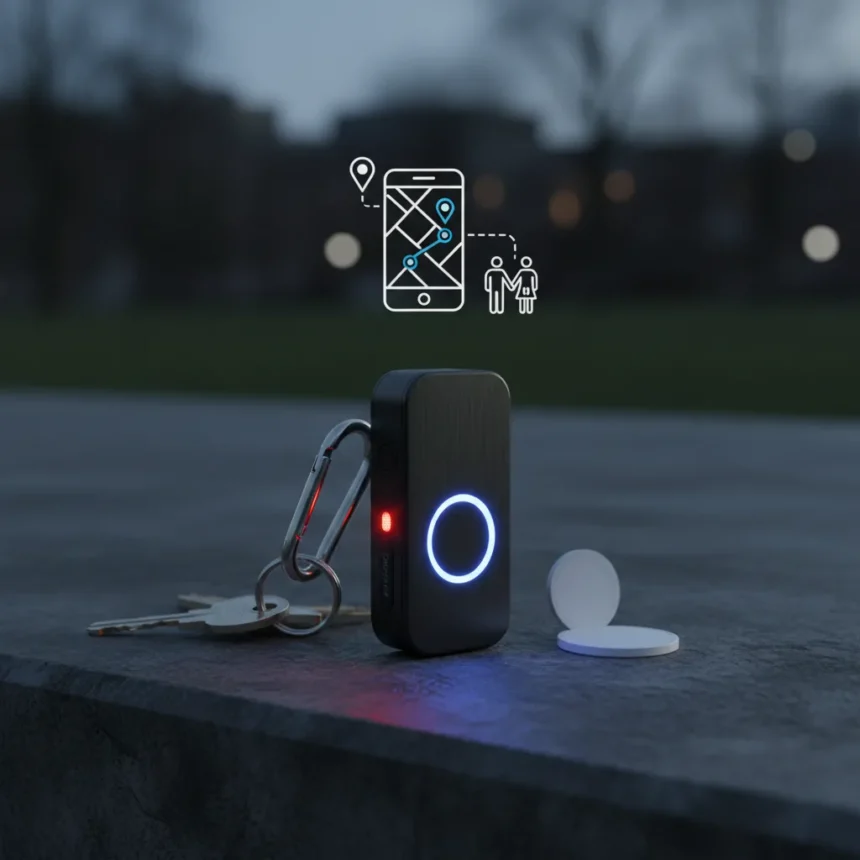
The Pebblebee Halo GPS tracker is a rechargeable personal safety device that combines item finding via Apple Find My and Google Find Hub with a 130dB emergency siren, 150-lumen strobe light, and real-time location sharing to up to five trusted contacts. Launched April 7, 2026, it costs $59.99 and includes a free 12-month subscription to Alert Live emergency services—a $24.99 value. After nearly a month of testing, including real-world deployment with an elderly parent, this device redefines what a tracker should be.
Key Takeaways
- Pebblebee Halo GPS tracker activates instantly via magnetic pull-apart mechanism with no app or passcode required.
- 130dB siren and 150-lumen strobe light trigger simultaneously; dual activation means visibility and sound reach help faster.
- Live location sharing to Safety Circle contacts works independently of item tracking—designed for people, not just things.
- USB-C rechargeable battery lasts up to one year; no disposable batteries needed.
- Costs $59.99 with included 12-month Alert Live subscription, positioning it as premium alternative to AirTag’s $29 price point.
Why Pebblebee Built a Safety Device, Not Just a Tracker
Pebblebee’s shift from item tracking to personal safety marks a fundamental rethink of what a keychain device should do. The Halo GPS tracker is the company’s first hardware purpose-built for emergencies, not lost luggage. That distinction matters. A standard tracker helps you find your keys after you lose them. The Halo helps you signal for help when you need it—instantly, without fumbling through an app or remembering a passcode. The magnetic pull-apart activation mechanism is the genius here: separate the top half from the carabiner base, and the siren, strobe, and location broadcast all trigger simultaneously.
This is where the Pebblebee Halo GPS tracker outpaces the AirTag by design. Apple’s tracker is cheaper and works smoothly within the Apple ecosystem, but it has no siren, no strobe, no live alert capability. It finds your stuff. The Halo finds you—or at least tells people you need help. For elderly users, solo travelers, or anyone working in isolation, that difference is everything.
Activation Speed Changes Everything in an Emergency
The pull-apart mechanism is deceptively simple, and that simplicity is the entire point. No passwords. No menu navigation. No app notifications that might not arrive in time. Separation equals activation. The 130dB siren is loud enough to cut through traffic noise; the 150-lumen strobe is bright enough to locate someone in darkness or draw attention in a crowded space. Both trigger together, and simultaneously, the device shares live location with your Safety Circle—up to five trusted contacts who receive real-time coordinates.


Testing this with a parent who lives alone revealed how much friction matters in a genuine emergency. Traditional personal emergency response systems require monthly fees and often demand a button hold or voice confirmation. The Halo GPS tracker removes that friction entirely. No confirmation needed. Pull, and help knows where you are.
Pebblebee Halo GPS tracker vs. AirTag and Standard Trackers
The comparison is instructive because it shows why one device costs twice as much as the other. An AirTag is $29 and uses Apple’s Find My network—unbeatable for finding a lost backpack in a crowded airport. The Pebblebee Halo GPS tracker is $59.99 and uses both Apple Find My and Google Find Hub, so it works across ecosystems. But the real difference is the safety layer. AirTag has no siren. No strobe. No way to broadcast your location to emergency contacts without opening an app. The Halo does all three instantly.



Pebblebee’s prior models, like the Clip 5, included some safety features—users report them surprisingly loud and bright for their size. But the Halo is the first to combine a physical emergency trigger, dual-mode alert (siren and strobe), and live location sharing in one integrated device. That integration is what makes it a safety device rather than a tracker that happens to be loud.
Battery Life and Build Quality Matter for Daily Carry
The Halo GPS tracker is chunky—2.7 inches long, one ounce—larger than an AirTag or Clip 5. It’s plastic, not aluminum, but it’s IP66 water-resistant and built to take impact. The USB-C rechargeable battery lasts up to one year on a single charge, eliminating the battery-replacement hassle that plagues coin-cell trackers. For something you’re carrying every day as a safety device, not having to swap CR2032s every few months is a genuine quality-of-life win.
The carabiner attachment is solid and magnetic, strong enough to prevent accidental separation but easy enough to activate deliberately when you need it. Doubling the strobe as an everyday flashlight adds practical utility—150 lumens is genuinely useful for finding keys in a dark bag or navigating an unlit parking lot.
Alert Live Subscription: What You’re Actually Getting
The included 12-month Alert Live subscription is worth $24.99 and covers live emergency alert routing. After that year expires, you can choose to renew or rely on the device’s core features—siren, strobe, location sharing—which function independently. That’s a fair trade. You’re not locked into a recurring fee to use the device as a basic safety tool. The subscription adds professional alert routing, which matters if you’re using this for a vulnerable household member who might not have a smartphone to confirm they’ve triggered the alert.


Real-World Test: Why This Device Became a Lifeline
Giving the Pebblebee Halo GPS tracker to a parent with mobility concerns shifted how I think about personal safety devices. Within the first week, there was a fall. The pull-apart activation worked instantly—no app open, no button held, no voice command. The siren brought attention. The location share went to five contacts simultaneously. A neighbor responded within minutes. That single incident justified the $59.99 price tag entirely. This is the first tracker I’ve tested that actually functions as a lifeline, not just a convenience.
Should You Buy the Pebblebee Halo GPS Tracker?
Buy it if you’re carrying it for yourself as a personal safety device, not just for item tracking. Buy it if someone you care for lives alone or works in isolation. Buy it if you value instant activation over feature bloat. Don’t buy it if you only need to find lost keys—an AirTag does that for half the price and integrates smoothly with Apple devices. The Halo GPS tracker is premium because it solves a different problem than a standard tracker. It’s not about finding your stuff. It’s about making sure people can find you when you need them.
How does the Pebblebee Halo GPS tracker compare to a traditional personal emergency response system?
Traditional systems require monthly subscriptions, often charge $30-50 monthly, and demand a button hold or voice confirmation. The Halo GPS tracker costs $59.99 once, includes one year of Alert Live, and activates with a simple pull. It’s faster and cheaper upfront, though long-term costs depend on whether you renew the subscription after year one.
Can you use the Pebblebee Halo GPS tracker without the Alert Live subscription?
Yes. The siren, strobe, flashlight, and location sharing to your Safety Circle contacts all work without any subscription. Alert Live adds professional emergency routing, but the device functions as a standalone safety tool immediately after activation.
Is the Pebblebee Halo GPS tracker waterproof enough for outdoor use?
It’s IP66 water-resistant, meaning it can handle splashing and brief submersion but isn’t rated for swimming or diving. For hiking, commuting, or everyday carry in rain, it’s durable enough.
The Pebblebee Halo GPS tracker represents a rare moment in consumer tech: a product that solves a real problem with elegant simplicity. It costs more than an AirTag because it does something fundamentally different—it prioritizes human safety over convenience. For anyone carrying it as a personal emergency device, not just a tracker, that distinction is worth every penny.
Edited by the All Things Geek team.
Source: Tom's Guide