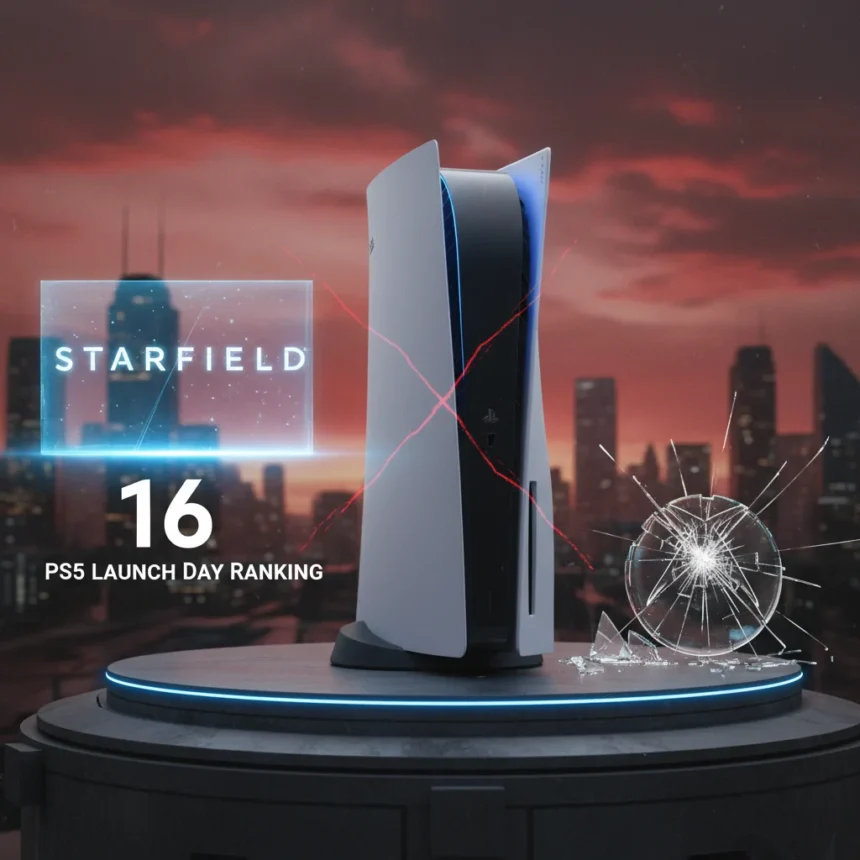
Starfield’s PS5 launch on April 7, 2026, tells a story Microsoft probably did not want to hear: strong pre-order momentum does not always translate to real-world sales. The Bethesda RPG, which topped PlayStation pre-order charts ahead of the upcoming exclusive Saros, debuted at number 16 on the PS5 best-sellers chart on launch day—failing to crack the top 15 despite a massive update, new story content, and PS5-specific features like adaptive triggers for weapons and ships. For a company that spent years defending exclusive content as essential to hardware sales, this result raises an uncomfortable question: was breaking the exclusivity promise actually worth it?
Key Takeaways
- Starfield launched on PS5 on April 7, 2026, with new story content and PS5 Pro Enhanced support.
- The game debuted at #16 on PS5 best-sellers despite ranking #3 in pre-orders shortly after announcement.
- Discounted competing titles like GTA 5, Call of Duty Black Ops 7, and NBA 2K26 outperformed the Bethesda RPG on launch day.
- PlayStation Store announcement trailer reached 2.4 million views in one day, showing strong initial interest.
- The weak launch undermines Microsoft’s argument that multiplatform strategy revives aging exclusives.
The Pre-Order Promise That Did Not Survive Launch
Starfield arrived on PlayStation with considerable momentum. The game ranked number three on PlayStation pre-order charts after Crimson Desert, signaling genuine interest from a platform that had waited years for the title. The PlayStation Store announcement trailer accumulated 2.4 million views in a single day, proof that PlayStation players were paying attention. Microsoft even backed the launch with a marketing campaign, treating the PS5 version as a major release rather than an afterthought.
Yet momentum evaporated on day one. The #16 debut on the PS5 best-sellers chart represents a stunning disconnect between what players said they wanted (strong pre-orders) and what they actually bought (something else). This is not a niche failure—it is a fundamental challenge to Microsoft’s entire strategy of breaking exclusivity to reach new audiences. If a 2.5-year-old game cannot convert pre-order interest into sales even with a major update and new content, what does that say about the value of porting aging exclusives to rival hardware?
Why Starfield PS5 Launch Failed to Compete
The answer lies in brutal market timing. On April 7, 2026, Starfield faced a PlayStation Store stacked with discounted alternatives. GTA 5, Arc Raiders, NBA 2K26, Call of Duty Black Ops 7, EA Sports FC 26, and EA Sports Madden NFL 26 all undercut Starfield’s position through aggressive pricing. Newer titles like Crimson Desert also outperformed the Bethesda RPG, pulling attention away from a game that had already spent 2.5 years on Xbox. The PlayStation market did not reject Starfield—it simply chose other options.

This matters because it exposes a flaw in Microsoft’s reasoning. The company assumed that porting exclusives to PlayStation would unlock hidden demand. Instead, it revealed that demand was conditional: players wanted Starfield when it was scarce and exclusive. Once it became just another multiplatform title competing for attention, it lost its scarcity premium. A game that dominated Xbox conversations for years landed with a whimper on the platform it was supposed to conquer.
Starfield PS5 Launch and the Exclusivity Question
The real cost of this launch is not measured in sales figures—it is measured in precedent. For two decades, Microsoft argued that exclusive games justified the Xbox purchase. Starfield was supposed to prove that multiplatform strategy could revive struggling titles and reach new players. Instead, the #16 debut suggests that breaking exclusivity may simply dilute a game’s value without actually expanding its audience. Players who wanted Starfield already owned it on Xbox. PlayStation players who were interested enough to pre-order proved willing to wait for discounts or competing titles instead.
The launch also complicates Microsoft’s relationship with its own hardware. Every exclusive that ships on PlayStation is a reason fewer players need to buy an Xbox. Starfield’s weak performance means Microsoft gave up exclusivity for minimal return—no sales explosion, no major audience conversion, just a #16 chart position alongside heavily discounted competitors. That is a difficult trade to justify to shareholders or to the gaming community that has always understood exclusives as the primary reason to choose one platform over another.
Did Bethesda’s Update Strategy Backfire?
One argument in Starfield’s favor is that the PS5 version arrived with substantial new content. The Free Lanes update and Terran Armada expansion, combined with PS5-specific features like adaptive triggers for weapons and ships and light bar indicators for health and ship status, represented a genuine effort to make the port feel native to PlayStation hardware. This was not a lazy port—it was a showcase of what PlayStation’s technology could do with a mature game.
Yet none of that mattered on launch day. Strong features and fresh content could not overcome the simple fact that Starfield is a 2.5-year-old game launching into a crowded market. Players had already made their decision about whether the game was worth playing. PlayStation owners who cared enough to pre-order did so in expectation of a launch-day experience that would justify their choice. Instead, they found a game competing against discounted blockbusters and newer titles. The update strategy was sound, but it could not overcome the structural disadvantage of arriving late to a new platform.
What This Means for Microsoft’s Multiplatform Future
Starfield‘s PS5 launch is a cautionary tale for any company considering breaking exclusivity. The theory is appealing: port your games to new platforms, reach new players, increase total sales. The reality is messier. Players do not buy games based on platform availability alone—they buy based on value, timing, and alternatives. A game that was exclusive and scarce loses both advantages the moment it becomes multiplatform. And if it launches into a market crowded with discounted competitors, it loses even more.

Microsoft will likely continue porting games to PlayStation—the financial incentives are too strong to resist. But Starfield’s weak debut should force a reckoning about whether exclusivity is truly worthless, or whether it simply serves a purpose that multiplatform strategy cannot replicate. A game that commands attention as an exclusive may simply be a different product once it is available everywhere. Starfield proved that lesson in the most expensive way possible.
Can Starfield recover on PlayStation after its weak launch?
Recovery is possible but unlikely without significant price drops or viral word-of-mouth. The #16 debut suggests that PlayStation players made their choice on day one, and Starfield lost that battle. Word-of-mouth from the existing Xbox player base could help, but the game is competing against established franchises with larger player communities. A slow climb up the charts is possible, but a dramatic reversal would require external factors like a major sale or a breakthrough streaming moment.
Why did Starfield pre-orders perform so much better than launch sales?
Pre-orders captured genuine interest from PlayStation players who had waited years for the game. However, launch-day reality—competing discounts, newer titles, and the realization that Starfield was now just another multiplatform game—shifted purchase decisions toward alternatives. The gap between pre-order enthusiasm and actual sales reveals that interest does not automatically convert to purchases when market conditions change.
Is the PS5 version worth playing compared to the Xbox version?
The PS5 version includes exclusive features like adaptive trigger support for weapons and ships, light bar indicators for health and ship status, and access to the new Free Lanes update and Terran Armada expansion. Whether it is worth playing depends on whether players value those enhancements and new content enough to justify a purchase. For players who already own the game on Xbox, the additions may not justify repurchasing. For new PlayStation players, the PS5-specific features offer a more tailored experience than the original Xbox version.
Starfield’s PS5 launch exposes a hard truth: exclusivity has value, and breaking it does not automatically unlock hidden sales. Microsoft spent years arguing that exclusive games justify console purchases, then undermined that argument by bringing Starfield to PlayStation. The result is a game that lost its scarcity premium without gaining meaningful new audience. For a company betting its future on multiplatform strategy, that is a sobering lesson delivered at full price.
Where to Buy
Microsoft Xbox Game Pass Ultimate | Microsoft Xbox Game Pass Ultimate 3
Edited by the All Things Geek team.
Source: Windows Central