





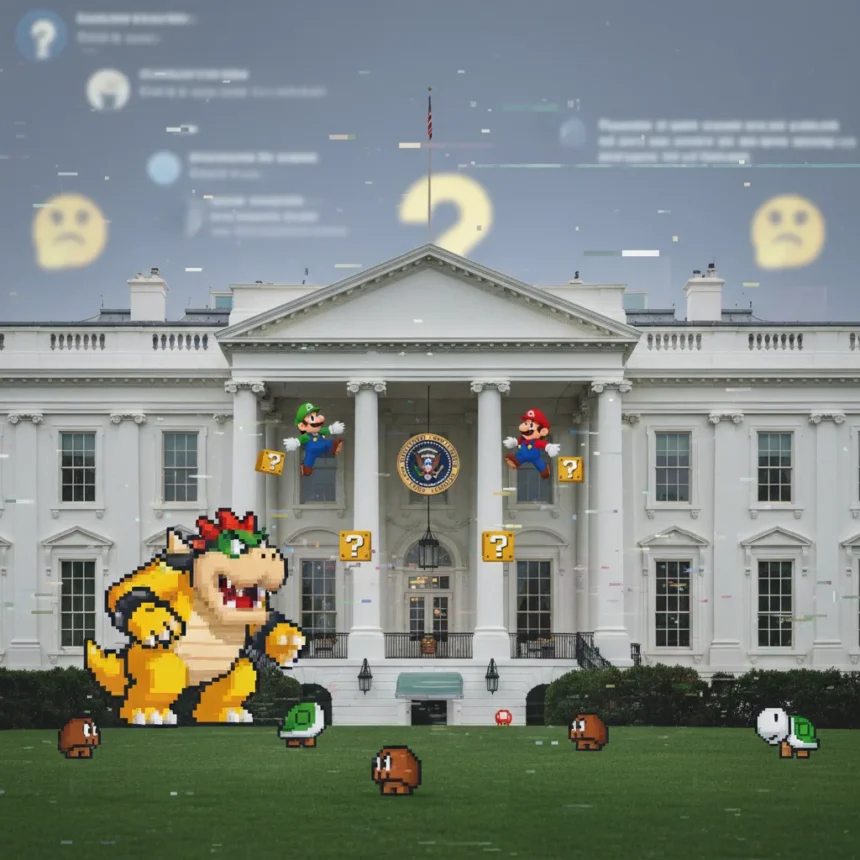
The White House Super Mario post has become an unexpected internet mystery, leaving social media users scrambling to understand what the government agency was trying to communicate. The post appeared without clear context, immediately triggering speculation and bewilderment across multiple platforms.
Key Takeaways
- The White House posted Super Mario content that confused observers about its purpose
- Social media users questioned the relevance and meaning of the post
- The post sparked widespread discussion about government social media strategy
- No official explanation was immediately provided for the cryptic message
- Internet culture and government communication collided in an unexpected way
What the White House Super Mario Post Actually Said
The White House Super Mario post appeared on social media without accompanying explanation, immediately raising questions about its purpose and timing. Observers noted the disconnect between typical government communication and the seemingly random pop culture reference. The post’s vagueness meant different audiences interpreted it in completely different ways, from promotional tie-ins to coded messages about policy initiatives.
Government social media accounts typically maintain formal, informational tones. This particular post broke that pattern dramatically. Without context clues or official guidance, users had little to work with beyond the Super Mario imagery itself. The ambiguity proved to be the post’s defining characteristic—it was precisely what people could not figure out that made it so widely discussed.
Why People Found It Perplexing
Social media users expressed genuine confusion about the White House Super Mario post because it lacked any obvious connection to government business, policy announcements, or public information. The post seemed designed to puzzle rather than inform. Typical government communication serves a clear function: announcing initiatives, providing updates, or sharing resources. This post did none of those things in any obvious way.


The randomness felt intentional to many observers, which only deepened the mystery. Was it a joke? A reference to something happening behind the scenes? A test of social media engagement? Without answers, speculation filled the void. People debated whether the post was an accident, a deliberate marketing stunt, or something else entirely. The lack of clarity transformed a simple post into a cultural moment precisely because no one could agree on what it meant.
The Broader Pattern of Unexpected Government Posts
Government accounts posting surprising or cryptic content is not entirely unprecedented, though it remains rare enough to generate headlines when it happens. Agencies occasionally experiment with humor, memes, or pop culture references to increase engagement with younger audiences. However, the White House Super Mario post stood out for its opacity—it offered no clear payoff, no punchline, and no explanation.



This moment highlights the tension between traditional government communication and modern social media expectations. Younger audiences expect personality and humor from accounts they follow. Older audiences expect professionalism and clarity. A post that satisfies neither group becomes a flashpoint for debate about what government communication should even be. The White House Super Mario post became less about the content itself and more about what it revealed about how different audiences view official channels.
Did It Achieve Its Purpose?
If the goal was to spark conversation and engagement, the White House Super Mario post succeeded spectacularly. If the goal was to communicate something specific, it failed entirely. The post generated far more questions than answers, which may or may not have been intentional. Without an official statement clarifying the post’s purpose, observers can only speculate.
The post’s virality came entirely from confusion rather than clarity. Social media algorithms reward engagement, and confusion generates plenty of comments, shares, and replies. Whether that constitutes a successful social media strategy depends entirely on what the White House was actually trying to accomplish—something the post itself never revealed.
What Should Have Been Different
A simple caption explaining the Super Mario reference would have transformed the entire conversation. Context matters enormously in communication, and the White House Super Mario post proved that principle dramatically. Government accounts have both the responsibility and the platform to explain themselves. Leaving audiences guessing is not transparency.


Future government posts could learn from this moment: if you reference pop culture, make clear why. If you’re promoting something, say so explicitly. If you’re testing a new communication style, acknowledge it. The White House Super Mario post became notable precisely because it violated basic communication principles that have existed long before social media.
Did the White House explain the Super Mario post?
No official explanation was provided for the White House Super Mario post, which only deepened the mystery. The absence of clarification became part of the story itself, fueling speculation and debate across social platforms about what the post meant or was supposed to accomplish.
Was the White House Super Mario post intentional or accidental?
Without an official statement, it remains unclear whether the White House Super Mario post was deliberate or a mistake. The lack of context and explanation left observers unable to determine the post’s origin or purpose with any certainty.
Why did people care about the White House Super Mario post?
The White House Super Mario post captured attention because it violated expectations about how government accounts communicate. The unexplained pop culture reference sparked curiosity and debate, transforming a simple post into a cultural moment worth discussing and analyzing.
The White House Super Mario post ultimately reveals how context shapes meaning in modern communication. A single image or reference means nothing without explanation. Government accounts, like any communicator, bear responsibility for clarity. When they abandon it—intentionally or otherwise—they invite confusion, speculation, and debate. The post succeeded at generating engagement but failed at the more fundamental task of actually saying something. In an era of information overload, saying nothing clearly is perhaps the loudest statement of all.
Edited by the All Things Geek team.
Source: Creativebloq




