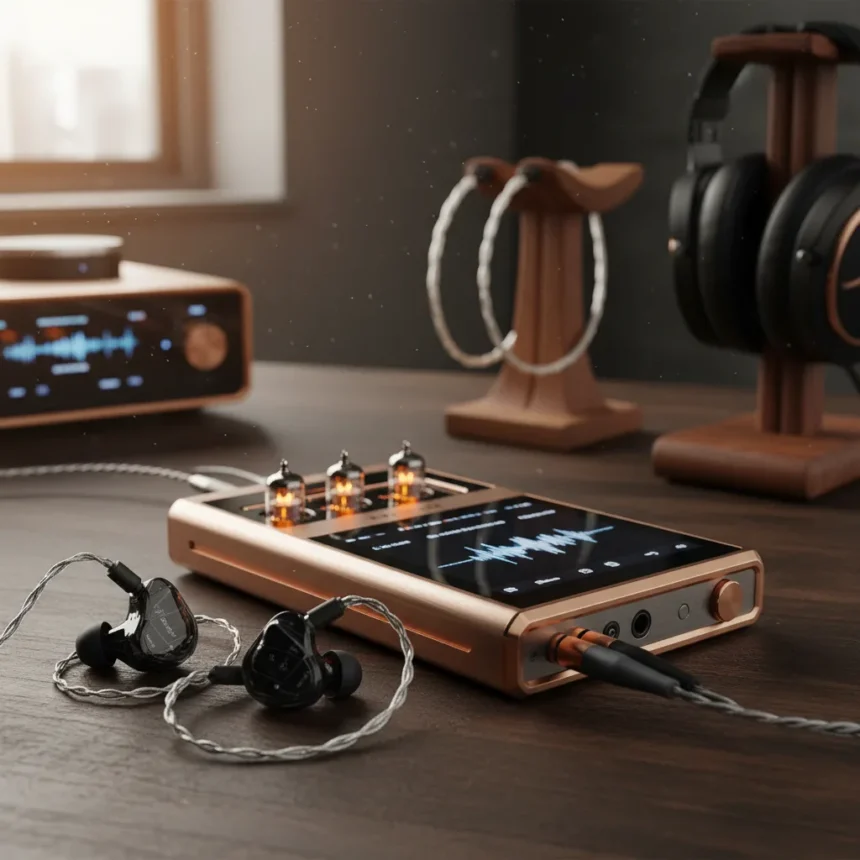
The Astell&Kern SP4000T is a premium digital audio player made by Astell&Kern, featuring built-in quad vacuum tubes designed for serious audiophiles seeking analog warmth in a portable device. This marks an unusual engineering choice for a modern DAP—tube amplification is uncommon in pocket-sized players and signals Astell&Kern’s commitment to a high-end, ecosystem-focused product strategy.
Key Takeaways
- The SP4000T integrates quad vacuum tubes directly into a portable digital audio player.
- Astell&Kern pairs the SP4000T with new Clarus in-ear monitors featuring a Tribrid 9-driver configuration.
- The product targets audiophiles willing to pay premium prices for matched source-and-earphone ecosystems.
- Vacuum tube amplification in portable audio is a rare design choice that emphasizes sonic character over compact efficiency.
- The Tribrid driver configuration suggests a hybrid approach combining different driver types in a single IEM.
What Makes the Astell&Kern SP4000T Stand Out
The Astell&Kern SP4000T distinguishes itself through its quad vacuum tube amplification stage, an architectural choice that sets it apart from conventional solid-state DAPs. Tube amps are prized in hi-fi circles for their perceived warmth and harmonic coloration—qualities that appeal to listeners who value analog character over clinical accuracy. By embedding this technology in a portable form factor, Astell&Kern is betting that premium users will accept a larger, heavier device in exchange for sonic signature they cannot get elsewhere.
This design philosophy reflects a broader trend in luxury audio: building matched ecosystems where source and headphones are engineered together. Rather than selling standalone products, high-end manufacturers increasingly view DAPs and IEMs as complementary components. The SP4000T’s pairing with the new Clarus IEMs reinforces this strategy. Astell&Kern is not simply releasing two products—it is creating a coordinated platform where the tube character of the player is meant to synergize with the driver architecture of the earphones.
The Clarus Tribrid 9-Driver IEMs: Complexity Meets Practicality
The Clarus in-ear monitors employ a Tribrid 9-driver configuration, a design choice that warrants explanation. Tribrid typically means the IEM uses three different driver technologies—often a combination of dynamic drivers for bass, balanced armatures for midrange, and piezoelectric or other technologies for treble. Nine drivers total suggests multiple units per technology type, creating a complex crossover network designed to handle different frequency ranges with specialized components.


This level of driver count is rare in consumer IEMs and reflects the same philosophy as the SP4000T: complexity justified by perceived sonic benefit. More drivers do not automatically mean better sound—crossover tuning, phase alignment, and driver quality matter enormously. However, the Tribrid approach offers flexibility in frequency response shaping that simpler single-driver or dual-driver designs cannot match. For users pairing the Clarus with the SP4000T, the nine-driver architecture may be engineered specifically to complement the tube player’s harmonic signature.
Positioning Against the Portable Audio Landscape
The SP4000T and Clarus arrive in a market where portable audio has become increasingly fragmented. Traditional dedicated DAPs compete against smartphone-based solutions, wireless earbuds, and ultra-portable all-in-one devices. Astell&Kern’s previous flagship, the SP4000, established itself as a reference-grade portable player for users who prioritize sound quality above all else. The SP4000T appears to build on that legacy while introducing tube amplification as a differentiator.



What separates these products from mainstream offerings is not just price—though premium audio typically commands premium prices—but philosophy. Smartphones optimize for battery life, processing power, and connectivity. Dedicated DAPs like the SP4000T optimize for audio fidelity, accepting trade-offs in portability and feature breadth. The Clarus IEMs similarly reject the wireless-first, convenience-focused design language of consumer earbuds in favor of wired connection and complex driver engineering.
The Vacuum Tube Choice: Why It Matters to Audiophiles
Vacuum tubes generate heat, require more power than transistors, and degrade over time. Why would Astell&Kern choose this technology for a portable device? The answer lies in the sonic qualities tubes impart. Tubes naturally compress peaks, add harmonic distortion that many listeners perceive as pleasing, and create a sense of spaciousness in the soundstage. These characteristics are subjective—some listeners prefer the transparency of solid-state amplification—but they are highly valued in the analog audio world.
By integrating quad tubes into the SP4000T, Astell&Kern is making a statement: this device prioritizes tone and character over neutrality. The tube stage sits between the digital-to-analog converter and the output, meaning every song played through the player passes through the tube amp. This is fundamentally different from a tube preamp in a home system, where you can switch tubes on or off. In the SP4000T, the tubes are integral to the signal path, suggesting Astell&Kern engineered the entire DAP around their presence.
Ecosystem Strategy: A Lesson From Apple and Sony
Astell&Kern’s decision to launch the SP4000T alongside the Clarus IEMs mirrors a strategy perfected by consumer electronics giants. Apple bundles AirPods with iPhones; Sony designs WF-1000XM earbuds optimized for Walkman players and smartphones. By creating a matched pair, Astell&Kern reduces the risk that users will pair the SP4000T with incompatible earphones that do not take full advantage of its capabilities.



This ecosystem approach also protects pricing power. A user who invests in the SP4000T becomes a natural customer for the Clarus IEMs. Conversely, someone who buys the Clarus is incentivized to upgrade their DAP to fully experience the IEMs’ potential. Neither product exists in isolation—each justifies the other.
Is the Astell&Kern SP4000T Worth the Premium?
For casual listeners, the answer is almost certainly no. Smartphone DACs and wireless earbuds deliver acceptable sound quality at a fraction of the cost. But for audiophiles—users who spend hours comparing cable geometries, tube types, and driver configurations—the SP4000T and Clarus represent the kind of equipment that justifies obsessive listening. These are products for people who view audio gear as an instrument, not a utility.
The real question is whether quad tube amplification in a portable DAP delivers sonic benefits that justify the engineering complexity and cost. Without access to hands-on testing data, that verdict rests with reviewers and users who have heard the device. What is clear is that Astell&Kern is betting heavily on the answer being yes.
Will the SP4000T Replace the SP4000?
The original SP4000 established itself as a reference-grade portable DAP. The SP4000T appears to be a variant or successor, but the research brief does not clarify whether it replaces the SP4000 entirely or coexists as a distinct product line. The tube amplification suggests a different sonic target, which may appeal to different listener preferences.
What is a Tribrid IEM driver configuration?
A Tribrid IEM uses three different types of drivers—typically dynamic drivers for bass, balanced armatures for midrange, and piezoelectric or other specialized drivers for treble. The Clarus employs nine drivers total across these categories, allowing fine-tuned frequency response and reduced distortion compared to simpler single-driver designs.
How do vacuum tubes affect sound in a portable DAP?
Vacuum tubes add harmonic coloration, compress peaks naturally, and create a sense of spatial width that many audiophiles perceive as pleasing. In the SP4000T, the quad tube stage sits in the signal path, meaning every audio signal passes through the tubes before reaching the earphones, making tube character integral to the device’s sound signature.
The Astell&Kern SP4000T and Clarus represent a bold bet on complexity and sonic character in an era when convenience dominates consumer electronics. For the niche audience that values these qualities, the products answer a real need—but they are uncompromising devices built for listeners who measure success in listening hours, not market share.
Edited by the All Things Geek team.
Source: TechRadar