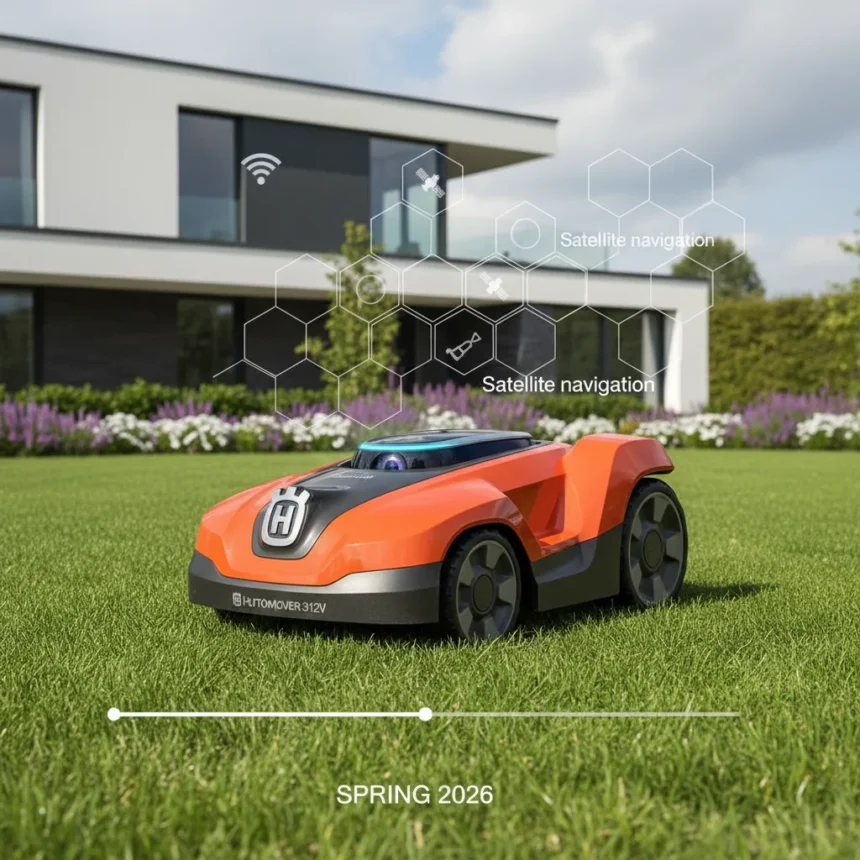
The Husqvarna Automower 312V is a wire-free robotic lawn mower using AI vision technology and satellite navigation (EPOS), designed for lawns up to 1200 m² in systematic mowing mode or 800 m² in carpet-finish irregular mode. Launched March 2, 2026, it strips away the boundary wire requirement that has defined Husqvarna’s entry-level segment for years, replacing it with smartphone control and cloud-based coverage mapping. At £1,499 in the UK and €1,699 in Europe, it sits between Husqvarna’s budget 308V (£1,249) and the pricier Aspire R6V (£999, confusingly cheaper despite fewer features).
Key Takeaways
- AI camera detects and avoids obstacles; satellite navigation delivers cm-level accuracy without boundary wire installation.
- Cutting width 22 cm, height adjustable 20-50 mm, 3 revolving blades, double-cutting direction for neat finish.
- 100-minute battery life per charge; 63 dB(A) noise level; IPX6 water protection for wet grass operation.
- Requires Wi-Fi coverage across the entire lawn or optional cellular accessory (EPOS RS1 kit) for full autonomous coverage.
- Spring 2026 availability; no subscription fees for cloud mapping, but app-dependent control limits offline functionality.
Smart Mowing Without the Boundary Wire
Husqvarna’s decision to ditch the boundary wire is the headline here. The Automower 312V uses AI vision combined with EPOS satellite positioning to map your lawn and navigate autonomously, eliminating the weekend chore of burying a perimeter cable. This is genuinely convenient for renters, garden redesigners, and anyone who values setup simplicity. The AI camera identifies obstacles—garden furniture, toys, parked bikes—and steers around them, while the satellite system pins its location to within 5 cm accuracy. For lawns with weak cellular signals, Husqvarna’s cloud system can still guide the mower if grass remains visible, a practical hedge against dead zones.
The catch is Wi-Fi dependency. To unlock full autonomous coverage, your garden must have Wi-Fi reach across the entire mowing area, or you need to add the optional Automower Connect kit or EPOS RS1 cellular module. Without either, you are tethered to manual app commands or Bluetooth range. For suburban gardens with solid home Wi-Fi coverage, this is fine. For sprawling rural properties or signal-dead zones, the accessory becomes mandatory—and Husqvarna does not disclose its cost in the available materials.
Cutting Performance and Physical Design
On the mowing side, the Automower 312V delivers what Husqvarna promises: reliable, quiet grass cutting. The three revolving razor blades cut at a 22 cm width, with manual height adjustment from 20 to 50 mm. Double-cutting direction (the blades reverse mid-stroke) produces a neater finish than single-direction systems, reducing the striped, directional look that budget mowers often leave behind. You can choose your cutting pattern via the Automower Connect app—striped, checkerboard, or triangle for systematic coverage up to 1,200 m², or irregular for a carpet-like finish on smaller lawns.


At 59 cm long, 45 cm wide, and 25 cm tall, weighing just 9.9 kg, the unit is compact enough to store in a garden shed or garage without claiming half the space. Noise runs at 63 dB(A), roughly equivalent to a quiet conversation—low enough that early-morning or evening mowing won’t provoke neighbors. The IPX6 water rating means it handles damp grass and light rain, though Husqvarna’s weather timer pauses mowing during frost to protect the lawn.
Battery, Charging, and Monthly Running Costs
The 4 Ah lithium-ion battery charges fully in 100 minutes and delivers 100 minutes of cutting time per charge, which sounds circular but reflects real-world use: the mower handles medium lawns in a single session, then returns to its dock. Over a full 15-hour active window (including charging cycles), the unit consumes roughly 7 kWh monthly at maximum usage—negligible for most households. Automatic docking means no manual intervention; the mower finds its charging base via satellite and camera guidance.



Automower 312V vs. Husqvarna’s Own Lineup
The 308V undercuts the 312V by £250 but maxes out at 800 m², making it suitable only for smaller gardens. The Aspire R6V, confusingly priced at just £999, covers only 600 m² and lacks the same cutting height range (20-50 mm vs. a narrower band). All three share the AI vision and wire-free architecture, but the 312V’s 1200 m² ceiling and dual mowing patterns position it as the sweet spot for medium-to-large suburban properties. Roborock’s robot mowers offer alternative AI-driven options in the US market, though Husqvarna’s satellite integration and app-based stay-out zones give it an edge in precision navigation.
The Wi-Fi Dependency Question
Here is where the Automower 312V stumbles slightly. Unlike traditional boundary-wire mowers that operate offline, this system leans heavily on cloud connectivity and app control. If your home Wi-Fi does not blanket your entire garden, or if you prefer to set it and forget it without smartphone involvement, the optional EPOS RS1 cellular module becomes necessary. Husqvarna’s decision to make this an add-on rather than bundling it reflects cost-cutting, but it also fragments the user experience—some buyers will pay full price only to discover they need another accessory.
Should You Buy the Husqvarna Automower 312V?
If you own a medium-to-large garden (800-1200 m²), hate burying boundary wire, and have solid home Wi-Fi coverage, the Automower 312V is a thoughtful upgrade over traditional electric mowers. The AI vision and satellite navigation genuinely simplify setup, and the quiet, precise cutting justifies the £1,499 price tag for a hands-off solution. The spring 2026 launch means early adopters will be guinea pigs, but Husqvarna’s track record with robotic mowers is solid. If your garden is smaller, the 308V saves money. If you lack Wi-Fi reach, budget for the cellular accessory or stick with a traditional boundary-wire system.
Does the Automower 312V require Wi-Fi to operate?
Full autonomous coverage requires Wi-Fi across your entire lawn or an optional cellular module (EPOS RS1 kit). Without either, you can control it via Bluetooth app commands, but the mower cannot roam freely across the entire garden. Husqvarna’s cloud system can guide it in weak-signal areas if grass is visible, but this is not a substitute for continuous connectivity.



What is the cutting height range on the Automower 312V?
The cutting height adjusts manually from 20 to 50 mm, giving you flexibility for different grass types and seasonal growth. The 22 cm cutting width and three revolving blades with double-cutting direction produce a neat finish without the striped appearance of single-direction mowers.
When is the Husqvarna Automower 312V available?
The Automower 312V launches March 2, 2026, with general spring 2026 availability across markets. UK pricing is £1,499; European pricing is €1,699. Early-order availability may vary by retailer.
The Husqvarna Automower 312V represents a genuine step forward for entry-level robotic mowing—no wires, smart navigation, quiet operation, and app control appeal to modern gardeners. But it is not a magic bullet. Wi-Fi dependency and the need for optional accessories for full functionality temper the convenience story. If you fit the use case (medium garden, solid Wi-Fi, no boundary-wire aversion), it delivers. If you do not, Husqvarna’s traditional wire-based models or competitors like Roborock remain viable alternatives.
Where to Buy
40 Amazon customer reviews | £199.99
Edited by the All Things Geek team.
Source: T3