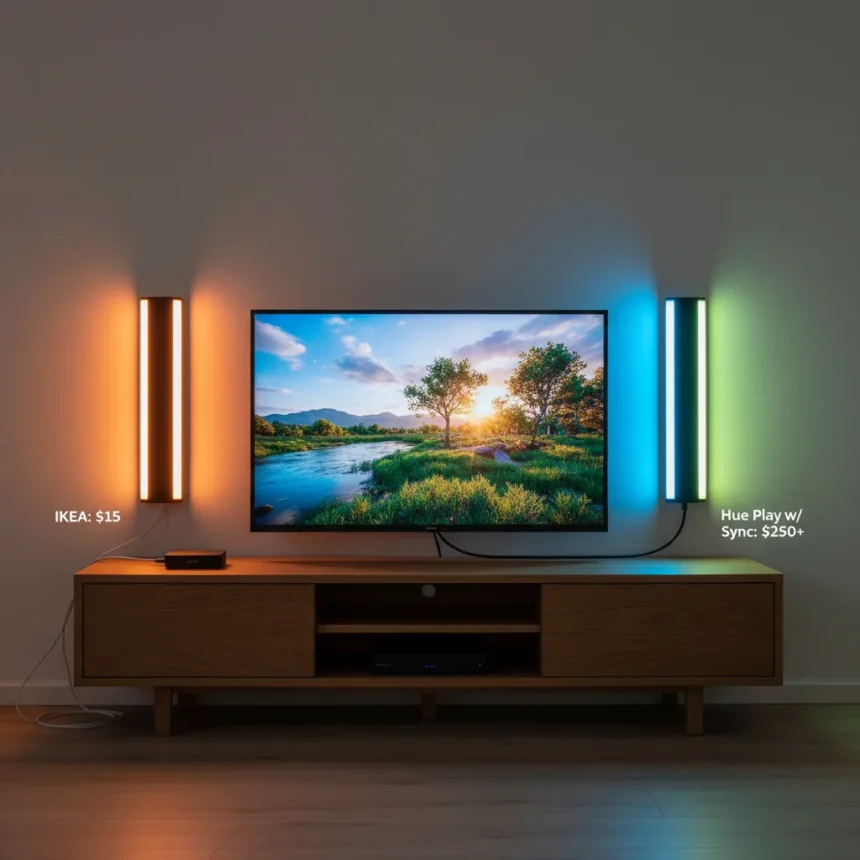
IKEA’s new Hue Play lookalike proves that great design doesn’t always translate to great functionality. The budget-friendly smart light mimics the sleek aesthetic of Philips Hue Play Light Bar but strips away the feature that justifies the premium price: immersive home theater syncing.
Key Takeaways
- IKEA’s Hue Play lookalike costs roughly the price of a cup of coffee, making it an ultra-affordable entry point to smart lighting.
- The product lacks HDMI Sync Box compatibility, preventing accurate color-matching with TV content for immersive home theater experiences.
- Philips Hue Play Light Bar remains the premium benchmark with true immersion tech, though Govee and Nanoleaf offer cheaper alternatives.
- IKEA’s TRADFRI ecosystem offers limited color control compared to competitors, relying on basic app-only management.
- Budget-conscious buyers should weigh design appeal against functional trade-offs when choosing between IKEA and rival smart lighting solutions.
Why IKEA’s Hue Play Lookalike Falls Short for Home Theater
The core problem with IKEA’s Hue Play lookalike is architectural. Philips Hue Play Light Bar achieves its immersive effect through an HDMI Sync Box—a device that sits between your TV and media source, interprets the video signal in real-time, and translates it into synchronized color changes on the light bar. This creates the Ambilight effect: your walls glow with colors pulled directly from what’s on screen, enhancing cinematic immersion without relying on an unreliable camera pointed at the display.
IKEA’s Hue Play lookalike has no such capability. It’s a dumb light bar that responds to app commands and basic automation routines through the IKEA Home Smart app, but it cannot sync to your TV’s content. For movie nights, gaming sessions, or streaming, you get static lighting or manual color changes—not the dynamic, responsive experience that makes premium light bars compelling. That’s the drawback that matters.
How Competitors Stack Up Against IKEA’s Hue Play Lookalike
Philips Hue Play Light Bar sits at the top of the Ambilight alternative market, offering flexible positioning (horizontal or vertical behind TVs), accurate color reproduction via HDMI sync, and seamless integration with Google Home, Alexa, and Apple HomeKit. It’s expensive, but the immersion justifies the cost for serious home theater enthusiasts.


Govee’s Flow Pro light bars cost significantly less than Hue Play—around £15 to £52 depending on kit size—and deliver impressive light output with app-based scenes, automation, and voice control compatibility. However, Govee’s camera-based TV syncing is less accurate and smooth than Hue’s HDMI approach, creating noticeable color shifts and delays. Still, for casual home theater use, Govee bridges the gap between IKEA’s affordability and Hue’s premium immersion.
Nanoleaf 4D takes a middle path: it uses camera-based color detection like Govee but costs less than Philips Hue Play and requires no separate HDMI box. The trade-off is identical to Govee’s—less precise color matching—but the flexibility appeals to buyers who want some level of immersion without Hue’s price tag or Philips’ ecosystem lock-in.


IKEA’s Hue Play Lookalike in the TRADFRI Ecosystem
IKEA’s Hue Play lookalike is part of the TRADFRI smart lighting line, which emphasizes affordability over features. The related TRADFRI LED Bulb E27, priced around £15, offers dimmable white-tone control and frosted glass design but zero color range. It’s a direct aesthetic copy of Philips Hue Ellipse, minus the color capability.
This pattern repeats with the Hue Play lookalike. IKEA nails the industrial design—the horizontal bar form factor looks identical to Philips’ product—but the internals are stripped to the bone. You get basic RGB color control through the IKEA Home Smart app, nothing more. No HDMI sync, no gradient strips, no ecosystem depth. For buyers who care only about ambient room lighting or accent colors, that’s acceptable. For anyone expecting home theater immersion, it’s a letdown.
Should You Buy IKEA’s Hue Play Lookalike?
If your budget is measured in single-digit pounds or euros, IKEA’s Hue Play lookalike is worth considering. It delivers recognizable design at coffee-cup pricing, and basic color control is genuinely useful for setting room mood or accent lighting during parties. The TRADFRI app is straightforward, and the light bar integrates with broader smart home routines if you already own IKEA devices.
But if you’re shopping for a light bar to enhance your TV experience, skip it. The lack of HDMI sync is not a minor limitation—it’s the entire point of buying a light bar in the first place. Spend the extra money on Govee Flow Pro if you want budget-friendly Ambilight-style effects, or save longer for Philips Hue Play if you demand accuracy. IKEA’s Hue Play lookalike is a design statement, not a home theater solution.



Is IKEA’s Hue Play lookalike compatible with smart home ecosystems?
IKEA’s Hue Play lookalike works within the TRADFRI ecosystem and integrates with the IKEA Home Smart app for control and automation. However, it lacks the broad ecosystem support of Philips Hue Play, which works with Google Home, Alexa, and Apple HomeKit. Check IKEA’s current compatibility list before purchasing if you rely on third-party voice assistants.
Can you use IKEA’s Hue Play lookalike for TV syncing with a camera?
No. IKEA’s Hue Play lookalike has no camera and no TV syncing capability—neither HDMI-based nor camera-based. It responds only to app commands and automation schedules. If camera-based TV syncing interests you, Govee Flow Pro or Nanoleaf 4D are your budget alternatives.
How does IKEA’s Hue Play lookalike compare to Govee in terms of immersion?
IKEA’s Hue Play lookalike offers no immersion features at all, while Govee Flow Pro provides camera-based TV color syncing that mimics Ambilight—though less accurately than Philips Hue Play. Govee’s syncing is imperfect and app loading can be sluggish, but it’s a real immersion feature. IKEA’s product is purely static or manually controlled lighting.
IKEA’s Hue Play lookalike is proof that budget pricing and premium design can coexist without premium functionality. It looks the part but plays a different game entirely. For coffee-cup money, you get a stylish light bar that handles basic color control and room ambience. That’s genuinely valuable for casual users. But anyone expecting immersive home theater effects should invest elsewhere—Govee, Nanoleaf, or Philips Hue Play all deliver what IKEA’s lookalike cannot.
Where to Buy
Philips Hue Play White and Colour | WiZ Gradient Light Bars
Edited by the All Things Geek team.
Source: TechRadar