





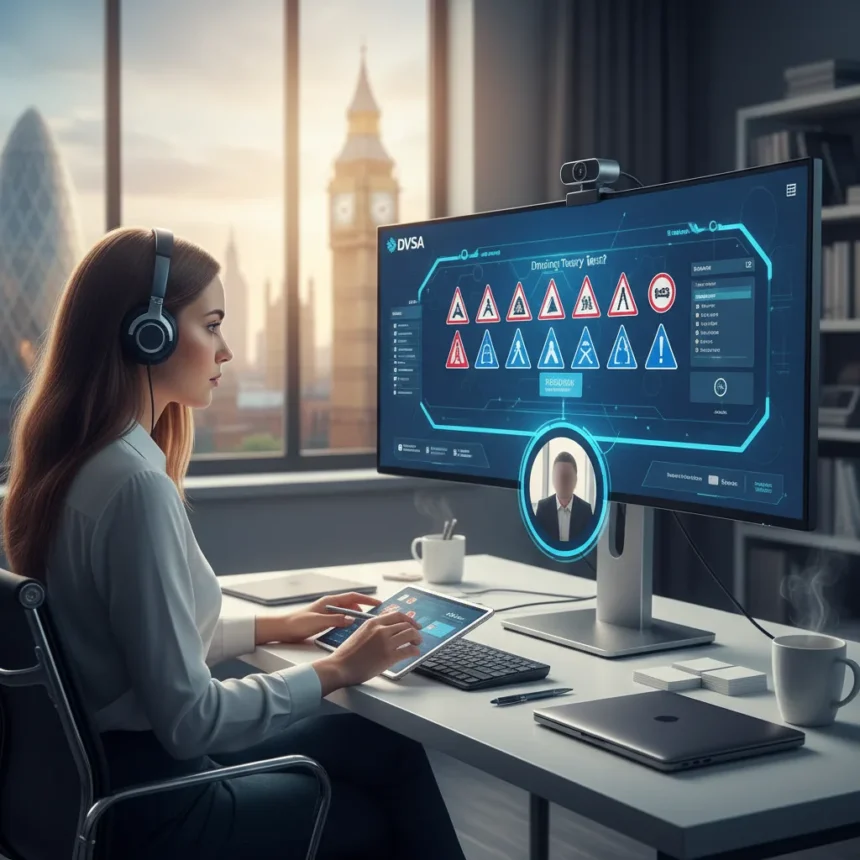
Remote driver theory testing has been under exploration by the DVSA (Driver and Vehicle Standards Agency) for almost five years as a potential solution to the enormous backlog of learner driver exams. The question driving this initiative is straightforward: can the driver’s theory test be successfully delivered in people’s homes? The answer could reshape how millions of UK learners access one of the most critical hurdles to getting on the road.
Key Takeaways
- DVSA has explored remote driver theory testing for nearly 5 years to address post-COVID demand and backlogs.
- Current UK theory test volume stands at 1.6 million annually, with the new service handling 3 million tests yearly.
- Remote testing could eliminate 3.4 million journeys and reduce operating costs significantly.
- 19% of test takers require accessibility support, a key driver for remote delivery options.
- Fraud protection and technical security remain unresolved challenges before full rollout.
Why Remote Driver Theory Testing Matters Now
The UK’s driving test system faces an unprecedented crisis. Post-COVID demand has created a backlog so severe that DVSA now facilitates 3 million tests annually—nearly double the historical 1.6 million baseline. Learners wait weeks for appointments. Test centres operate at maximum capacity. Remote driver theory testing represents the most ambitious attempt yet to decouple exams from physical infrastructure and unlock capacity without building new facilities.
DVSA’s exploration of remote delivery addresses a genuine accessibility gap. Currently, 19% of test takers require extra support—a cohort that often struggles with travel logistics, cost, and stress associated with centre-based exams. Home-based testing eliminates these barriers entirely. A learner with mobility challenges, transport anxiety, or caregiving responsibilities could sit their theory test on their own terms. This is not a minor convenience—it is a structural equity issue.
The Current Digital Transformation and Its Results
Before remote delivery can work, DVSA had to modernise its underlying infrastructure. The agency spent years trapped with a 19-year-old outsourced legacy system that could not scale. In 2023, DVSA brought the service in-house through a partnership with Kainos, disaggregating the old monolithic system and deploying a multi-supplier test centre model. The results have been dramatic: up to 15,000 bookings per day—more than double the previous record.


This modernisation already delivers tangible wins. The new system has achieved 96% customer satisfaction and enabled a 129% increase in tests with accessibility adjustments. Over five years, the digital overhaul is projected to save £50 million. These figures matter because they prove DVSA can execute large-scale digital change. Remote driver theory testing builds on proven capability, not untested ambition.
Parallel work on practical driving tests reinforces this momentum. CGI digitised practical tests by replacing paper with tablet-based cloud systems deployed across 1,900+ examiners. This shift improved accuracy, accelerated data processing, and tightened GDPR compliance. The lesson is clear: DVSA can modernise critical infrastructure when given the right partner and mandate.



The Security and Fraud Challenge
Why hasn’t remote driver theory testing already launched? Fraud. DVSA maintains strict test centre requirements specifically because of identity verification and cheating risks. A learner sitting at home could hand the keyboard to someone else. Proctoring software can be circumvented. High-stakes tests demand absolute confidence in the candidate’s identity and the test’s integrity.
The research brief notes that DVSA’s exploration addresses technical feasibility, secure services for risk and fraud protection, and operational implications. Translation: the agency knows what it wants to build but has not yet solved how to prevent cheating at scale. This is not a minor engineering problem. It is the crux of whether remote driver theory testing can ever work in the real world.
Remote testing platforms exist elsewhere—MVProctor offers remote proctoring for DMV written tests in the US, using biometric verification and ID checks. But US driving tests carry lower stakes and different fraud incentives than UK theory exams. DVSA cannot simply copy a US model; it must build something that satisfies both accessibility and security in the UK context.
What Remote Driver Theory Testing Could Unlock
If DVSA solves the fraud problem, the benefits ripple outward. Eliminating 3.4 million journeys to test centres would reduce carbon emissions, ease traffic congestion, and lower operating costs. Learners in rural areas would gain genuine parity with urban candidates. The agency could scale testing dynamically—ramping capacity during peak demand without physical constraints.



The broader implication is that DVSA could build the world’s largest online assessment platform, as Kainos describes it. This infrastructure could eventually support continuous learning, adaptive testing, and integration with electric and autonomous vehicle training—technologies that will reshape driving in the next decade.
Is remote driver theory testing launching soon?
No confirmed launch date exists. DVSA is still in the exploration phase, working through fraud prevention, technical architecture, and operational readiness. The agency has been researching this for five years, which suggests the problem is harder than it first appears. Expect years more of development before any pilot.
How does remote driver theory testing compare to current test centres?
Current test centres are reliable but inflexible. Learners must travel, book weeks in advance, and sit exams on a fixed schedule. Remote driver theory testing would offer flexibility and accessibility but introduces fraud risks that test centres naturally prevent through physical presence. The trade-off is real: convenience versus certainty.
Could other countries adopt DVSA’s remote testing model?
Potentially, but each jurisdiction faces its own fraud and regulatory landscape. The US has MVProctor, which uses biometric verification for DMV tests. Other nations may build similar systems, but DVSA’s solution will be tailored to UK law, identity verification systems (like DVLA records), and learner behaviour. Export value is limited unless DVSA’s fraud-prevention architecture proves transferable.
Remote driver theory testing remains a promise, not a reality. DVSA has spent five years exploring it because the challenge is genuine: delivering secure, accessible exams at scale without the safeguards that physical test centres provide. The agency’s recent success modernising the existing system proves it can execute. Whether it can solve the fraud riddle is the question that will determine whether millions of UK learners ever sit their theory tests at home.
Edited by the All Things Geek team.
Source: TechRadar




