





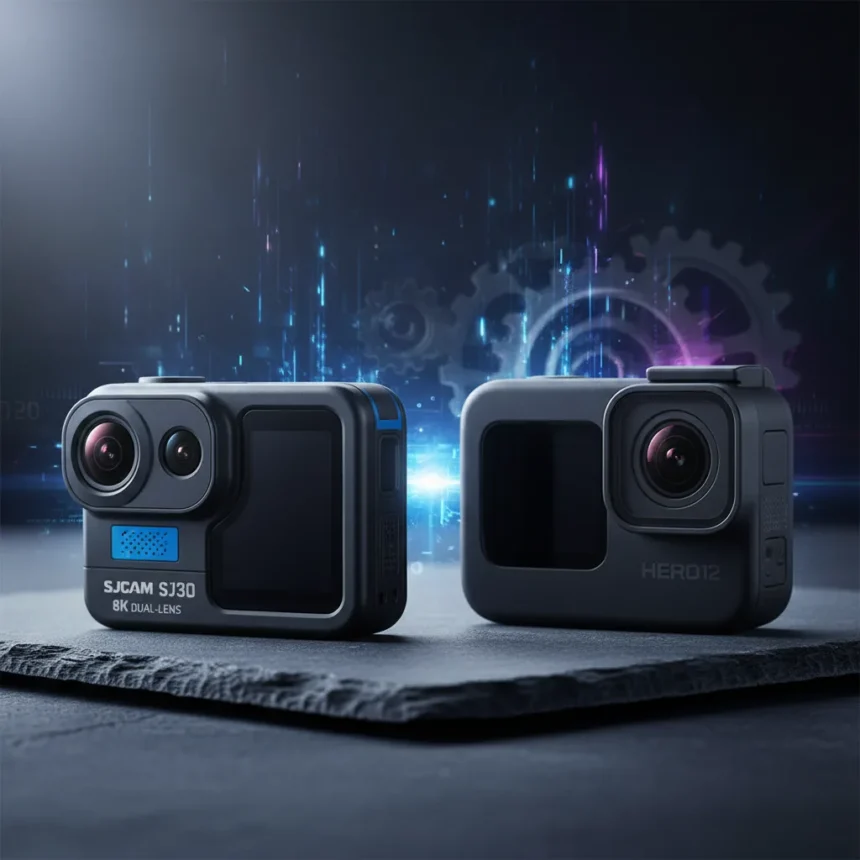
The SJCAM SJ30 8K action camera is a dual-lens flagship model from a brand most casual creators have never heard of, and it is positioning itself to do what GoPro and DJI have largely ignored: deliver true 8K capture at a price that does not require a second mortgage. On paper, the specs are seductive. In practice, the promise of 8K at 20 frames per second on budget hardware raises immediate red flags.
Key Takeaways
- Dual 8K/4K lens system auto-switches between daylight (1/2.0-inch) and low-light (1/1.8-inch F1.8) sensors
- SteadyMotion 2.0 stabilization includes six-axis gyroscopic EIS and automatic 45-degree horizon correction
- Low-light performance is genuinely strong—users report usable footage in darkness where competitors produce noise
- 8K at 20fps and 48MP specs may be overstated; real-world verification beyond SJCAM marketing is essential
- 2000mAh battery claims 7 hours; expandable power handle extends runtime to 6+ hours intermittent shooting
Dual-Lens Design Targets the Real Problem GoPro Ignores
Action cameras have a darkness problem. Shoot a GoPro or DJI Osmo in dim light—a forest canopy, a night ride, wildlife at dusk—and you get muddy, noise-choked footage. The SJCAM SJ30 addresses this with a genuinely clever dual-lens architecture. The primary sensor is a 1/2.0-inch daylight lens optimized for true-to-life color in bright conditions. The secondary is a 1/1.8-inch starlight night sensor with an F1.8 aperture that pulls in 2.4 times more light than a standard action camera, automatically switching between lenses based on ambient light. This is not a gimmick. A motorcycle vlogger reported that night riding footage went from unusable to genuinely usable, capturing street lights and dark roads with detail never seen from an action cam. A wildlife reviewer noted that low-light performance is better than expected, often eliminating the need for artificial lighting. These are not SJCAM marketing claims—they are user experiences from real-world testing.
The Stabilization Story: Gimbal Claims Need Verification
The SJCAM SJ30 ships with SteadyMotion 2.0, a six-axis gyroscopic electronic image stabilization system that suppresses high-frequency vibrations during cycling, skiing, and other jittery activities. The headline feature is automatic 45-degree horizon leveling and correction, which SJCAM markets as gimbal-like footage. Here is where skepticism is warranted. Gimbal-level smoothness requires either mechanical stabilization or computational processing powerful enough to track and correct motion in real-time at high resolution. A budget action camera achieving true gimbal parity is improbable. The system works well at 4K and 1080p, but applying six-axis EIS to 8K video is computationally demanding. Real-world testing at 8K resolution would clarify whether the processor can sustain this without dropping frames or introducing artifacts.
The 8K Spec That Sounds Too Good to Be True
The SJCAM SJ30 records 8K at 20 frames per second, 4K at 60 or 30 frames per second, and 1080p at up to 240 frames per second. The 8K spec is real—but context matters. Twenty frames per second is the absolute minimum threshold for smooth motion. Most cinema and broadcast 8K work at 24fps or higher. At 20fps, fast-moving subjects in low light will show motion blur. The camera is designed for cropping and detail extraction from 8K footage, not for delivering broadcast-ready 8K motion capture. This is a legitimate use case—wildlife documentarians and travel creators who want to zoom into 8K footage in post-production benefit enormously. But marketing 8K at 20fps without emphasizing the frame-rate limitation invites buyer disappointment. Pair this with the challenge of applying gimbal-level stabilization at 8K, and the processing burden becomes clearer. SJCAM has not published independent benchmarks proving that 8K/20fps stabilization works without quality loss.


Battery Life: Promise Versus Intermittent Reality
SJCAM claims 7 hours of battery life from the built-in 2000mAh cell. A travel creator reported shooting intermittently for six hours on the optional 4200mAh power handle with battery remaining, which is genuinely competitive—no other action camera tested came close. The distinction between continuous and intermittent shooting is crucial. Seven hours of continuous 8K recording is unlikely. Seven hours of intermittent shooting (record 30 seconds, pause, record again) is plausible and practical for vlogging and wildlife work. The expandable power handle solves the runtime problem for extended trips, but buyers expecting all-day 8K capture from the base unit will be disappointed.
Low-Light Performance Is the Real Differentiator
If the SJCAM SJ30 has a genuine competitive advantage, it is low-light capture. GoPro and DJI optimize for bright outdoor sports. The SJ30’s dual-lens design and F1.8 starlight aperture shift the target use case to everyday creators, wildlife photographers, and night riders—segments largely underserved by existing action cameras. The autofocus performs reliably in dim light, and the silent operation makes it ideal for sneaking up on wildlife without mechanical shutter noise. These are real strengths, not marketing theater. However, low-light superiority does not excuse overstated specs in other areas.



Comparing to the SJ20: A Genuine Upgrade or Marketing Refresh?
The SJCAM SJ30 succeeds the SJ20, released in 2024. The upgrade path is clear: 8K at 20fps versus 4K on the predecessor, improved noise suppression and shadow detail, enhanced EIS with horizon correction, and higher resolution support. The SJ20 remains the better choice for budget-conscious creators shooting 4K. The SJ30 targets those willing to pay for 8K capture and low-light performance. This is not a revolutionary generational leap—it is a focused refinement of SJCAM’s low-light and stabilization strategy.
Why the Specs Ring Alarm Bells
A budget action camera shipping with 8K, dual lenses, gimbal-like stabilization, and 48MP photos is suspicious by design. Consumer electronics at aggressive price points often make spec claims that collapse under real-world scrutiny. The 8K at 20fps limitation, the unverified gimbal stabilization at 8K resolution, and the battery claims all require independent testing beyond SJCAM’s own marketing videos. The low-light performance appears genuine based on user reports, but buyers should not assume every spec performs as advertised. Extreme skepticism is warranted until third-party reviewers stress-test the camera at 8K with stabilization enabled.
Is the SJCAM SJ30 worth buying over GoPro or DJI?
If you shoot primarily in low light and value 8K detail extraction over smooth motion, the SJCAM SJ30 offers capabilities GoPro and DJI largely ignore. If you need gimbal-level stabilization for fast action, the SJ30 is unproven. GoPro and DJI have established ecosystems and warranty support; SJCAM is a riskier bet. The SJ30 makes sense for wildlife creators, night riders, and travel vloggers willing to trade brand recognition for specialized low-light performance.
Does the SJCAM SJ30 really shoot gimbal-quality video?
SJCAM markets gimbal-like footage through its SteadyMotion 2.0 system, but independent verification at 8K resolution is lacking. The stabilization works well at 4K and 1080p. Whether it maintains that smoothness while processing 8K at 20fps remains unclear without third-party testing.



How does the SJ30 compare to the GoPro Hero 13?
GoPro focuses on bright-light sports performance and ecosystem integration. The SJCAM SJ30 prioritizes low-light capture and 8K detail. GoPro offers proven reliability and support; the SJ30 offers specialized low-light strength at lower cost. Choose based on your primary shooting environment.
The SJCAM SJ30 is a calculated bet on an underserved segment: everyday creators and wildlife shooters who need low-light performance more than brand prestige. The dual-lens architecture and low-light results are genuinely impressive. But 8K at 20fps, gimbal-level stabilization claims, and budget pricing together suggest some specs may not survive real-world scrutiny. Wait for independent reviews before committing—or buy cautiously if low-light performance is your primary need.
Edited by the All Things Geek team.
Source: TechRadar




