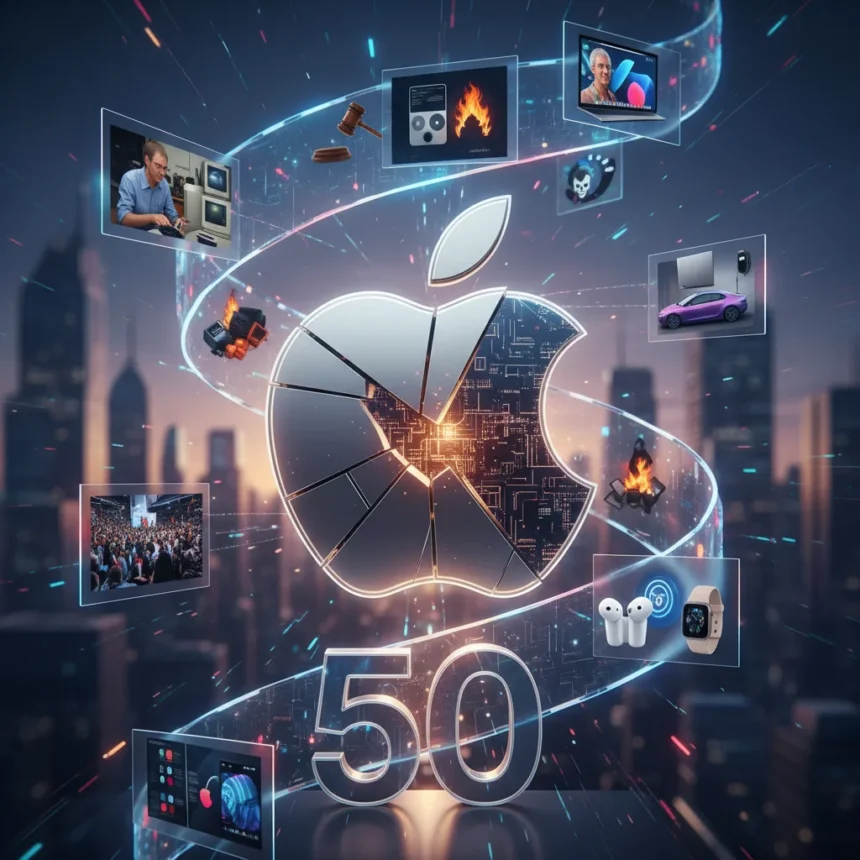
Apple’s 50th anniversary arrives April 1, 2026, marking half a century since Steve Jobs, Steve Wozniak, and Ronald Wayne founded the company in a California garage on that same date in 1976. The milestone prompts a harder question than most anniversary celebrations dare ask: how much do we actually remember about the moments that shaped one of the world’s most valuable companies?
Key Takeaways
- Apple was founded April 1, 1976, by Jobs, Wozniak, and Wayne in a California garage
- The Apple-1 computer launched at $666, establishing personal computing as the company’s mission
- Ronald Wayne, the third founder, sold his stake for $800 and was written out of Apple’s official history
- The company dropped “Computer” from its name and launched the “Think Different” campaign under Steve Jobs’ return
- Global 50th anniversary celebrations begin March 13, 2026, featuring Alicia Keys at Apple Grand Central in New York
A quiz testing knowledge of Apple‘s controversial moments and tech innovations reveals a pattern: the company’s most audacious moves have become invisible. We remember the iPhone. We forget the third founder. We celebrate “thinking different” without recalling what that phrase originally challenged. The research brief above contains the verified facts—let’s examine what they tell us about Apple’s selective memory.
The Forgotten Founding and the $800 Decision
Apple’s official origin story centers on two visionaries: Jobs and Wozniak. But the company’s founding involved a third co-founder whose exit shaped the entire narrative of Apple’s future. Ronald Wayne sold his stake for $800 in 1976, a decision that would eventually cost him billions in unrealized equity. His removal from the company’s mythology is so complete that most people cannot name him without searching.
When Apple Computer Co. officially incorporated on January 3, 1977, only Jobs and Wozniak appeared as co-founders in the official record. This was not a footnote—it was a deliberate rewriting. The company’s founding story became a duology instead of a trinity, and that narrative choice shaped how Apple presented itself to the world. The exclusion raises an uncomfortable question about how corporations construct their own histories, choosing which founders to remember and which to erase.

The Apple-1 computer, priced at $666, was the product that launched this mythology. The price point itself became part of Apple lore, though the decision to price at that specific number has generated decades of speculation and myth-making. What matters more than the price is what it represented: a bet that personal computing should be accessible, personal, and designed around individual expression rather than corporate utility.
Think Different: Marketing a Philosophy
Under Steve Jobs’ return to the company, Apple underwent a radical transformation that went far beyond product design. The “Think Different” campaign and the removal of “Computer” from the company name signaled a shift in identity. Apple was no longer selling hardware. It was selling a worldview—one that positioned the company as the ally of creative rebels, artists, and people who rejected conformity.



Tim Cook, Apple’s current CEO, has framed this philosophy as the engine of Apple’s innovation: “Thinking different has always been at the heart of Apple. It’s what has driven us to create products that empower people to express themselves, to connect, and to create something wonderful”. The statement is aspirational, but it also reveals how completely Apple has internalized its own marketing. The company’s founding idea—that technology should be personal—became inseparable from the brand mythology that “Think Different” created.
What the quiz format exposes is how much of this history has become disconnected from the actual products and decisions that defined Apple. The company built a trillion-dollar valuation on the foundation of personal computing, but that foundation is now abstract. Younger users know Apple through services, ecosystems, and devices, not through the philosophical battles that Jobs fought against IBM and Microsoft.
The 50th Anniversary Moment and What It Reveals
Global celebrations begin March 13, 2026, with Alicia Keys performing at Apple Grand Central in New York, and the iPhone 17 Pro will be featured at the event. The choice of venue and performer signals Apple’s continued investment in cultural positioning—the company is not just celebrating 50 years of technology, but 50 years of cultural influence.
A quiz format for an anniversary is revealing in itself. Quizzes test memory, but they also expose forgetting. The quiz highlights controversial moments and tech innovations, suggesting that Apple’s history contains both celebrated breakthroughs and decisions the company would prefer to downplay. This is true of any 50-year-old corporation, but Apple’s mythology—built on the idea of thinking differently—makes the gaps between the narrative and the reality more jarring.



The company’s evolution from a garage startup to a trillion-dollar institution has required strategic forgetting. The third founder disappears. The early design controversies fade. The failed products get minimized. What remains is a polished narrative of visionary leadership and relentless innovation. A 50th anniversary quiz invites people to test whether they can see through that narrative, or whether they’ve internalized it so completely that the myth and the history have merged.
What Does the Quiz Actually Measure?
A trivia quiz about Apple’s history is not neutral. It measures what the company has successfully made memorable versus what it has allowed to fade. The quiz format itself—with its emphasis on specific dates, product names, and historical moments—privileges certain kinds of knowledge while rendering other aspects of Apple’s story invisible.
The book “Apple: The First 50 Years” offers one attempt to document this history comprehensively, though any official or semi-official history will reflect the company’s own perspective. A true test of knowledge would require understanding not just what Apple did, but what it chose not to do, what it abandoned, and what it rewrote. The quiz, by its nature, cannot capture that complexity.
What matters most about Apple’s 50th anniversary is not whether readers can pass a trivia test, but whether they understand the difference between Apple’s public narrative and its actual history. The company founded on the principle that technology should be personal has become so dominant that its products now shape how billions of people experience technology. That power is real, regardless of whether anyone remembers Ronald Wayne or the exact price of the Apple-1.
How many founders did Apple have at incorporation?
Apple Computer Co. officially incorporated on January 3, 1977, with Steve Jobs and Steve Wozniak listed as co-founders. Ronald Wayne, the third founder, had already sold his stake for $800 and departed the company by that date. The official record reflects only two founders, though the company was originally started by three people in a California garage in 1976.
What was the original price of the Apple-1 computer?
The Apple-1 computer was priced at $666 when it launched. This price point has become part of Apple folklore, though the specific reasoning behind the number choice has generated considerable speculation over decades. The price represented Apple’s vision of making personal computing accessible to individual users rather than just corporations.
When is Apple’s 50th anniversary and how is the company celebrating?
Apple’s 50th anniversary is April 1, 2026, marking exactly 50 years since the company’s founding on April 1, 1976. Global celebrations begin March 13, 2026, with a major event at Apple Grand Central in New York featuring a performance by Alicia Keys and the iPhone 17 Pro. The company has announced additional celebrations around the world throughout the anniversary period.
Apple’s 50th anniversary quiz serves a purpose beyond entertainment—it asks whether we truly understand the company that shaped modern technology, or whether we’ve simply accepted the mythology it constructed. The forgotten moments matter as much as the celebrated ones. The third founder’s absence from the official record tells us something about how power and narrative intertwine in corporate history. As Apple enters its next chapter, that gap between what the company says it is and what it actually did remains the most important question to ask.
Edited by the All Things Geek team.
Source: Tom's Guide