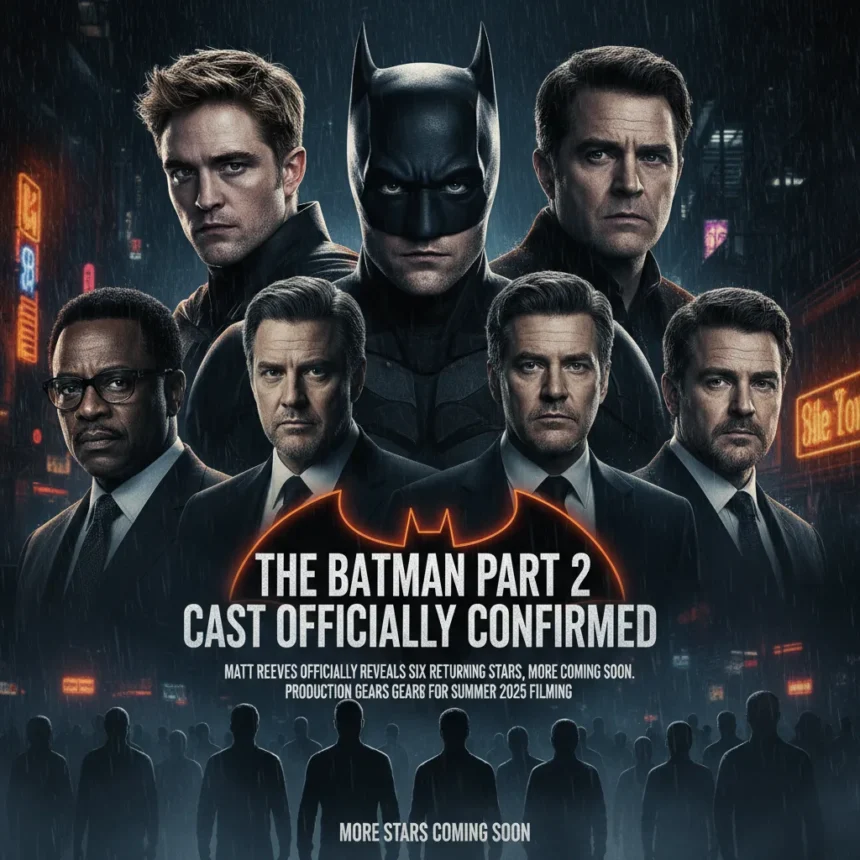
The Batman Part 2 cast has officially been confirmed by director Matt Reeves, who revealed six returning stars via social media in a move that signals the long-awaited sequel is moving into high gear. The announcement marks the first formal cast confirmation since the original 2022 film’s release, and it arrives as production prepares to begin in summer 2025 in London.
Key Takeaways
- Six returning stars confirmed for The Batman Part 2: Pattinson, Kravitz, Wright, Serkis, Farrell, and Turturro
- Director Matt Reeves teased additional cast reveals coming “very, very soon”
- Principal photography set to begin summer 2025 in London
- Film releases October 1, 2027, following The Penguin HBO series events
- Script nearly complete; cinematographer Greig Fraser replaced by Eric Messlyidjian
The Batman Part 2 Cast: Who’s Returning
Matt Reeves confirmed the returning ensemble through a social media post captioned “We meet again, my friend”—a line that references the characters’ prior encounters and their relationships within Gotham’s criminal underworld. Robert Pattinson returns as Batman and Bruce Wayne, while Zoe Kravitz reprises her role as Selina Kyle, also known as Catwoman. Jeffrey Wright continues as James Gordon, Andy Serkis as Alfred Pennyworth, Colin Farrell as Oswald Cobblepot (The Penguin), and John Turturro as Carmine Falcone.
The confirmation of these six actors signals continuity with the first film’s approach, which emphasized character depth and relationship dynamics over spectacle. Farrell’s return is particularly significant given his starring role in The Penguin, an HBO prequel series that explores his character’s rise through Gotham’s underworld. The Batman Part 2 will pick up after the events of that series, creating a direct narrative bridge between the two projects.
What’s Next: More Cast Announcements Expected
Reeves’ post teased that “more” cast confirmations are coming “very, very soon,” suggesting the director plans a steady rollout of announcements as production approaches. This strategy builds momentum and keeps the sequel in public conversation without overwhelming the reveal all at once. The timing aligns with the script’s near-completion, as Reeves and co-writer Mattson Tomlin have delivered large portions to DC Studios already.

Behind-the-scenes imagery released separately hints at the film’s visual direction and potential plot elements. A monitor shot revealed a snowy Gotham setting with the Batmobile visible, sparking fan speculation about the villain and tone, though Reeves has not officially confirmed these details. The production design suggests a shift toward winter aesthetics and possibly higher-stakes action sequences.
Production Timeline and Release Strategy
The Batman Part 2 is scheduled for theatrical release on October 1, 2027, giving the production team nearly two and a half years from the start of principal photography. Filming begins in summer 2025 in London, with the script in its final stages. Cinematographer Greig Fraser, who shot the original film, is unavailable due to his work on The Beatles films, and has been replaced by Eric Messlyidjian.



This extended timeline reflects the complexity of modern blockbuster production and post-production, particularly for a franchise that prioritizes character work and visual storytelling. The October 2027 date positions The Batman Part 2 after James Gunn’s Superman sequel, Man of Tomorrow, in the theatrical calendar, giving each project distinct positioning in the marketplace.
How The Batman Part 2 Fits Into the Broader DC Universe
The Batman Part 2 exists as part of Matt Reeves’ standalone Gotham saga rather than James Gunn’s broader DC Universe. This separation allows Reeves creative freedom while the DCU develops its own Superman-centric storylines. However, speculation persists about potential Robin inclusion in the sequel, which could theoretically intersect with Gunn’s universe plans, though nothing has been officially announced.
The film’s connection to The Penguin series demonstrates how DC Studios is building interconnected stories within Reeves’ Gotham universe. Unlike the fragmented approach of earlier DC films, this strategy emphasizes narrative continuity and character arcs that span multiple projects.
Is The Batman Part 2 releasing in 2025?
No. The Batman Part 2 releases on October 1, 2027. Principal photography begins in summer 2025, but the film will not reach theaters until two years later, following post-production, visual effects work, and marketing campaigns.



Will The Penguin series affect The Batman Part 2’s plot?
Yes. The Batman Part 2 will pick up after the events of The Penguin HBO series, creating a direct narrative continuation. Colin Farrell’s character arc in the series will inform his storyline in the sequel.
Who is the villain in The Batman Part 2?
The villain has not been officially confirmed by Matt Reeves or DC Studios. Behind-the-scenes imagery and fan speculation have suggested possibilities like Hush or Clayface, but these remain unconfirmed theories rather than official announcements.
The official confirmation of The Batman Part 2’s cast marks a turning point for the sequel, moving it from speculation and rumors into concrete production reality. With six returning stars locked in, additional announcements promised, and filming set to begin within months, the project is no longer a distant promise—it is an active production with a clear release target. For fans of Reeves’ grounded, character-driven approach to Batman, the ensemble’s return suggests the sequel will maintain the first film’s emphasis on relationships and moral complexity rather than chasing bigger explosions.
Edited by the All Things Geek team.
Source: TechRadar