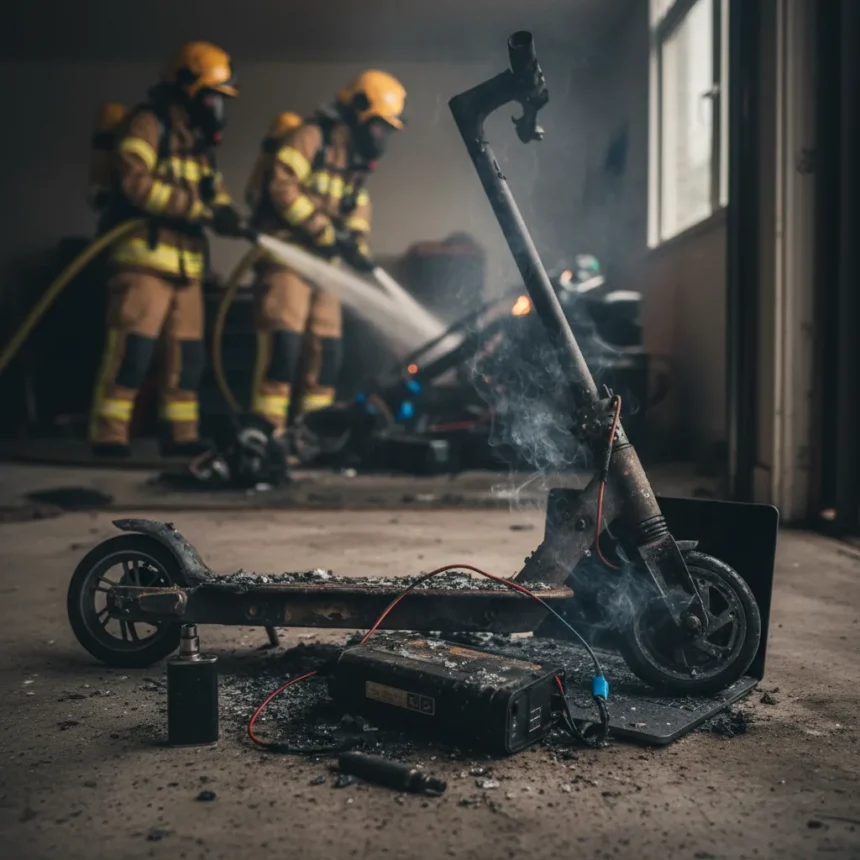
Lithium-ion battery fires in the UK have reached a critical threshold. UK firefighters now attend a lithium-ion battery fire every five hours, based on data from the National Fire Chiefs Council (NFCC) analyzing fires from October 2023 to October 2024. Over that 12-month period, 1,729 lithium-ion battery fires were reported across the country, with e-bikes accounting for the largest share at 465 incidents—a 42% year-on-year increase that reflects the rapid adoption of electric mobility devices in British homes and streets.
Key Takeaways
- UK firefighters respond to one lithium-ion battery fire every five hours, totaling 1,729 incidents in 12 months.
- E-bike fires surged 42% year-on-year, with modified e-bikes representing 25% of all e-bike fire incidents.
- Vapes and e-cigarettes caused 226 lithium-ion fires (13% of total incidents) in the reporting period.
- London Fire Brigade recorded 160 e-bike fires in 2024, up from 90 in 2023, highlighting regional severity.
- Thermal runaway—triggered by damage, overcharging, or poor manufacturing—is the primary cause of battery fires.
Why lithium-ion battery fires are becoming a crisis
The surge in lithium-ion battery fires reflects the explosion of battery-powered consumer devices entering UK homes without adequate safety oversight. E-bikes lead the charge, causing 465 of the 1,729 reported fires. Vapes and e-cigarettes account for 226 incidents, while e-scooters (82 fires), hoverboards (52 fires), and electric toothbrushes (35 fires) round out the landscape. What makes these fires particularly dangerous is their intensity. According to the NFCC, these fires burn incredibly hot and can reignite even after they appear to be extinguished, posing a serious risk to life and property.
Modified e-bikes present a specific hazard. These devices—upgraded with non-standard batteries, motors, or chargers—account for 25% of all e-bike fires, yet they remain cheaper and more accessible than factory-standard alternatives. Buyers attracted to bargain-priced e-bikes under £500 or suspiciously cheap vapes under £5 often lack the safety certifications (UKCA, CE, UL, IEC 62133) that legitimate products carry. London Fire Brigade reported 160 e-bike fires in 2024 alone, more than double the 90 fires recorded in 2023, underscoring how rapidly the problem is accelerating in one major metropolitan area.
The mechanics of thermal runaway
Lithium-ion battery fires begin with a process called thermal runaway, where the battery enters an uncontrolled heat-generating state. This cascade can be triggered by physical damage (dents or punctures), overcharging, manufacturing defects, or the use of incompatible chargers and components. Modified e-bikes are particularly vulnerable because they pair upgraded motors with batteries that may never have been tested together, creating untested failure modes. Once thermal runaway begins, the battery’s internal chemistry accelerates the reaction, producing intense heat and toxic smoke that spreads rapidly through homes and can reignite after initial extinguishing attempts.

The problem worsens when consumers buy from unregulated platforms. Amazon, eBay, and AliExpress host countless listings for unbranded e-bikes, batteries, and chargers that bypass UK safety standards entirely. A product might meet CE marking on paper but lack genuine testing. Worse, counterfeit safety certifications are common on cheap imports, leaving buyers with no recourse when a fire occurs.
How to prevent lithium-ion battery fires at home
Prevention hinges on three pillars: buying smart, charging safely, and maintaining vigilance. Start by purchasing only from reputable sellers. Look for UKCA, CE, or UK-regulated products; avoid unbranded imports and suspiciously cheap devices. Check that batteries carry UL or IEC 62133 certification, and verify that battery capacity matches manufacturer specifications—a 1000Wh battery installed on a 250W e-bike is a red flag.



Charging habits matter enormously. Always use the original charger supplied with your device; third-party chargers often lack safety controls. Charge on a non-flammable surface away from curtains, bedding, and other combustibles. Never charge unattended, overnight, or under stairs or beds—these locations trap heat and smoke, accelerating fire spread. Unplug the charger as soon as the battery reaches full charge. For longevity and safety, aim to keep batteries charged between 20% and 80% capacity rather than running them flat or keeping them perpetually at 100%.
Storage is equally critical. Keep batteries in cool, dry places below 25°C, away from direct sunlight and freezing temperatures. Separate batteries from metal objects that could cause short-circuiting. Perform daily visual inspections of batteries, e-bikes, and vapes, looking for dents, swelling, heat damage, or unusual smells. If you spot any of these warning signs, stop using the device immediately and dispose of the battery through council recycling centers or retailer take-back schemes—never throw lithium-ion batteries in general waste.
Special considerations for e-bikes and vapes
Modified e-bikes deserve particular caution. Never attempt to upgrade an e-bike’s battery or motor yourself; doing so voids all safety certifications and dramatically increases fire risk. The cost savings are illusory when weighed against the potential for a house fire. For vapes, the UK’s regulatory landscape is shifting. Disposable vapes, which are banned for sale from June 1, 2025, have been a significant fire source due to poor manufacturing and lack of safety oversight. Buy regulated, rechargeable vape devices instead, and recycle used vapes at designated collection points rather than binning them.
What to do if a lithium-ion battery fire starts
If a battery fire ignites, evacuate immediately. Do not attempt to tackle a lithium-ion battery fire with water—water can intensify the reaction and spread flaming debris. If you have a fire blanket or appropriate extinguisher and it is safe to do so, use those. Call 999 and let firefighters handle containment. Only after flames are fully out should you attempt to cool the surrounding area to prevent reignition. Most importantly, prioritize life over property—get yourself and others out of the building first.



FAQ
How often do lithium-ion battery fires occur in the UK?
UK firefighters attend a lithium-ion battery fire every five hours, based on 1,729 reported incidents over 12 months from October 2023 to October 2024. E-bikes are responsible for the majority of these fires, followed by vapes and e-scooters.
Are modified e-bikes really that much riskier than factory-standard ones?
Yes. Modified e-bikes account for 25% of all e-bike fires despite representing a smaller share of the e-bike market. Upgrades using non-standard batteries and motors have not been tested together for safety, creating unpredictable failure modes that factory-built e-bikes avoid through rigorous certification processes.
Can I use any charger with my e-bike or vape battery?
No. Always use the original charger supplied with your device. Third-party chargers often lack the safety controls built into genuine chargers and can trigger overcharging or thermal runaway. Using an incompatible charger is one of the leading causes of battery fires.
The lithium-ion battery fire crisis in the UK is not inevitable—it is preventable through informed purchasing, disciplined charging habits, and vigilant maintenance. As e-bikes, vapes, and other battery-powered devices proliferate in British homes, consumer awareness is the first line of defense. Buy certified, charge safely, inspect regularly, and never modify your devices. Your home’s safety depends on it.
Edited by the All Things Geek team.
Source: TechRadar