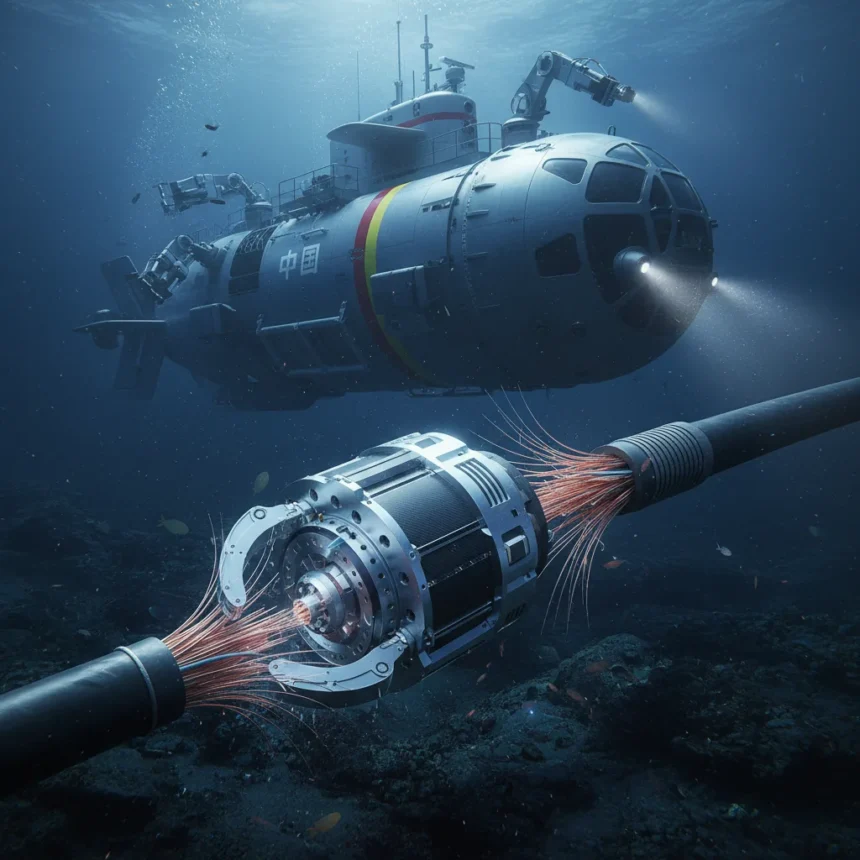
China has successfully tested a deep-sea cable-cutting actuator designed to sever undersea cables at depths of 3,500 meters, according to state media announcements hinting at imminent deployment. The device represents a significant advancement in China’s deep-sea operational capabilities and has triggered international concern over the vulnerability of critical undersea infrastructure that carries global telecommunications and power transmission.
Key Takeaways
- China tested an electro-hydrostatic actuator capable of cutting undersea cables at 3,500-meter depths.
- Electro-hydrostatic actuators combine electric motors with hydraulic pumps, eliminating separate pump systems for improved reliability.
- State media framed the trial as successful with hints of near-term deployment readiness.
- Undersea cables carry 99% of intercontinental data traffic and remain largely unguarded against deliberate sabotage.
- Competing subsea actuators exist for oil and gas applications but lack cable-cutting specifications.
What Is a Deep-Sea Cable-Cutting Actuator?
A deep-sea cable-cutting actuator is a specialized hydraulic or electro-hydraulic device engineered to operate under extreme pressure at ocean depths where conventional equipment fails. The deep-sea cable-cutting actuator combines an electric motor with an integrated hydraulic pump system, eliminating the need for separate pumping units and external tubing that would complicate deep-water deployment. This electro-hydrostatic architecture delivers the force necessary to sever fiber-optic and power cables while withstanding crushing pressures equivalent to thousands of metric tons per square centimeter. The 3,500-meter operational depth places the device well within the range of most undersea cable routes, which typically run between 200 and 6,000 meters below the surface.
Electro-hydrostatic actuators (EHAs) integrate electric motors with hydraulic pumps, eliminating separate pumps and tubing for simplified, reliable systems. This design philosophy reduces mechanical complexity and failure points—critical advantages in environments where maintenance or repair is impossible. The deep-sea cable-cutting actuator achieves this through a sealed, pressure-resistant housing that protects internal components from saltwater corrosion and thermal stress.
China’s Strategic Capability and Timing
The successful trial comes at a moment of heightened tension over undersea infrastructure vulnerability. Undersea cables carry approximately 99 percent of intercontinental data traffic, yet most lack physical protection against deliberate cutting or sabotage. China’s announcement of a deep-sea cable-cutting actuator, paired with state media hints of deployment readiness, suggests the technology may transition from laboratory testing to operational use within months rather than years. This timeline is significant: it signals confidence in the device’s reliability and indicates pre-positioning of the capability in strategic locations.

The geopolitical context is stark. In recent years, undersea cable damage—whether from ship anchors, fishing equipment, or natural causes—has disrupted communications across entire regions. A tool designed specifically for cable severance at extreme depths transforms accidental damage into a potential weapon. China’s willingness to publicize the capability, rather than keep it secret, suggests either confidence in operational deployment or an intent to signal strategic reach to regional competitors and global powers. The announcement carries implicit deterrent messaging: China possesses the technical means to disrupt global communications at will.
How the Deep-Sea Cable-Cutting Actuator Compares to Existing Subsea Technology
Existing subsea actuators serve primarily industrial applications in oil and gas extraction, CO2 injection, and hydrogen storage—not infrastructure disruption. The SSEAC subsea actuator by WITTENSTEIN motion control, for example, operates to 4,000 meters depth with 25-year service life, using redundant 24V motors and planetary gearbox systems for valve control. This device excels at precision flow control on the seabed but was designed for collaborative industrial workflows where operators expect the equipment to function reliably within a defined system. By contrast, the deep-sea cable-cutting actuator requires only a single function: apply sufficient force to sever a cable and withdraw. The operational simplicity—no feedback loops, no precision calibration—makes the cutting tool fundamentally easier to deploy and operate in a covert context.



Chinese manufacturers including Flowinn and Theoborn produce electro-hydraulic actuators for general industrial use, including lawn mowers and valve systems, but none have published specifications for deep-sea cable-cutting applications. The fact that a purpose-built deep-sea cable-cutting actuator emerged from Chinese development suggests either a dedicated military or state-sponsored research program, or rapid adaptation of existing EHA platforms to a new operational requirement. Either pathway indicates serious investment and technical capability.
Why Undersea Cable Vulnerability Matters Now
Undersea cables are the physical backbone of global finance, commerce, and communication. A single cable cut can disrupt stock markets, interrupt cloud services, and isolate entire nations from international data networks. Unlike power grids or terrestrial fiber routes, undersea cables operate in international waters where attribution is difficult and military response options are limited. A nation that can cut cables at 3,500 meters gains a form of asymmetric leverage: the ability to inflict economic and strategic damage without firing a shot or risking conventional military escalation.
The deep-sea cable-cutting actuator also shifts the cost-benefit calculation for adversaries. Previously, cable sabotage required either surface ships (visible, attributable) or submarines (expensive, detectable). A remotely operated or autonomous platform equipped with a cable-cutting actuator could operate at depth for extended periods, severing multiple cables before detection. Recovery and forensic analysis of the device would take weeks, by which time the damage spreads globally and attribution becomes speculative.
What Happens Next?
State media hints at deployment readiness suggest China may already be positioning the deep-sea cable-cutting actuator for operational use. This could mean integration onto submarines, unmanned underwater vehicles, or remotely operated platforms stationed near critical cable routes. The technology does not require new carrier platforms—it can retrofit onto existing deep-diving assets. Deployment timelines could accelerate if political tensions spike or if China perceives a window of opportunity before international countermeasures emerge.



Defensive responses remain limited. Cable routes cannot be easily hardened at 3,500-meter depths. Redundancy helps—running multiple cables on different routes reduces the impact of any single cut—but redundancy is expensive and incomplete. Detection systems for subsea intrusion are nascent. Attribution after a cable cut is difficult, creating ambiguity about whether damage was accidental or deliberate. These gaps explain why the announcement of a deep-sea cable-cutting actuator triggered alarm among security analysts and government officials worldwide.
Is the deep-sea cable-cutting actuator already deployed?
State media framed the trial as successful with hints of deployment readiness, but no independent confirmation exists regarding operational positioning. The timeline between announcement and actual deployment remains unclear. Chinese military doctrine often emphasizes demonstrating capability before use, which may explain the public disclosure.
How deep do undersea cables typically run?
Most undersea cables operate between 200 and 6,000 meters below the surface, with the majority clustered in the 2,000 to 4,000-meter range. China’s 3,500-meter capability covers the critical middle range where most high-value routes concentrate.
What would happen if a major undersea cable was cut?
A single major cable cut disrupts data transmission across continents, affecting financial markets, cloud services, and international communications. Recovery requires weeks of repair work, during which affected regions operate on degraded or backup connectivity. Multiple simultaneous cuts would cause cascading failures across global networks.
China’s successful test of a deep-sea cable-cutting actuator marks a turning point in undersea infrastructure vulnerability. The technology itself is not revolutionary—electro-hydraulic systems have existed for decades—but its application to cable severance at extreme depths represents a meaningful shift in strategic capability. The state’s willingness to publicize the achievement, coupled with hints of imminent deployment, signals confidence and intent. For nations dependent on undersea cable infrastructure, the message is clear: the physical foundation of global connectivity is now a potential target, and defensive options remain limited. The next phase will likely involve either operational use or accelerated international efforts to detect, deter, and defend critical undersea assets.
Edited by the All Things Geek team.
Source: Tom's Hardware