





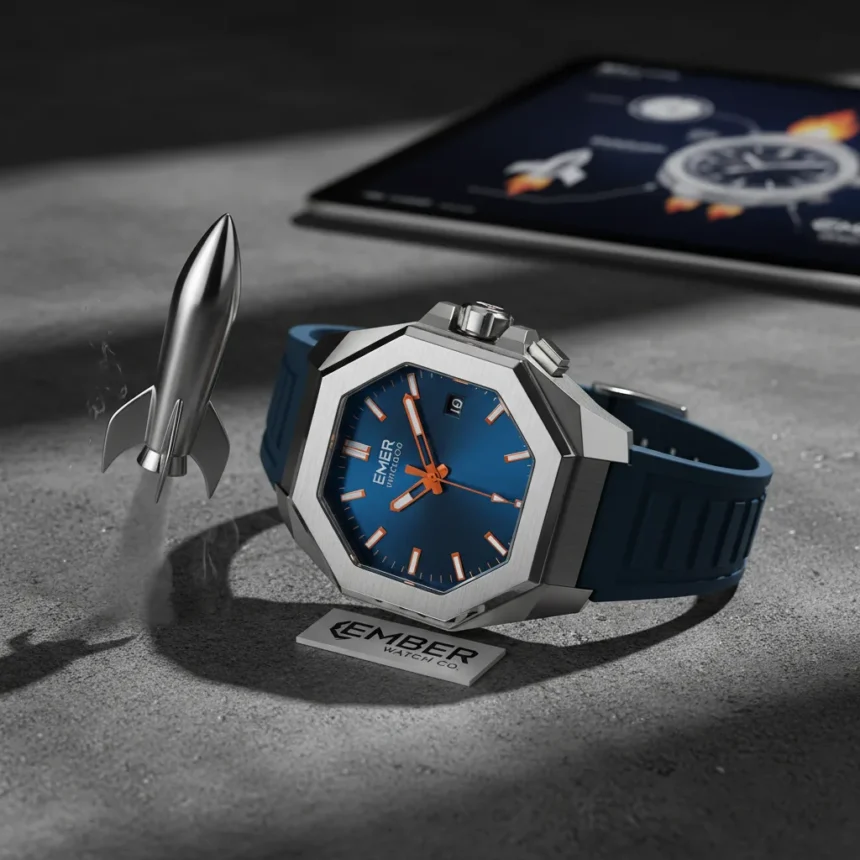
The Ember Watch Company Rocket is a British microbrand’s first model, built around a faceted stainless steel case that looks like it was designed for a stealth fighter jet. After a week on the wrist, it becomes clear why this watch has generated genuine excitement in the independent watch community—it refuses to look like everything else.
Key Takeaways
- Unique 27-faceted case design sets the Rocket apart from conventional field watches and tool watches.
- Priced at $473–$486 USD, the Rocket undercuts most Swiss-made competitors by half.
- Seiko NH38A movement delivers reliable timekeeping with 41-hour power reserve and strong lume performance.
- Available in eight dial colors including robin egg blue, skyline pink, and glacial white variants.
- 100m water resistance with screw-down crown makes it genuinely wearable, not just a desk piece.
Why the Faceted Case Actually Works
The Rocket’s defining feature is its multi-faceted case—roughly 27 angled surfaces arranged around a 40mm diameter body. This is not a gimmick. The geometry evokes the vintage Zenith Defy, a watch that cost ten times as much and looked just as intentional. On a 6.5-inch wrist, the Rocket feels muscular without being oversized, and the faceting changes the watch’s appearance completely depending on how light hits it. Matte bead-blasted surfaces contrast against a polished upper bezel section, creating visual depth that catches the eye without screaming for attention.
Finding genuinely new case designs in the watch industry is rare. Most microbrands iterate on existing templates—the Submariner homage, the Speedmaster homage, the field watch with slightly different proportions. The Rocket’s faceted geometry is not a refinement of an existing design language; it is its own thing. That confidence in design choice is what separates watches with personality from watches that merely tell time.
Specs That Match the Design Philosophy
The Rocket does not coast on looks alone. The case is 316L stainless steel with a screw-down crown and screw-down solid caseback featuring an embossed geometric pattern. Water resistance reaches 100m with 10ATM rating, enough for swimming and snorkeling but not diving. The flat sapphire crystal is scratch-resistant, and the dial uses sandwich construction—a lumed bottom layer with cutouts to the top layer, a technique usually reserved for watches costing twice the price. Available dial colors include blue and orange, white and green, black and pink, and several monochromatic options like robin egg blue and glacial white.

The movement is a Seiko NH38A automatic, a no-date caliber with true no-date construction (no ghost positions on the dial) and hacking seconds. It runs at 21,600 vibrations per hour with a 41-hour power reserve. This is not exotic, but it is reliable. The Super-LumiNova BG-W9 lume on the hands and dial bottom layer glows strongly enough to read at 3am without any ambient light. The rotor is quiet, a small detail that makes wearing the watch less annoying on a metal bracelet.
Bracelet and Strap Options Elevate the Package
The Rocket ships with a bead-blasted H-link stainless steel bracelet featuring a folding clasp with double-trigger safety and micro-adjust capability. Quick-release pins make swapping to the included FKM rubber strap or genuine leather strap straightforward. Both alternative straps come with bead-blasted stainless steel pin buckles, maintaining the design consistency across the entire package. This attention to detail—ensuring every component matches the overall aesthetic—is where many microbrands cut corners. Ember did not.



How It Compares to the Field Watch Status Quo
The independent watch market is saturated with Seiko NH36-powered field watches priced between $300 and $600. Most use dial designs and case shapes borrowed from military or vintage references. The Rocket occupies the same price range and uses the same movement family, but the faceted case design immediately signals that this is not another retro homage. It is a contemporary tool watch that looks forward rather than backward. For readers tired of the endless parade of vintage-inspired designs, the Rocket offers something genuinely different without sacrificing wearability or practicality.
Is the Rocket Worth Buying?
The Rocket succeeds because it commits fully to its design vision. The faceted case is not a cosmetic afterthought; it is the entire reason the watch exists. At $473–$486, the price is aggressive for a microbrand with no established reputation. That gamble pays off because the execution is solid. The case finishing is clean, the movement reliable, the dial options appealing, and the overall package feels considered rather than rushed. If you are searching for a tool watch that does not look like every other tool watch, the Ember Watch Company Rocket deserves serious consideration.
What makes the Ember Watch Company Rocket’s case design unique?
The Rocket features approximately 27 angled facets arranged around the case, inspired by stealth fighter jets and vintage Zenith sports watches. This multi-faceted geometry is rare in modern microbrands and changes the watch’s appearance dramatically depending on lighting conditions.
Does the Ember Watch Company Rocket hold up to water sports?
Yes. The Rocket is rated to 100m water resistance with a screw-down crown and solid caseback, making it suitable for swimming and snorkeling. However, it is not designed for diving, which requires deeper water resistance ratings.



How does the Seiko NH38A movement perform over time?
The NH38A is a proven workhorse caliber found in thousands of independent watches. It offers true no-date construction, 41-hour power reserve, and hacking seconds. Reliability is solid, though it does not offer the chronograph or GMT functionality found in more expensive movements.
The Ember Watch Company Rocket proves that a microbrand can break through the noise with bold design choices and honest execution. In a market drowning in safe, derivative watches, the Rocket’s faceted case and confident personality are exactly what the independent watch space needs.
Edited by the All Things Geek team.
Source: T3




