Level 4 autonomous driving represents a critical inflection point in automotive technology, where vehicles can operate without human intervention across most driving scenarios. The gap between industry optimism and internal skepticism has widened sharply, with Rivian’s leadership projecting imminent deployment while Tesla grapples with employee concerns about the reliability of its current self-driving systems.
Key Takeaways
- Rivian CEO claims Level 4 autonomy deployment is closer than public expectations suggest.
- Tesla employees express doubts about the reliability of the company’s autonomous-driving technology.
- Internal confidence and external messaging diverge significantly across the autonomous-vehicle industry.
- Level 4 systems require vehicles to handle most driving tasks without human oversight.
- The gap between promise and proven capability remains a credibility challenge for self-driving leaders.
Rivian’s Optimism on Level 4 Autonomous Driving Timelines
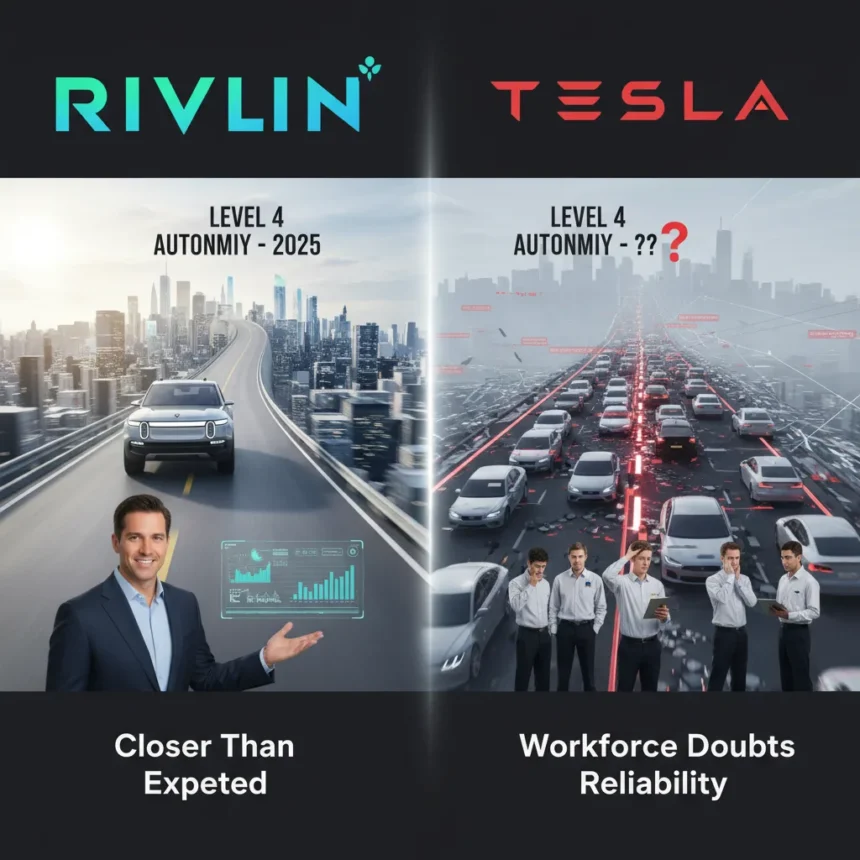
Rivian’s leadership has publicly stated that Level 4 autonomous driving capabilities are much closer to reality than mainstream perception suggests. This claim positions Rivian as a more aggressive competitor in the autonomous-vehicle race, signaling confidence in the company’s technical roadmap and engineering capabilities. The statement carries weight because it comes from the CEO, the highest authority on company strategy and product timelines.
This optimism contrasts sharply with the cautious, incremental approach most established automakers have taken toward autonomous systems. Rivian’s bet on proximity to Level 4 suggests the company believes its architecture, sensor suite, and software stack are further along than competitors publicly acknowledge. Whether this confidence reflects genuine technical progress or aspirational messaging remains a central question for investors and customers evaluating the company’s credibility.
Tesla’s Internal Credibility Crisis on Self-Driving Reliability
Tesla faces a more immediate problem than timeline disputes: its own employees question whether the company’s self-driving technology is reliable enough to deploy at scale. This internal skepticism represents a far deeper challenge than external criticism, because it signals that people closest to the technology—those who understand its limitations intimately—lack confidence in its safety and performance.

Employee doubt about reliability undercuts Tesla’s public messaging around Full Self-Driving and Autopilot capabilities. When the workforce does not believe the product works as advertised, the company faces recruitment friction, retention risk, and vulnerability to whistleblowing. This gap between CEO claims and employee conviction is a hallmark of companies struggling to deliver on ambitious autonomous-driving promises. Tesla’s challenge is not merely technical; it is organizational and reputational.
Why Internal Skepticism Matters More Than External Hype
The contrast between Rivian’s external confidence and Tesla’s internal doubts reveals a fundamental truth about autonomous-driving development: the people building the systems often know better than the public relations teams selling them. When engineers, test drivers, and safety specialists express reservations, those reservations typically reflect real technical hurdles, not pessimism.



Tesla’s employee concerns suggest the company has encountered obstacles in reliability that public statements have minimized or glossed over. Conversely, Rivian’s optimism may reflect genuine progress, or it may represent the confidence of a company with less operational history and thus less exposure to real-world edge cases. The autonomous-vehicle industry has a credibility deficit because timelines have slipped repeatedly. Rivian and Tesla are both vulnerable to this skepticism, but Tesla’s internal fracture is more damaging because it erodes the trust of the people who know the technology best.
What Level 4 Autonomy Actually Requires
Level 4 autonomous driving means a vehicle can operate without human intervention in most conditions, though human override may still be available and certain edge cases may require human takeover. This is distinct from Level 3, where the driver must remain ready to intervene, and far beyond Level 2 systems like Tesla’s Autopilot, which requires constant human monitoring.
Achieving Level 4 requires redundancy in sensors, processing power, and decision-making algorithms. The system must handle weather, construction zones, unusual traffic patterns, and sensor failures gracefully. It must also navigate the legal and insurance frameworks that vary by region. These technical and regulatory hurdles explain why Level 4 deployment has been slower than early predictions suggested. Neither Rivian nor Tesla has demonstrated Level 4 capability in production vehicles available to consumers, despite years of development.
Can Either Company Deliver on Its Promises?
Rivian’s timeline claim will be tested by real-world deployment metrics. If the company achieves Level 4 capability ahead of competitors, it gains a significant market advantage. If the claim proves aspirational, the credibility damage will be substantial. Rivian has less operational history than Tesla, which cuts both ways: fewer edge cases discovered means fewer opportunities to be humbled, but also less proven track record in shipping complex autonomous systems.



Tesla’s path is steeper. The company must not only close the technical gap but also rebuild internal confidence. Employees who doubt the reliability of Full Self-Driving will be harder to recruit and retain. The company will struggle to attract top autonomous-driving talent if the perception persists that internal teams lack faith in the product. Tesla’s scale and resources are unmatched, but no amount of capital can overcome a workforce that believes the technology is not ready.
The Broader Industry Pattern
Both companies reflect a pattern seen across the autonomous-vehicle industry: overpromise on timelines, underdeliver on capability, then recalibrate expectations. Waymo, Cruise, and others have all faced delays and setbacks. The gap between Level 3 and Level 4 is wider than many engineers initially believed, and the regulatory pathway remains unclear in most markets. Rivian’s optimism and Tesla’s internal doubts are both data points in an industry learning that autonomous driving is harder than it looked five years ago.
FAQ
What is the difference between Level 3 and Level 4 autonomous driving?
Level 3 requires a human driver to remain ready to take control at any moment, while Level 4 allows the vehicle to operate independently in most conditions without requiring human intervention. Level 4 is a fundamental shift in capability and liability, which is why it remains largely undeployed in consumer vehicles.
Why do Tesla employees doubt the company’s self-driving technology?
Employees who work directly with the technology likely encounter real-world failures, edge cases, and limitations that public statements minimize. Internal skepticism typically reflects genuine technical challenges rather than pessimism, and it signals that the gap between current capability and Level 4 readiness remains substantial.
Is Rivian closer to Level 4 autonomy than Tesla?
Rivian’s CEO has claimed proximity to Level 4 deployment, but neither company has demonstrated production-ready Level 4 capability in vehicles available to consumers. Rivian’s optimism may reflect genuine progress or may be aspirational positioning. Real-world deployment will determine credibility.
The autonomous-driving race is not won by the loudest voice but by the first company to deploy Level 4 capability safely and at scale. Rivian’s confidence and Tesla’s internal doubts tell different stories, but both companies face the same fundamental challenge: proving that the technology works reliably in the real world, not just in controlled tests or carefully curated demos. Until either company delivers that proof, skepticism—whether external or internal—remains justified.
Edited by the All Things Geek team.
Source: TechRadar