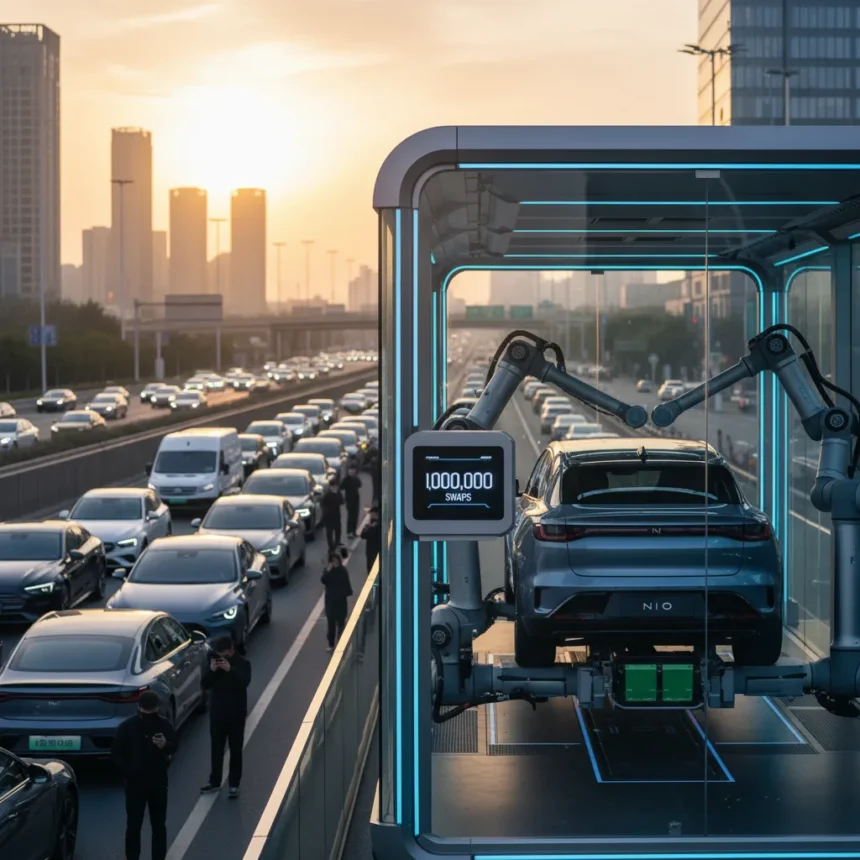
Nio battery swap technology just completed over 1 million battery swaps in a single week, shattering the notion that swappable batteries are a gimmick. During China’s May Day travel rush from April 30 to May 6, 2024, the Chinese EV maker executed 1,031,469 battery swaps across its network, averaging 147,350 swaps per day. This achievement demonstrates that battery swapping has matured from an experimental concept into a scalable, consumer-ready solution for range anxiety.
Key Takeaways
- Nio completed 1,031,469 battery swaps during May Day 2024, averaging 147,350 swaps per day.
- The company operates 3,839 battery swapping stations across China with approximately 40 swaps per station daily.
- Each swap takes roughly 3 minutes without requiring the driver to exit the vehicle.
- Nio has completed over 100 million cumulative battery swaps since launching the technology in 2018.
- Fourth-generation stations launched in June 2024 reduce swap time to 144 seconds and store up to 23 batteries.
Why Nio Battery Swap Technology Matters Now
Battery swapping addresses the core complaint that kills EV adoption: charging time. Conventional fast-charging takes 20 to 40 minutes or longer, while Nio’s automated process completes in approximately 3 minutes. This speed advantage is not theoretical—it proved decisive during the busiest travel week of China’s calendar, when millions of drivers hit the roads simultaneously. Nio’s peak single-day performance reached 170,585 swaps on May 1, with an all-time record of 177,627 swaps on February 22 during the Spring Festival rush. These numbers show the technology works at scale, not just in pilot programs.
The scale of Nio’s network makes this possible. As of May Day 2024, the company operated 3,839 battery swapping stations across China, distributed across all 31 provinces. While that averages roughly 270 swaps per station over the week (or about 40 swaps per station per day), the geographic spread means drivers in most regions have access to a swap station within reasonable distance. This is the infrastructure that makes battery swapping viable—not just the technology itself.
How Nio Battery Swap Technology Works in Practice
The process is fully automated. A driver pulls into a battery swap station, and the vehicle is conveyed to a designated area. An automated system removes the depleted battery pack from the vehicle’s undercarriage, installs a fully charged pack, and charges the driver’s account for the service. The entire transaction takes about 3 minutes without the driver leaving the vehicle. This simplicity is the key advantage over fast-charging, which requires the driver to wait inside or near the car while power flows slowly into a stationary battery.

Nio’s fourth-generation stations, launched in June 2024, improved efficiency further. These newer stations complete each swap in 144 seconds (2.4 minutes) and store up to 23 battery packs, increasing throughput during peak demand. The company is not standing still—it continues refining the hardware to handle higher volumes and faster turnarounds.
Nio Battery Swap Technology Beyond China
Nio’s ambitions extend beyond China’s borders. By November 2023, the company had installed 30 battery swap stations in Europe, growing to 50 stations by July 2024. European customers using the Battery-as-a-Service (BaaS) model pay approximately 30 euros per swap after the first four free swaps included in their subscription. This pricing model—leasing the battery separately from purchasing the vehicle—lowers the upfront cost of ownership and lets customers switch between different battery pack sizes depending on their needs.



However, European expansion has slowed. Only 11 additional stations were added after July 2024, suggesting the company is consolidating its footprint rather than aggressively expanding. This contrasts sharply with China, where Nio added 681 new stations in 2024 alone, representing 34.1% of its original guidance for the year. The disparity reflects China’s dominance in EV adoption and infrastructure investment—more than half of global EVs are sold in China, and Nio’s home market remains its primary focus.
How Nio Battery Swap Technology Compares to Competitors
Tesla abandoned battery-swapping technology around 2013 and never pursued it further, betting instead on a global fast-charging network. That choice shaped the entire EV industry. Most legacy automakers and startups followed Tesla’s lead, treating battery swapping as a dead-end experiment. Nio proved them wrong by building the world’s largest battery-swapping network and demonstrating genuine consumer demand.
CATL, the world’s largest battery manufacturer, is now rolling out its own swap network with plans for thousands of stations. The company’s CEO predicted that by 2030, battery swapping, home charging, and public charging could share the market roughly equally. This forecast signals that battery swapping is transitioning from Nio’s competitive advantage to an industry standard. BAIC Motor Corp. uses swappable battery technology, but only for fleet vehicles, not individual consumers. Nio remains the only EV maker offering battery swapping to regular buyers at scale.
The Cumulative Impact: 100 Million Swaps and Counting
The May Day milestone matters because it sits atop a much larger achievement. Nio has completed over 100 million battery swaps since launching the technology in 2018. Customers cumulatively consumed 5.28 billion kilowatt-hours of electricity through battery swap stations. These figures represent six years of real-world operation, not a one-week publicity stunt. The consistency proves the model is sustainable, not a temporary phenomenon.



Nio battery swap technology has also expanded beyond China’s borders, with over 250,000 swaps completed across the European network, though this represents only about 0.2% of the global total. The ratio underscores China’s dominance in EV adoption and Nio’s reliance on its home market, but it also confirms that battery swapping works internationally wherever infrastructure exists.
What This Means for the EV Industry
Nio’s May Day achievement forces the industry to reckon with a question it largely ignored: what if battery swapping is not a gimmick but the future of EV charging? The 1 million swaps in a week prove the technology scales. The 3-minute swap time proves it solves the core problem faster than any alternative. The 100 million cumulative swaps prove it works reliably over years, not just in controlled tests.
This does not mean battery swapping will replace home charging and public fast-charging. Most EV owners charge at home overnight and rarely need rapid top-ups. But for road trips, commercial fleets, and drivers without home charging access, battery swapping offers a compelling alternative that fast-charging cannot match. Nio has built the infrastructure to prove it. The question now is whether other automakers and charging networks will invest in the same approach or continue betting on incremental improvements to fast-charging technology.
Is Nio battery swap technology reliable?
Yes. Nio has completed over 100 million battery swaps since 2018, with no major safety incidents or widespread reliability issues reported. The May Day performance—averaging 147,350 swaps per day across thousands of stations—demonstrates the system handles high volume reliably. The automated process removes human error from the equation, making swaps more consistent than manual fast-charging.
How much does a Nio battery swap cost?
In Europe, Nio charges approximately 30 euros per swap after the first four free swaps included in the Battery-as-a-Service subscription. Pricing in China varies by region and subscription tier but follows a similar model where customers lease the battery separately from the vehicle. This approach reduces upfront purchase cost compared to buying a vehicle with a battery included.
How does Nio battery swap technology compare to fast-charging?
Nio battery swaps take about 3 minutes and do not require waiting for power to flow into a battery. Fast-charging takes 20 to 40 minutes or longer, even under ideal conditions. Battery swapping is roughly 15 to 25 minutes faster than fast-charging a typical EV from 10% to 80% state of charge. The trade-off is that battery swapping requires a physical network of stations, while fast-charging works anywhere with a grid connection.
Nio battery swap technology has moved from skepticism to vindication. A million swaps in one week is not a gimmick—it is proof of concept at scale. As competitors like CATL build their own swap networks and traditional automakers watch nervously, Nio’s May Day achievement marks the moment battery swapping stopped being a curiosity and became a serious contender in the race to solve EV charging.
Edited by the All Things Geek team.
Source: TechRadar