





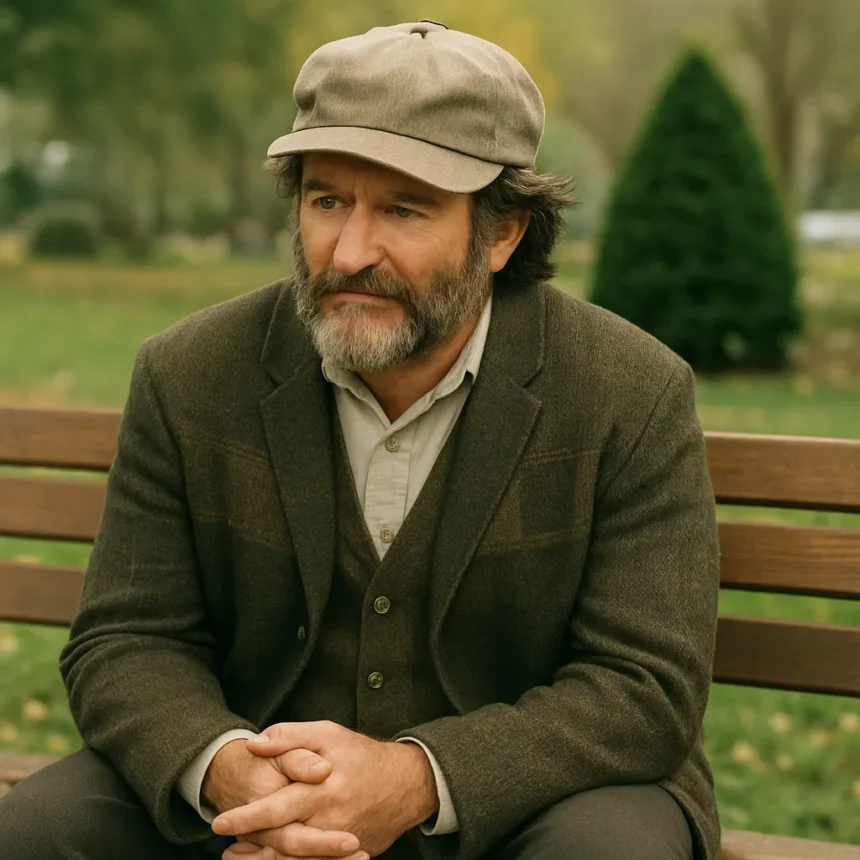
The Robin Williams Good Will Hunting park bench scene is one of cinema’s most quietly devastating pieces of acting — two men on a bench, no special effects, no score swelling beneath the dialogue, just Williams dismantling Matt Damon’s defences with surgical emotional precision. Williams played therapist Sean Maguire opposite Damon’s Will Hunting in the 1997 film, and his performance earned him the Best Supporting Actor Oscar at the 70th Academy Awards in 1998 — his first win after three prior nominations.
TL;DR: Nearly 30 years after the 1997 release of Good Will Hunting, the park bench scene where Robin Williams delivers a raw monologue on love and vulnerability remains one of the most emotionally honest performances in Hollywood history. It won Williams his first Oscar in 1998 and still streams on Paramount+.
What makes the Robin Williams Good Will Hunting monologue so powerful?
Williams’ monologue works because it refuses to be inspirational in the conventional sense. Sean Maguire doesn’t offer Will a pep talk — he offers him exposure, describing love not as a triumph but as a risk that could destroy you. That honesty is what separates this scene from a hundred other movie-therapy moments.
The specific lines Williams delivers make the case better than any description can. “You’ve never looked at a woman and been totally vulnerable, known someone that could level you with her eyes, feeling like God put an angel on Earth just for you” — it’s a description of love as profound weakness, not strength. For a character like Will Hunting, who has built his entire identity around intellectual invulnerability, it’s the one argument he can’t deflect with a clever answer.

What’s striking in hindsight is how much Williams drew on something that felt genuinely personal rather than performed. The scene doesn’t read like acting. It reads like confession. That quality is almost impossible to manufacture, and it’s why the clip circulates endlessly online decades after the film’s release.
How did the 70th Academy Awards recognise this performance?
At the 70th Academy Awards in 1998, Mira Sorvino presented Robin Williams with the Best Supporting Actor Oscar for Good Will Hunting — his first win after three previous nominations. The category that year included Robert Forster for Jackie Brown, Burt Reynolds for Boogie Nights, and Greg Kinnear for As Good as It Gets, a genuinely competitive field that made the win more meaningful, not less.



Williams’ acceptance speech leaned into the same emotional register as the performance itself. He quoted directly from the park bench monologue, referencing the line about looking at a woman and feeling totally vulnerable — a choice that collapsed the distance between the character and the actor in a way that landed hard in the room. It was the right speech for the right moment.
The win also corrected what many felt was a long-standing oversight. Williams had been nominated previously without taking home the award, and by 1998 there was a sense in Hollywood that the Academy owed him one. Whether or not you believe in debt-settling as awards logic, the performance itself left no room for argument.
Why does this scene hit harder now than it did in 1997?
Robin Williams died in August 2014. That fact reshapes how the park bench scene lands for anyone who watches it today. A monologue about vulnerability, about the courage it takes to truly love someone, delivered by a man who struggled privately with his own pain — the weight of that context is impossible to ignore.
It’s not that the scene needs the biographical layer to work. It worked in 1997 on pure craft alone. But grief has a way of deepening art retroactively, and Williams’ passing turned a great performance into something closer to a document. When he talks about knowing someone who could level you with her eyes, it no longer sounds like a scripted line. It sounds like a man who understood exactly what he was describing.



Compared to his other nominated roles, the Sean Maguire performance stands apart precisely because the film asked Williams to be still. His comedic instincts were world-class, but restraint was the harder skill — and the park bench scene is almost entirely restraint, one long act of holding back so that the emotional release, when it comes, hits with full force.
Where can you watch Good Will Hunting now?
Good Will Hunting is currently available on Paramount+, which means the park bench scene is a few taps away for subscribers. The film holds up across its full runtime, but the bench scene is the reason to watch — or rewatch — it in 2025. If you haven’t seen it since the late 1990s, you’ll find it plays differently now. That’s not nostalgia. That’s a genuinely great piece of filmmaking aging into something richer.
Why did Robin Williams win the Oscar for Good Will Hunting specifically?
Williams won Best Supporting Actor at the 1998 Academy Awards because his performance as therapist Sean Maguire in Good Will Hunting combined emotional authenticity with remarkable restraint. It was his first Oscar win after three prior nominations, and the park bench monologue on love and vulnerability is widely considered the centrepiece of his campaign.
What does the park bench monologue actually say about love?
The monologue describes love as total vulnerability — the terrifying experience of knowing someone who could devastate you simply by existing. Williams’ character tells Will that real love means risking being hurt, and that no book or intellectual framework can prepare you for it. It’s this specificity that made the speech feel less like movie dialogue and more like hard-won truth.
Is Good Will Hunting still worth watching in 2025?
Yes. Good Will Hunting, released in 1997, remains a sharply written drama that holds its emotional power across repeat viewings. The film streams on Paramount+, and the Robin Williams Good Will Hunting park bench scene alone justifies the runtime. For anyone who watched it as a younger viewer, returning to it now — with Williams gone and nearly three decades of distance — is a different, and deeper, experience.
The Robin Williams Good Will Hunting park bench scene won an Oscar because it earned one. Nearly 30 years on, it doesn’t need the award to justify itself — the performance stands entirely on its own terms, and the fact that it keeps finding new audiences on streaming suggests that some things don’t age so much as they deepen. Watch it, or watch it again. Either way, it’ll cost you something.
Edited by the All Things Geek team.
Source: Tom's Guide




