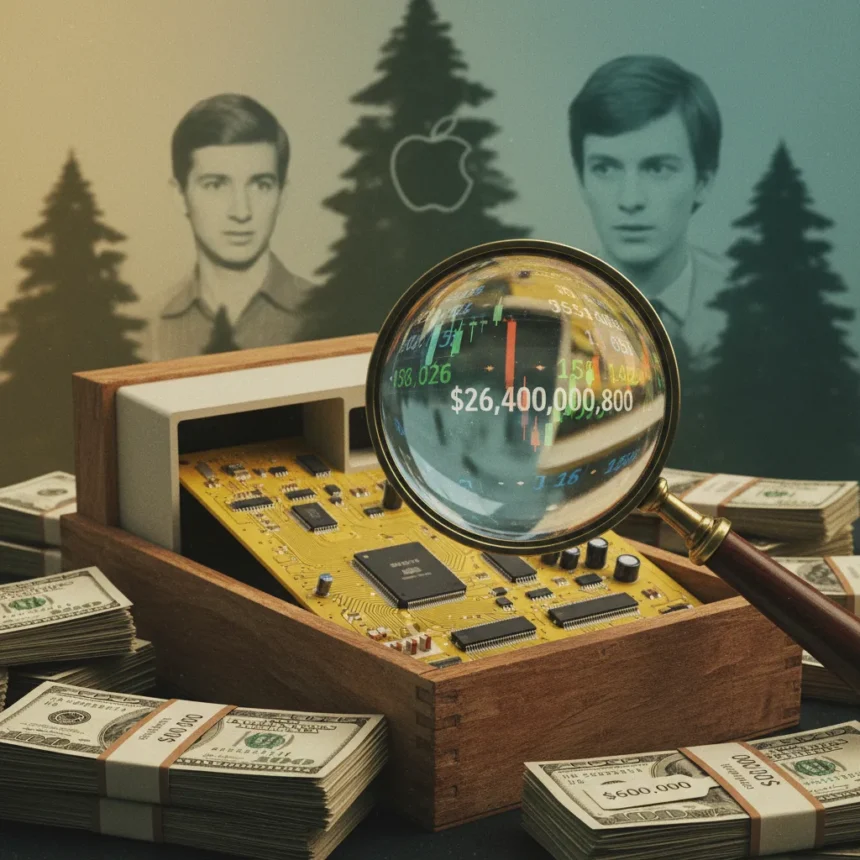
Sequoia Capital Apple investment decisions in 1977 were not driven by conviction. Founder Don Valentine wrote an internal memo proposing a $600,000 stake in Apple Computer, but his language revealed deep reservations about the bet he was about to make. The memo, released publicly for the first time in April 2026 to mark Apple’s 50th anniversary, exposes a truth that venture capital firms rarely admit: sometimes the best returns come from deals you almost passed on.
Key Takeaways
- Don Valentine’s 1977 memo called Apple’s management “questionable” despite backing the company for $600,000.
- Sequoia’s $600K investment secured 10% of Apple, valuing the company at $6 million—8 times its net sales.
- Sequoia sold its stake in 1979 for around $6 million, a 40-fold return, but exited far too early.
- If held to today, the initial investment would be worth $26.4 billion, highlighting the cost of early exits.
- The memo was released April 2026, coinciding with Apple’s 50th anniversary since its April 1, 1976 founding.
Why Sequoia Capital Apple investment almost didn’t happen
The 1977 memo described Apple’s business as a “Leading company in a hot biz” in the home and hobby computer space, yet Valentine’s tone was cautious bordering on reluctant. He valued the company at $6 million for Sequoia’s $600,000 stake—a price he himself flagged as “very rich” given Apple’s modest sales at the time. What made Sequoia Capital Apple investment possible was not confidence in management but belief in the product category itself. Valentine later explained: “We backed Apple on the basis of getting a product to market that was a consumer-aimed product, and that cost very little in comparison to what computers were thought to cost, and in 1977 that’s what they did”. The real barrier to the deal was not financial—it was psychological. Steve Jobs was polarizing. “A lot of people wouldn’t invest in Apple, wouldn’t even talk to Apple, because Steve was so odd,” Valentine recalled. Sequoia’s willingness to overlook Jobs’ eccentricities and focus on market timing became the foundation of one of venture capital’s most valuable positions.
The math that haunts every early-stage investor
Sequoia Capital Apple investment returns compounded in ways that expose a brutal truth: exits matter more than entry prices. The firm sold its 10% stake in 1979 for approximately $6 million—a 40-fold return in just two years. By any measure, this was a phenomenal outcome. But the hypothetical value of that same stake held to 2026 would be $26.4 billion, a gap so vast it redefines what “success” means in venture capital. This is not a failure of Sequoia’s decision-making in 1977; it is a failure of foresight in 1979. No investor in 1979 could have predicted Apple’s trajectory across five decades. Yet this gap illustrates why venture capital returns are so concentrated among firms that hold positions through multiple inflection points rather than taking quick exits. Sequoia Capital Apple investment would have been a legendary win either way, but the firm’s decision to cash out early meant other investors—including later entrants like Warren Buffett—captured the lion’s share of Apple’s long-term value creation.
What the memo reveals about venture capital skepticism
The most striking phrase in Valentine’s memo was his assessment that management was “questionable for this evaluation”. This candid admission challenges the myth that successful venture capitalists possess superior judgment about founders. Valentine did not believe in Steve Jobs’ management capabilities. He believed in the market timing and the product-market fit. He believed Apple was addressing a real consumer need at a price point that made sense. Those convictions were enough to override his doubts about the founder. This distinction matters because it suggests that Sequoia Capital Apple investment succeeded not because Valentine was a visionary who saw Jobs’ genius, but because he was disciplined enough to separate product opportunity from founder risk. Many venture firms in 1977 rejected Apple entirely, unable to look past Jobs’ unconventional personality or the skepticism surrounding personal computers. Sequoia’s edge was not prescience—it was the willingness to make a bet despite management concerns, provided the market thesis was sound.

How early exits reshape venture capital narratives
The public release of Valentine’s 1977 memo coincides with Apple’s 50th anniversary, creating a narrative of prescient investing that masks a more complex reality. Sequoia Capital Apple investment is celebrated as a home run, and it was. But the firm’s decision to exit in 1979 means Sequoia’s story is one of early success followed by opportunity cost. This pattern repeats across venture capital: firms make bold bets, achieve strong returns, and exit before the truly transformational value creation occurs. The memo’s release serves a dual purpose for Sequoia—it demonstrates Valentine’s investment acumen while quietly glossing over the 1979 exit decision. For founders and entrepreneurs reading the memo today, the takeaway is different: Sequoia believed in your market but doubted your management. For later-stage investors and long-term shareholders, the lesson is that holding through uncertainty, not timing entry perfectly, is where generational wealth accumulates.
Did Sequoia Capital Apple investment reflect broader VC trends in the 1970s?
Sequoia’s caution about Steve Jobs mirrored widespread skepticism in 1977. Personal computers were a niche category. Apple had launched just months earlier. Most institutional investors viewed the space as speculative at best, a hobby market at worst. Sequoia’s willingness to invest at all was contrarian, even if the firm’s internal framing was cautious. The $600,000 check represented real capital deployment into an unproven category. By comparison, traditional computer manufacturers like IBM and Digital Equipment Corporation dominated institutional investing attention. Sequoia Capital Apple investment was a calculated bet that the personal computer category would grow, not a conviction that Apple would become the world’s most valuable company. This distinction is important because it shows that successful venture investing often comes down to sector timing rather than founder worship.



What happens when you hold instead of exit early?
If Sequoia had held its 10% stake from 1977 to 2026, the $600,000 investment would theoretically be worth $26.4 billion. This figure is not a prediction but a mathematical extrapolation based on Apple’s actual growth. The gap between $6 million (1979 exit value) and $26.4 billion (hypothetical hold value) represents roughly 4,400x additional upside that Sequoia never captured. No venture firm can hold every position forever—liquidity events, fund lifecycles, and portfolio management require exits. But Sequoia Capital Apple investment illustrates how dramatically exit timing can overshadow entry skill. A perfect entry at a fair price becomes mediocre if you exit before the company achieves its full potential. Conversely, a skeptical entry at a high valuation can become legendary if you hold long enough.
FAQ
Why was Sequoia skeptical about Apple’s management in 1977?
Don Valentine’s memo flagged Apple’s management as “questionable” because Steve Jobs was unconventional and lacked traditional business experience. However, Valentine backed the company anyway because he believed in the consumer-focused product strategy and the emerging home computer market.
How much would Sequoia’s Apple stake be worth today if never sold?
If Sequoia had held its 10% stake from 1977 to 2026, the initial $600,000 investment would be worth approximately $26.4 billion. The firm actually sold in 1979 for around $6 million, exiting before Apple’s most significant growth phases.
When was the 1977 memo first released to the public?
Sequoia Capital released Don Valentine’s original 1977 investment memo publicly for the first time in April 2026, coinciding with Apple’s 50th anniversary. The memo had been kept private for nearly five decades before Sequoia chose to share it.



Sequoia Capital Apple investment remains one of venture capital’s most celebrated bets, yet the story is not one of flawless vision—it is one of market timing, founder skepticism overcome, and an early exit that left billions on the table. Valentine’s memo is valuable precisely because it strips away the mythology. The best venture returns do not always come from founders you believe in or deals you felt confident about. Sometimes they come from bets you almost passed on, made for the right reasons at the right moment, then held far longer than you initially planned.
Edited by the All Things Geek team.
Source: Tom's Hardware