Why standing Pilates for glutes is worth your next 10 minutes
Standing Pilates for glutes refers to a low-impact movement format drawn from Pilates principles — controlled breathing, core engagement, and precise alignment — applied entirely upright, without floor work. The format has gained traction across free YouTube platforms, with routines from instructors including Andrea of Pilates for the People and FitLara, targeting the glutes, core, legs, hips, and back in sessions as short as ten minutes. If you have been skipping lower-body work because you dread getting down on the floor, this is the format that removes that excuse entirely.
The appeal is straightforward. No mat is required for most routines, no equipment is necessary (though an optional resistance band or ankle weights can add challenge), and the movements are beginner-friendly enough to do at home between meetings. That accessibility does not mean the workout is easy — done with proper form, a ten-minute standing session can meaningfully challenge the gluteus maximus, medius, and minimus, alongside the quads, hamstrings, calves, and stabilising muscles of the back and hips.
What the exercises actually look like — and why form matters
Before starting any standing Pilates routine, a brief safety note: if you are a beginner, returning from injury, pregnant, or postpartum, consult a qualified fitness professional before attempting these movements. The exercises are low-impact, but proper alignment is essential to avoid placing stress on the knees or lower back.
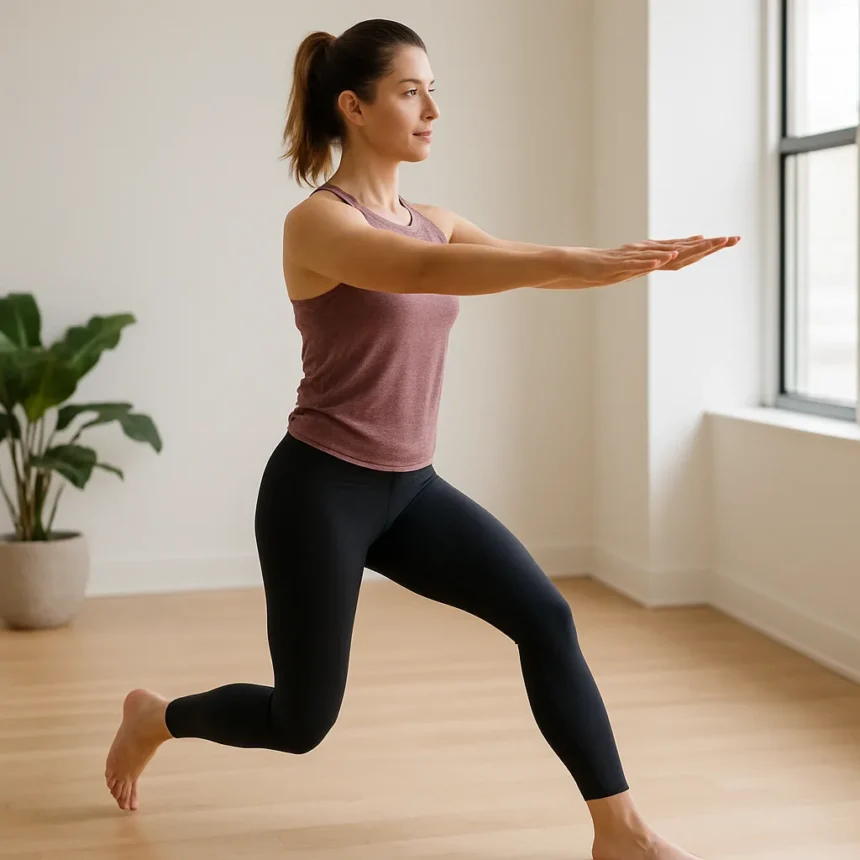
A typical ten-minute standing glute routine moves through a logical progression of patterns. Side steps — stepping out and back in a controlled rhythm — warm up the hips and begin activating the glute medius. Forward and back steps follow, with a slight knee bend throughout to keep the quads and glutes under tension rather than letting the joints lock out passively. The reach-back movement, where you press one foot behind you and hold the contraction, is where you first feel the gluteus maximus engage directly — the cue to press from the heel rather than the toe makes a significant difference in muscle recruitment.

From there, routines typically layer in more demanding patterns. A squatting-back-and-forwards movement has you stepping back at a 45-degree angle, keeping the knee behind the toe and driving the return from the heel. The drive-knee-and-press combines a knee lift with a glute squeeze and explicit core engagement — arms can be added for balance challenge. Lunge-back variations ask you to drop the hips, lift into a kick-back, and land softly with the front knee tracking over the ankle. Heel raises, performed with feet hip-distance apart and lined up with the hipbones, shift the challenge to the calves and demand genuine ankle stability. A wide-leg squat pulse with hips turned out, and a hinge-forward that rounds the spine and rolls back up on the exhale, round out the sequence and address hip mobility alongside strength.
How this compares to mat-based Pilates lower body work
The obvious alternative is a mat-based lower body Pilates session — think hip hinges, Pilates bridges, and side-lying leg series. Fitness Blender’s lower body Pilates content, for example, leans heavily on floor exercises like the Pilates Bridge, which isolates the posterior chain effectively but requires getting down and back up repeatedly. For anyone managing back pain, hip discomfort, or simply working in a small space without a mat, that format presents real friction. The standing format trades some of the deep isolation work you get lying down for functional, weight-bearing movement that also trains balance and coordination — a genuine trade-off, not a downgrade.



A ten-minute standing session from a channel like Khetanya Henderson’s PS Fit incorporates squat holds, plié pulses, and heel presses but does require a mat for some movements. FitLara’s standing full-body routine adds arms into the mix, making it a fuller-body challenge if glute isolation is not the sole priority. The no-equipment, no-mat, no-floor versions — like the twelve-exercise sequence structured around sixty seconds per move — are the most accessible entry point for complete beginners or those easing back into movement.
Is 10 minutes of standing Pilates enough to see results?
Ten minutes is not a magic number, but it is enough to be meaningful if the movements are performed with genuine attention to form cues — heel drives, knee tracking over the toes, active core engagement throughout. The format works because Pilates principles demand quality over quantity: a slow, controlled heel raise with the feet properly aligned at hip-distance activates stabilising muscles that a fast, sloppy squat ignores entirely. Consistency across multiple sessions per week will matter far more than the duration of any single session.
What equipment do you need for a standing Pilates glute workout?
Most standing Pilates glute routines require no equipment at all — just enough floor space to step side to side. Optional additions mentioned across routines include a resistance band, ankle weights, or a mat if you prefer cushioning underfoot. The Mira Mat is referenced in at least one similar workout context, but any non-slip surface works.
Can standing Pilates help with back and hip pain?
The standing format is specifically suited to people managing back or hip discomfort, since it avoids the floor transitions and spinal loading that mat work can involve. Movements like the hinge-forward with a rounded spine and soft knees, or the heel-raise sequence, address hip mobility and posterior chain activation without compressing the lower back. That said, anyone with an existing injury or chronic condition should get clearance from a healthcare professional before starting.



How is standing Pilates different from a regular bodyweight squat workout?
The difference is in the intentionality of movement. A standard bodyweight squat workout typically prioritises load and repetition. Standing Pilates sequences use slower tempos, breathing cues, precise foot placement, and deliberate muscle engagement — pressing knees outward, grounding through heels and the balls of the feet, squeezing the glute at the top of a movement rather than just completing the range of motion. The result is a lower-intensity session that trains coordination and body awareness alongside strength, which makes it genuinely complementary to heavier training rather than a replacement for it.
Standing Pilates for glutes is not a trend to dismiss as too gentle to matter. The format is precise, accessible, and surprisingly effective when the form cues are followed — and with free ten-minute routines widely available, there is no barrier to trying it today. Start with the basics, focus on heel drives and knee alignment, and build from there.
Edited by the All Things Geek team.
Source: Tom's Guide