Android’s Tap to Share feature is a gesture-based file-sharing capability under development across Samsung’s One UI 9, Google Play Services, and Android 17, designed to enable AirDrop-style transfers by holding phones close together. The leaked code strings reveal a deceptively simple interaction model: “Just hold the top of your phone close to the device, and the files will be sent.” This represents Google and Samsung’s answer to Apple’s ubiquitous AirDrop, and the evidence suggests it is further along than previously known.
Key Takeaways
- Tap to Share appears in One UI 9, Google Play Services, and Android 17 code with specific UI strings and descriptions
- Feature previously called “Gesture Exchange” internally, initially limited to contacts but now linked to Quick Share for broader file transfers
- Leaked code includes dialog messages: “Requesting to %1$s” and “Sent to %1$s”, indicating active sending states
- Aims to expand Quick Share across multiple Android brands and devices, not just Samsung phones
- No confirmed launch date or official announcement from Google or Samsung yet
What Android Tap to Share Actually Does
Android Tap to Share is a system-level feature that simplifies file and contact sharing by replacing manual selection with a physical gesture. Instead of opening an app, finding a contact, and tapping share, users simply hold their phone’s top near another device. The feature handles the rest—detecting proximity, initiating the transfer, and managing the handoff. This differs fundamentally from Quick Share’s current model, which requires opening the app and selecting a recipient manually.
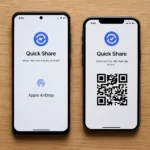
The leaked code strings provide the clearest picture yet of how the feature will guide users through the process. Dialog messages reference “Requesting to %1$s” and “Sent to %1$s”, suggesting the system will display the recipient’s name and confirm successful transfers. A summary string reads “Tap your phone with someone”, emphasizing the simplicity Google and Samsung are targeting. The feature description—”Just hold the top of your phone close to the device, and the files will be sent”—suggests no additional taps or confirmations beyond the physical proximity trigger, though the code evidence does not clarify whether both devices must initiate the action or if one can push files unilaterally.
How It Compares to Apple’s AirDrop and Quick Share
AirDrop has dominated cross-device sharing for years, but it requires users to open Control Center, enable AirDrop, and wait for nearby devices to appear—a friction point many users find tedious. Android Tap to Share aims to eliminate that friction entirely by making the gesture the sole interface. Unlike AirDrop’s range limitations and occasional connectivity hiccups, Tap to Share’s reliance on NFC-like proximity detection could theoretically offer more predictable, intentional transfers.


Quick Share, Google and Samsung’s existing cross-platform sharing tool, already bridges the gap between Android and iOS in some contexts. But Quick Share still requires opening the app and selecting recipients, making it slower than AirDrop for casual transfers. Tap to Share builds on Quick Share’s infrastructure—the code evidence links the new feature directly to Quick Share’s backend—but replaces the UI friction with a single gesture. This suggests Google and Samsung are not abandoning Quick Share but rather evolving it into a more competitive alternative to AirDrop.
The distinction matters for ecosystem strategy. AirDrop works exclusively within Apple’s ecosystem. Quick Share works across Android and iOS. Tap to Share, based on the leaked code, appears designed to work across multiple Android manufacturers, not just Samsung devices, potentially giving Android users a unified gesture-based sharing standard that Apple users cannot access.


Where Tap to Share Appears in Android’s Codebase
The evidence for Tap to Share spans three critical layers of Android’s software stack, each suggesting different stages of development and deployment. Samsung’s One UI 9 contains explicit UI strings and descriptions, indicating the feature is being integrated into Samsung’s custom Android skin. Google Play Services, the middleware layer that powers many Google services across all Android devices, also contains references to Tap to Share, suggesting Google intends to roll it out broadly rather than limit it to Samsung phones.
Most significantly, Android 17 itself includes Tap to Share code. This is the system-level integration point—the feature would be available to any manufacturer that chooses to implement it, similar to how Bluetooth or NFC sharing works today. The presence in Android 17 code, rather than just in Samsung’s One UI, signals that Google views this as a platform-wide feature, not a Samsung exclusive. This architecture mirrors how Google approached Quick Share’s rollout, making it available system-wide while allowing manufacturers like Samsung to add their own UI refinements.
What the Leaked Code Tells Us About Timing
Leaks sourced from Telegram and AssembleDebug show that Tap to Share is not a theoretical feature—it exists in working code with complete UI strings, dialog messages, and integration points. The specificity of the leaked strings suggests the feature has moved beyond early prototyping. Developers have written and tested the user-facing copy (“Requesting to %1$s”, “Sent to %1$s”, “Tap your phone with someone”), debugged the dialog flows, and integrated it into multiple Android versions simultaneously.
However, the absence of any official announcement or public-facing documentation means the feature is still under wraps. Google and Samsung have not confirmed a launch date, regional availability, or which devices will support it first. The code evidence indicates the feature could arrive in One UI 9 (Samsung’s next major update), but Samsung has not officially announced One UI 9’s release timeline. Similarly, Android 17’s rollout schedule remains unconfirmed, though it is expected later this year based on Google’s typical release cycle.

Why This Matters Now
Android’s file-sharing experience has long lagged behind iOS in simplicity and reliability. While AirDrop is not perfect, its single-gesture interface has become the gold standard for casual transfers. Quick Share closed much of the gap, but the requirement to open an app and select a recipient kept it from matching AirDrop’s friction-free appeal. Tap to Share, if implemented as the code suggests, could finally give Android users a genuine competitive advantage—a sharing method that works across brands and requires nothing but a physical gesture.
The timing is also significant. As Android fragmentation increases and manufacturers seek differentiation, a system-level feature that works across brands addresses a real pain point. Users with mixed Android devices (a Samsung phone, a OnePlus tablet, a Google Pixel) would benefit from a universal gesture-based sharing protocol. Apple’s ecosystem advantage partly stems from the seamless experience between devices. Tap to Share, implemented across Android, could begin to level that playing field.
Is Tap to Share confirmed for my device?
Not yet. The feature exists in code for One UI 9 (Samsung), Google Play Services, and Android 17, but Google and Samsung have not officially announced which devices will support it or when it will roll out. Based on the code evidence, Samsung devices running One UI 9 and any Android device running Android 17 would be eligible, but official confirmation is still pending.
How does Tap to Share differ from Quick Share?
Quick Share requires opening an app and selecting a recipient manually. Tap to Share replaces that workflow with a single gesture—holding phones close together. Both likely use the same backend infrastructure, but Tap to Share simplifies the user-facing interaction to match AirDrop’s simplicity.
Will Tap to Share work between Android and iPhone?
The leaked code does not clarify cross-platform compatibility with iOS. Quick Share currently supports some iPhone integration, but Tap to Share’s architecture is not yet detailed enough to confirm whether Apple devices will be supported. The feature appears designed primarily for Android-to-Android transfers.
Android Tap to Share represents a genuine step forward for Android’s sharing ecosystem, but it remains unconfirmed vaporware until Google and Samsung make an official announcement. The leaked code evidence is compelling—the feature is real, functional, and further along than expected. Whether it launches this year or next, and whether it delivers the frictionless experience the code promises, will determine whether Android finally catches up to AirDrop or remains one gesture behind.
Edited by the All Things Geek team.
Source: Android Central