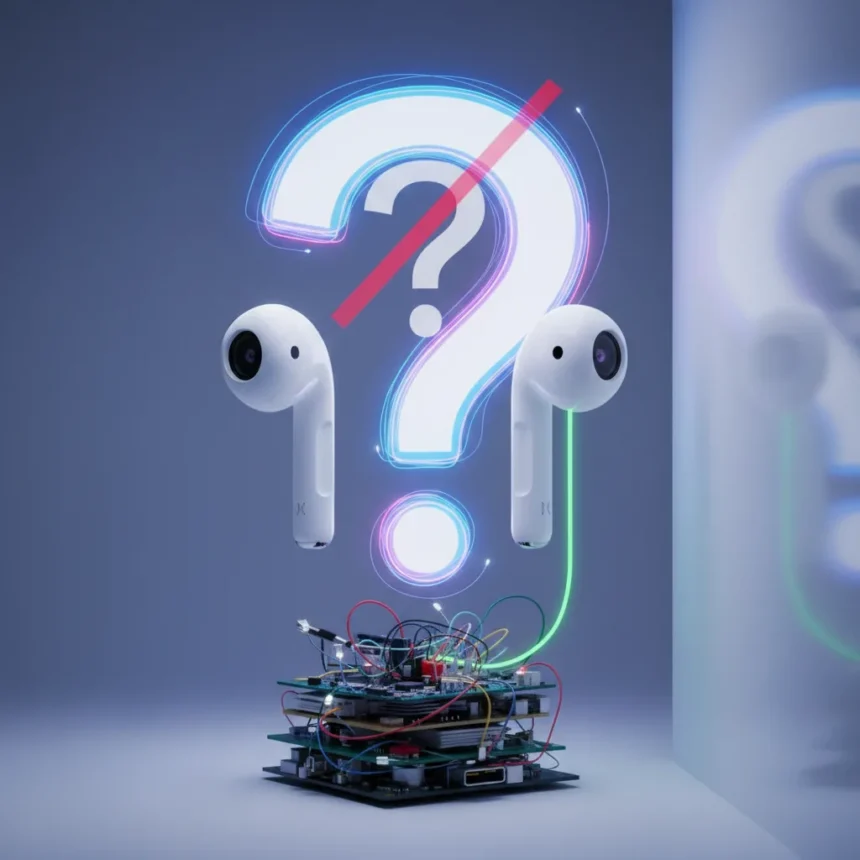
Apple’s camera-equipped AirPods are entering final testing stages, with production tipped for 2026 or sooner. But before you imagine earbuds that snap photos, understand what Apple is actually building: infrared modules similar to Face ID sensors in iPhones, designed to detect movement, recognize in-air gestures, and feed contextual awareness to Apple’s ambient computing ambitions.
Key Takeaways
- Apple is developing infrared camera modules for next-generation AirPods, not photo-taking devices.
- The cameras enable Vision Pro gesture control, obstacle avoidance, and enhanced Siri with environmental awareness.
- Production timeline is 2026 or before; standard AirPods Pro 3 launch September 9 with hearing health features.
- Competitors like OpenAI’s Sweetpea earbuds and Meta’s camerabuds are pursuing similar ambient computing strategies.
- Apple has filed multiple patents on in-air gesture control for device interaction.
What camera-equipped AirPods actually do
The infrared cameras in these AirPods are not designed to record video or photograph your surroundings. Instead, they function as environmental sensors that detect movement within their field of view, enabling gesture recognition and spatial awareness. This architecture mirrors the Face ID sensors embedded in iPhones and iPads, repurposed for a different use case: making earbuds aware of the world around you rather than just the audio flowing through them.
According to analyst Ming-Chi Kuo, the cameras are capable of detecting movement and supporting Vision Pro integration through gesture control. Beyond that, the sensors unlock accessibility features like obstacle avoidance for users with visual impairments, enhanced Siri responses based on context, and spatial audio that adapts to your environment. Apple has filed multiple patents on in-air gestures for device control, suggesting the company sees hand movements near your ears as a natural interaction model for future wearables.
Why Apple wants them now
This is not a feature Apple dreamed up in isolation. The project originated years ago, was paused, then revived as part of Apple’s broader spatial computing and Apple Intelligence strategy. The timing matters: Apple is positioning the Vision Pro as the centerpiece of its next computing era, and camera-equipped AirPods would be the natural companion device—lightweight spatial computing hardware you wear all day, not just when you strap on a headset.


The standard AirPods Pro 3, launching September 9, will include an in-ear heart rate sensor and temperature detector, plus hearing test and hearing aid features. But the camera variant represents Apple’s premium tier, a product aimed at users who want their earbuds to do more than play music and take calls. It is a deliberate escalation of the AirPods lineup, mirroring how Apple sells AirPods 4 alongside AirPods 4 with active noise cancellation—same form factor, different capabilities, different price point.
The competition is already moving
Apple is not alone in this vision. OpenAI is developing Sweetpea earbuds, codenamed to rival and potentially replace AirPods, with a custom 2nm processor and AI features designed to command Siri through voice. Meta has released camera-equipped headphones for world recognition without requiring a full headset, pursuing similar environmental awareness goals. The race is on to make earbuds the hub of ambient computing, and whoever gets the software right will win the ecosystem.



This competitive pressure explains why Apple is accelerating the timeline. If AirPods with cameras launch in 2026, they will not be first to market—but they will arrive with Apple’s ecosystem advantage, tight integration with iPhone and Vision Pro, and the company’s track record of making AI features work reliably at scale.
Do we actually need this?
The harder question is whether camera-equipped AirPods solve a real problem or create an answer in search of a question. Gesture control sounds elegant in demos, but most users already have their phones in their pockets. Obstacle avoidance is genuinely useful for accessibility, but it does not require infrared cameras in earbuds—it could live in a Vision Pro or a dedicated wearable. Enhanced Siri based on context is interesting, but Siri’s core problem is not awareness of your environment; it is understanding what you actually want.
The hearing health features in standard AirPods Pro 3 are more immediately compelling. The hearing aid mode in AirPods Pro 2 is FDA-approved and functions similarly to how the Apple Watch ECG app screens for heart problems. That is a feature with real-world utility, not a speculative ambient computing play. A temperature detector and in-ear heart rate sensor address user needs that exist today.
Camera-equipped AirPods, by contrast, are a bet on a future where infrared sensors in your ears become as essential as microphones. That future might arrive. Or Apple might find that most users never enable the gesture features, prefer not to wear devices that sense their surroundings, or simply do not care about seamless Vision Pro integration because they do not own a Vision Pro.



When will they actually arrive?
Production is tipped for 2026 or before, but that timeline has shifted before. Apple originally announced this project years ago, paused it, and revived it more recently. Consumer electronics timelines are notoriously slippery, especially for experimental hardware like infrared-sensing earbuds. Expect delays. Expect feature cuts. Expect the final product to look different from the prototype.
Are camera-equipped AirPods worth waiting for?
That depends on whether you care about spatial computing. If you are a Vision Pro owner or plan to be one, infrared-sensing AirPods are a logical companion device. If you are content with standard AirPods Pro 3—which offer hearing health features, better audio, and active noise cancellation without the complexity of environmental sensing—there is no reason to wait. Apple will likely price the camera variant as a premium product, and premium products need to justify their cost with features that matter to you personally.
Will OpenAI’s Sweetpea earbuds be better?
OpenAI’s Sweetpea earbuds are designed to rival AirPods with custom AI features and a unique design, with production ramping to 5 devices by Q4 2028. But Sweetpea is still vaporware—no shipping date, no real-world reviews, no proven ecosystem integration. Apple’s advantage is not just hardware; it is the ecosystem. Camera-equipped AirPods will work smoothly with iPhone, iPad, Mac, Vision Pro, and Apple Watch. Sweetpea will need to prove it can match that integration while competing against Apple’s resources and installed base.
The real story here is not whether camera-equipped AirPods are innovative—they are. It is whether they represent a genuine shift in how we interact with wearables, or just another feature that sounds compelling in a press release but rarely gets used in real life. Apple is betting big on spatial computing as the next era of personal technology. Camera-equipped AirPods are the company’s way of making that bet wearable, literally. Whether that bet pays off depends entirely on whether the software makes the hardware feel necessary rather than gimmicky.
Where to Buy
Edited by the All Things Geek team.
Source: T3