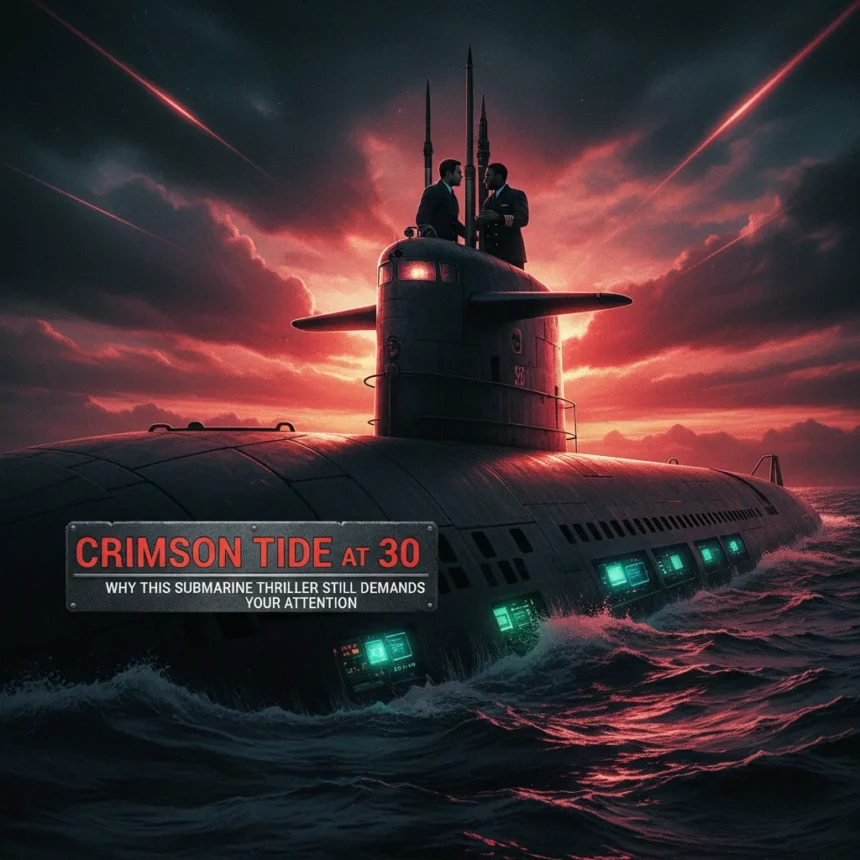
Crimson Tide submarine thriller released in 1995 remains a rare film that makes audiences forget their phones exist. Over three decades later, Tony Scott’s nuclear standoff drama between Denzel Washington and Gene Hackman hasn’t lost its grip on viewers seeking genuine tension and moral ambiguity.
Key Takeaways
- Released in 1995 with a runtime of 1 hour 55 minutes, directed by Tony Scott
- Stars Denzel Washington as Lt. Cmdr. Ron Hunter and Gene Hackman as Capt. Frank Ramsey aboard USS Alabama
- Central conflict: whether to follow orders blindly or verify incomplete launch commands during a post-Cold War crisis
- Hans Zimmer’s score is considered one of his best, building relentless tension throughout
- Contains heavy profanity and violence; rated Very Offensive for mature audiences
Why Crimson Tide Submarine Thriller Still Grips Audiences
The Crimson Tide submarine thriller works because it traps viewers in an impossible ethical box. The USS Alabama receives a fragmented launch order during a crisis involving a breakaway Russian republic. Captain Ramsey wants immediate compliance. Hunter demands verification. Neither man is wrong, and that’s what makes the film unbearable to watch—in the best way. The submarine becomes a pressure chamber where two competent, principled men clash over protocol versus intuition, with nuclear missiles hanging in the balance.
Scott’s direction transforms the sub’s tight corridors into a maze of paranoia and duty. Every metallic clang, every sonar ping, every muffled conversation amplifies the dread. The film doesn’t rely on explosions to create stakes; it relies on the suffocating knowledge that a wrong decision could end civilization. Audiences report being so absorbed they abandon distractions entirely—the phone stays in the pocket.
Hans Zimmer’s score deserves equal credit. The main theme doesn’t announce itself with bombast; it builds, whispers, and tightens around your chest until the only sound that matters is what the captain says next. Few composers have matched Zimmer’s ability to make silence feel dangerous.


The Performances That Anchor the Tension
Washington and Hackman elevate what could have been a gimmicky premise into something genuinely tragic. Washington’s Hunter is the idealist—younger, educated, convinced that procedure exists for a reason. Hackman’s Ramsey is the veteran—battle-tested, convinced that orders are orders, and hesitation kills. Their conflict never becomes a simple good-versus-evil binary. Both men are trying to save lives. They simply disagree on method.
The mutiny that follows is not a action-movie rebellion. It’s a constitutional crisis played out in a metal tube under the ocean. Crew members face impossible choices. Friendships fracture. The film treats the armed conflict between these men with the weight it deserves, never winking at the camera or treating it as spectacle.



How Crimson Tide Submarine Thriller Compares to Other Undersea Thrillers
Crimson Tide submarine thriller occupies a different space than The Hunt for Red October or Das Boot, though all three explore submarine warfare and Cold War tension. Hunt for Red October leans toward espionage and defection; Das Boot is a war film about survival under bombardment. Crimson Tide is a political thriller about command authority and the limits of obedience. The stakes are not military victory but whether a single man’s judgment should override protocol when communication breaks down.
The film’s post-Cold War setting also distinguishes it. The nuclear threat isn’t from an established superpower but from a fractured state with unstable leadership. That scenario felt prescient in 1995 and remains uncomfortably relevant today.
The Ending and Its Aftermath
Some critics argue the film’s resolution feels like a cop-out, unwilling to follow its moral argument to its darkest conclusion. The ending does offer a way out that avoids the catastrophe the first 110 minutes promised. Whether that’s a flaw or a mercy depends on what you wanted from the film. A tighter ending might have been more intellectually satisfying. The ending the film chose is more humane.
by 1996—just one year after the film’s release—actual nuclear launch authority shifted from submarine commanders to the President, making the film’s entire conflict scenario obsolete in real-world practice. That historical footnote doesn’t diminish the film’s power, but it does add an eerie layer: the system the film worried about was already changing.



Does Crimson Tide submarine thriller deserve a rewatch?
Yes, especially if you watched it in the 1990s. The film’s tension doesn’t fade on repeat viewing; it deepens. Knowing how the standoff resolves doesn’t spoil the experience because the real drama is the clash of philosophies, not the plot mechanics. Scott’s direction rewards close attention.
How does Crimson Tide compare to modern submarine thrillers?
Modern submarine films tend to prioritize spectacle and action. Crimson Tide prioritizes conversation and moral weight. That makes it feel slower by contemporary standards but also more substantive. A film that makes you think about command authority and obedience ages better than one built on set pieces.
Why do people recommend putting your phone down for Crimson Tide?
The Crimson Tide submarine thriller demands sustained attention because its tension builds through dialogue and atmosphere, not through jump scares or rapid cuts. Distraction breaks the spell. The film’s power lies in making you sit with two men’s impossible choice and feel the weight of it.
Thirty years after its release, Crimson Tide submarine thriller endures because it respects its audience’s intelligence and refuses easy answers. In an era of streaming, scrolling, and constant distraction, that alone makes it worth the 115 minutes of undivided attention. Washington and Hackman’s performances, Scott’s direction, and Zimmer’s score create something rare: a thinking person’s thriller that never stops moving.
Where to Buy
Buy or rent "Philadelphia" digitally from Amazon now
Edited by the All Things Geek team.
Source: Tom's Guide