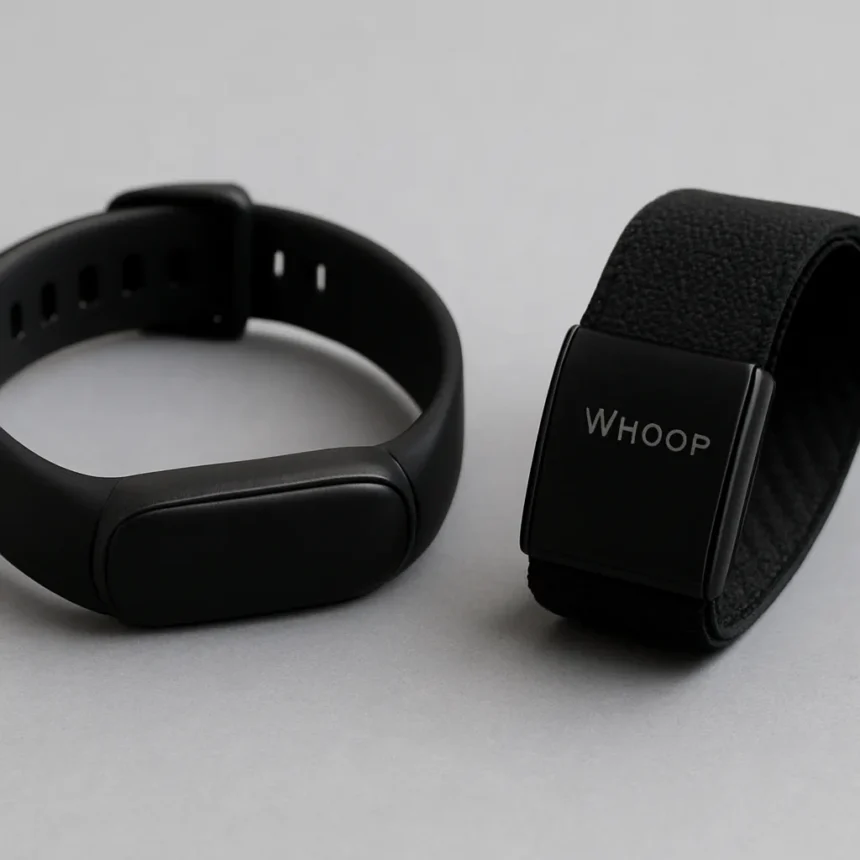
Fitbit Air vs Whoop is shaping up to be the defining screenless tracker debate of 2026. Google just launched the Fitbit Air at $99 with no subscription required, directly challenging Whoop’s premium subscription model. If you’re torn between these two, the choice hinges on whether you want simplicity and affordability or advanced recovery metrics and AI coaching.
Key Takeaways
- Fitbit Air costs $99 upfront with no subscription; Whoop requires $200–$350 yearly
- Fitbit Air weighs 12g and is nearly half Whoop’s size, fitting discreetly on your wrist
- Fitbit Air battery lasts 7 days; Whoop 5.0 runs roughly 14 days between charges
- Whoop excels at advanced metrics: recovery scores, strain analysis, 65+ biomarkers, AI coaching
- Fitbit Air includes 3-month trial of Google Health Premium with Gemini coaching
Fitbit Air vs Whoop: The Core Difference
Fitbit Air vs Whoop fundamentally asks: do you want a tracker that works without a subscription or one that demands ongoing payments for full functionality? Google’s Fitbit Air launches May 26, 2026, at $99 with core tracking free forever. Whoop 5.0, by contrast, costs nothing upfront but becomes a doorstop without an active subscription—roughly $30 monthly or $200–$350 annually depending on your tier. For casual fitness enthusiasts, Fitbit Air wins on cost. For athletes obsessing over recovery optimization, Whoop’s subscription fee feels justified.
The design philosophy differs sharply too. Fitbit Air weighs just 12 grams and features an almost skeletal form factor—it’s visibly narrower and slimmer than Whoop, occupying roughly half the wrist real estate. Whoop is bulkier, more noticeable, which some find intrusive during sleep tracking. Fitbit Air’s screenless approach uses LED light patterns instead: white light for battery status (20–100%), red when critically low, nothing when drained. You control it via double-tap gestures to check battery or dismiss alarms. Whoop displays all data on its wrist display, making information immediately visible.
Fitbit Air Tracking: Everyday Essentials Done Right
Fitbit Air delivers solid baseline health tracking without subscription gatekeeping. It monitors heart rate 24/7, tracks SpO2, resting heart rate, HRV, and includes AFib detection—serious health features for a $99 device. The silent vibration alarm wakes you at your optimal sleep cycle point, a thoughtful touch that prevents grogginess. Battery stretches to 7 days, meaning you charge roughly weekly. You get 140+ activity modes and continuous health data logging. Google sweetens the deal with a 3-month trial of Google Health Premium, which unlocks Gemini coaching—essentially a free AI fitness advisor for a quarter-year.


The trade-off: Fitbit Air won’t calculate recovery scores, strain metrics, or the granular biomarker analysis that serious athletes crave. It’s a tracker for people who want their sleep, steps, and heart health monitored without complexity or recurring charges. Pre-order before May 25 includes $35 Google Store credit, and a Stephen Curry special edition costs $129.99 if you want a branded variant.
Whoop 5.0: The Premium Recovery Platform
Whoop 5.0 is built for optimization obsessives. It pulls biometric data every second, generating recovery scores, strain indexes, and sleep quality analytics that make Fitbit Air look elementary. You get 65+ biomarkers synced from blood work, hormonal insights, blood pressure monitoring, ECG on premium models, and AI-powered coaching tailored to jet lag, stress, and training load. Whoop’s algorithm learns your baseline and alerts you when you’re pushing too hard or under-recovered—the kind of intelligence that endurance athletes and CrossFit enthusiasts depend on.



Battery lasts roughly 14 days, double Fitbit Air’s runtime, though you’re paying $200–$350 yearly for the privilege. The device is inoperable without an active subscription—a dealbreaker if you ever pause or cancel. Whoop targets the premium fitness market where $25 monthly feels reasonable for recovery optimization. If your training depends on data-driven decisions, Whoop justifies its cost. If you’re logging steps and monitoring sleep for general wellness, you’re overpaying.
Design and Comfort: Fitbit Air’s Advantage
Fitbit Air’s screenless, minimalist design is its strongest asset. At 12 grams with a narrow profile, it sits almost invisibly on your wrist. You forget you’re wearing it—ideal for sleep tracking when bulk becomes uncomfortable. Whoop’s larger form factor, while not heavy, occupies more real estate and some find it noticeable during the night. For people sensitive to wrist-worn devices, Fitbit Air’s lightness is a genuine advantage.
The LED status system is clever but requires learning. You’ll tap twice to check battery or dismiss alarms, a gesture-based interface that takes practice. Whoop’s display shows everything instantly—no guessing, no taps required. This is a subjective preference: minimalist elegance versus informational transparency.
Which Should You Buy?
Choose Fitbit Air if you want solid health tracking without subscription lock-in, prefer a discreet wearable, and value simplicity. It’s perfect for people building a fitness habit or monitoring general wellness. The $99 entry point and free core features make it accessible.



Choose Whoop if you’re a serious athlete, understand recovery metrics, and check your strain and recovery scores regularly. You’re paying for algorithmic intelligence and biomarker depth that Fitbit Air doesn’t offer. Whoop justifies its subscription for competitive runners, cyclists, and strength athletes optimizing training loads.
Frequently Asked Questions
Does Fitbit Air require a subscription?
No. Fitbit Air’s core tracking features are free forever. You get 24/7 heart-rate monitoring, SpO2, HRV, AFib detection, and 140+ activity modes without paying. A 3-month Google Health Premium trial is included, but it’s optional after that.
How long does Whoop battery last compared to Fitbit Air?
Whoop 5.0 battery runs approximately 14 days between charges, while Fitbit Air lasts up to 7 days. Whoop’s longer runtime is one advantage of its larger form factor, though both require weekly or bi-weekly charging.
Can you use Whoop without a subscription?
No. Whoop hardware is free with subscription, but the device becomes inoperable without an active paid subscription. You cannot use Whoop as a basic tracker without ongoing payments—it’s subscription-dependent by design.
Fitbit Air vs Whoop ultimately reflects two philosophies: Google’s bet on affordable, subscription-free tracking versus Whoop’s premium recovery optimization platform. For most users, Fitbit Air’s $99 price and lack of subscription make it the smarter first purchase. For serious athletes, Whoop’s biomarker depth and AI coaching justify the annual cost. Neither is objectively better—they’re built for different fitness goals and budgets.
Where to Buy
Edited by the All Things Geek team.
Source: TechRadar