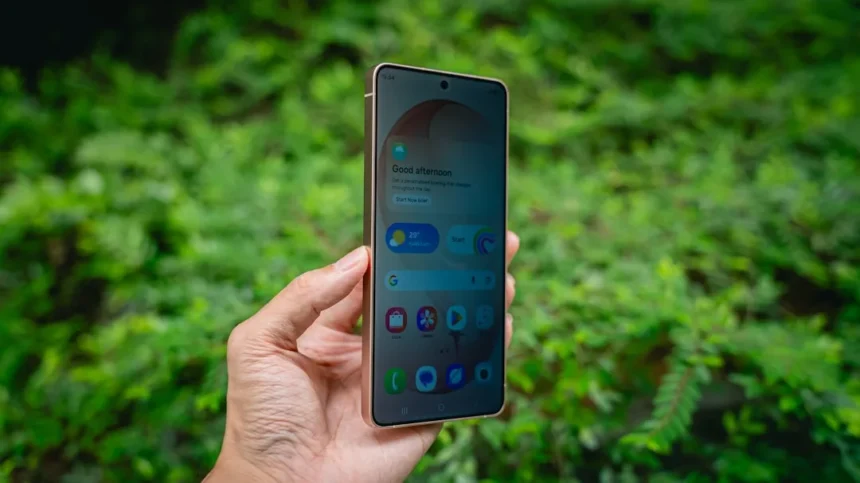
Samsung’s Galaxy S26 Ultra display represents a bold bet: sacrifice peak brightness and viewing angles to prevent strangers from seeing your screen. The Galaxy S26 Ultra display is a 6.9-inch OLED panel made by Samsung, featuring a hardware-integrated Privacy Display that blocks light projected to the sides while keeping the front-facing view intact. It’s a privacy feature that actually works—but the engineering costs are real.
TL;DR: The Galaxy S26 Ultra display peaks at 1,806 nits, down from the S25 Ultra’s 1,860 nits, and dims significantly at wider viewing angles due to its Privacy Display hardware. The 8-bit panel shows less color banding than its predecessor despite lacking true 10-bit color depth.
How the Galaxy S26 Ultra display privacy feature actually works
The Privacy Display is not a software filter or blue-light trick. Samsung built it into the hardware itself—specific pixels on the sides of the panel simply do not emit light when the feature is active. Customize it per app or notification type, and the screen stays visible only to whoever is holding the phone. This is the kind of feature that sounds gimmicky until you realize someone is reading your messages from across a coffee table.
The trade-off is immediate. Lab testing shows the Galaxy S26 Ultra display is measurably darker than the S25 Ultra even with Privacy Display disabled, measuring 1,806 nits against the S25 Ultra’s 1,860 nits. At wider angles, the difference becomes obvious—the S26 Ultra dims noticeably where the S25 Ultra holds its brightness. Straight-on, the difference is almost imperceptible, but tilt the phone and the S26 Ultra looks like it is running at lower brightness.


Galaxy S26 Ultra display color accuracy and banding improvements
Here is where Samsung actually got something right. Despite being an 8-bit panel (16.7 million colors) rather than the rumored 10-bit, the Galaxy S26 Ultra display shows less color banding than the S25 Ultra in dark scenes. Samsung confirmed the 8-bit specification to Android Authority, but improved processing—likely dithering or frame-rate control—reduces visible gradients without the pixel flashing typical of older FRC techniques.
Lab tests using 4K HDR wildlife video reveal the advantage. Dark green gradients on a snake at the eight-second mark show smoother transitions on the S26 Ultra versus visible stepping on the S25 Ultra. Under microscope inspection, no pixel movement or flashing appears, suggesting Samsung is handling the dithering in a way that remains invisible even under magnification. This is a genuine technical improvement, even if it does not match the true 10-bit color depth of competitors like the Honor Magic 8 Pro or OnePlus 15.



The panel uses Samsung’s M14 OLED material, which is thinner and more power-efficient than previous generations, though peak brightness claims based on those leaks remain unverified by actual measurements.
Should you accept the Galaxy S26 Ultra display trade-offs?
The brightness drop is real, but Tom’s Guide reviewer John Velasco argues it is worth the privacy gain. For daily use, the difference in straight-on brightness is imperceptible. The angle penalty is sharper—if you frequently hand your phone to someone next to you or work in open offices, the reduced side-angle brightness becomes a feature, not a flaw.
One caveat: the low-frequency PWM rate makes this display unsuitable for users sensitive to flicker. If you experience headaches or eye strain from certain screens, test this one in person before committing.
The Galaxy S26 Ultra display is exclusive to the Ultra model—lower-tier S26 variants do not get the Privacy Display hardware. That makes this a legitimate flagship differentiator, even if the brightness numbers read as a step backward on spec sheets.



How does the Galaxy S26 Ultra display compare to the S25 Ultra?
The S25 Ultra is brighter (1,860 nits vs. 1,806 nits) and maintains that brightness across wider viewing angles. It also shows more visible color banding in dark scenes, particularly in gradients. The S26 Ultra trades peak brightness for privacy and smoother color gradients. If you value privacy over raw brightness, the S26 Ultra wins. If you spend time outdoors or share your screen frequently, the S25 Ultra remains the safer choice.
Is the Galaxy S26 Ultra display really 10-bit?
No. Samsung confirmed to Android Authority that the panel is 8-bit, not 10-bit. Early leaks suggested 10-bit color depth, but that did not materialize. The improved banding reduction comes from processing, not from additional color data.
Does the Privacy Display on the Galaxy S26 Ultra actually prevent people from seeing your screen?
Yes. The hardware blocks light projected to the sides, making the screen invisible to anyone viewing from an angle. It is customizable per app or notification, so you control when the privacy feature activates. It is one of the few phone privacy features that does not rely on software gimmicks or hope.
The Galaxy S26 Ultra display is a reminder that smartphone engineering is not just about bigger numbers. Samsung chose to solve a real problem—shoulder surfers and nosy coworkers—at the cost of brightness and viewing angles. That is a legitimate trade-off, not a failure. Whether it is the right one depends on how much you value privacy over peak brightness.
Edited by the All Things Geek team.
Source: Android Central