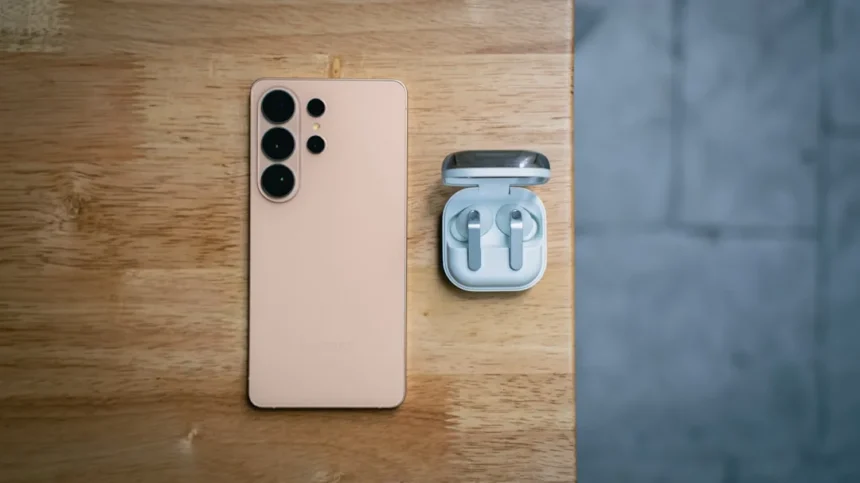
The Samsung Galaxy S26 Ultra is Samsung’s boldest flagship yet, and after spending time with it, I can confirm that some of its innovations genuinely challenge why anyone would stick with iPhone. Yet I’m still not switching, and that tension is exactly what makes this phone worth examining closely.
Key Takeaways
- Galaxy S26 Ultra debuts world’s first built-in Privacy Display that limits side-angle viewing by assigning it to a button press
- Snapdragon 8 Elite Gen 5 delivers CPU up to 19% faster, NPU 39% faster, and GPU 24% faster than S25 Ultra
- 200 MP main camera with F1.4 aperture and 50 MP telephoto with 5x optical zoom plus 100x Space Zoom via AI
- Slimest Ultra ever: 0.3 mm thinner than predecessor, weighing 214 grams with refined design and thermal improvements
- 5000 mAh battery supports 75% charge in 30 minutes via Super Fast Charging 3.0
Samsung Galaxy S26 Ultra’s Privacy Display Changes the Game
The Privacy Display isn’t just a marketing gimmick—it’s the first time I’ve seen a phone maker actually solve a real problem that affects millions of users daily. The technology limits viewing angles from the side, meaning someone sitting next to you on a train or plane cannot see your screen without leaning directly in front of it. You assign it to a side button double-press, toggling privacy on demand. This is genuinely clever hardware, not another AI chatbot or photo filter dressed up as innovation.
Apple hasn’t shipped anything remotely like this, and that’s a gap worth acknowledging. Privacy Display addresses a tangible security concern that matters more than most flagship features get credit for. Yet one smart privacy feature, no matter how well-executed, doesn’t outweigh the ecosystem friction I’d face switching platforms.
The Camera System That Makes You Reconsider
The Samsung Galaxy S26 Ultra’s camera setup is where Android’s hardware advantage becomes undeniable. A 200 MP main sensor with an F1.4 aperture and a 50 MP telephoto with F2.9 and 5x optical zoom, plus AI-powered 100x Space Zoom, deliver flexibility that iPhone’s tighter focal range simply cannot match. Low-light performance improves thanks to those wider apertures, and the Nightography refinements make night shots cleaner than they have any right to be.


Photo Assist, Samsung’s AI editing suite, handles object removal and addition, day-to-night conversions, and wardrobe edits with a fluidity that feels more intuitive than competing tools. The front camera now includes an AI ISP for sharper selfies, and Super Steady with horizontal lock keeps video rock-solid during panning. These aren’t theoretical improvements—they work in daily shooting.
The 10-bit display panel, debuting on a Samsung phone, expands color depth precision by 4x and pairs with ProScaler to keep scaled content sharp. If you shoot in ProRes on iPhone or use color-graded footage, you’ll notice the difference. But again, camera excellence alone doesn’t guarantee a switch when your entire photo library, iCloud integration, and editing workflows live in Apple’s ecosystem.


Performance That Justifies the Flagship Price
The Snapdragon 8 Elite Gen 5 for Galaxy—a customized variant—delivers performance gains that matter for sustained multitasking and gaming. CPU speeds jump up to 19% over the S25 Ultra, the NPU accelerates AI tasks 39% faster, and the GPU gains 24%. Pair that with a redesigned Vapor Chamber, the largest thermal interface ever on a Galaxy phone, and the S26 Ultra handles demanding workloads without throttling.
The 5000 mAh battery pushes 31 hours of video playback, and Super Fast Charging 3.0 reaches 75% in 30 minutes. These are the spec-sheet gains that matter—real thermal engineering and power efficiency, not just marketing math. Compared to the S25 Ultra, the refinements are tangible: a thinner chassis at 214 grams with rounded curvature that feels premium in hand, and a unified color palette that avoids the visual fragmentation of previous generations.
Why I’m Still Team iPhone Despite All This
Here’s the honest part: the Samsung Galaxy S26 Ultra is an exceptional phone that does several things better than iPhone. Privacy Display is genuinely innovative. The camera system is more versatile. Performance is snappy and sustained. Yet switching platforms means abandoning years of ecosystem investment—iMessage threads with family, health data synced across Watch and iPhone, photos automatically backed up and organized in a way that feels native.
Android‘s openness is real, but it comes with fragmentation that iPhone users never experience. Settings vary between Samsung and Google apps. Default behaviors shift depending on which service you prioritize. For a power user who enjoys tinkering, that flexibility is a feature. For someone who wants their phone to simply work without constant optimization, iPhone’s walled garden delivers peace of mind that no individual feature can replicate.

The S26 Ultra proves that Samsung’s innovation engine is firing on all cylinders. Privacy Display alone justifies the R&D investment, and the camera gains are tangible. But flagship phones aren’t chosen on specs alone—they’re chosen on the sum of all the moments when you’re not thinking about your phone at all. That’s where ecosystem matters most.
Is the Samsung Galaxy S26 Ultra worth upgrading to from the S25 Ultra?
If you own an S25 Ultra, the gains are incremental: thinner design, better thermal management, and camera refinements that improve low-light and zoom performance. The Privacy Display and 10-bit panel are genuinely new, but they don’t fundamentally change how you use the phone. Upgrade if you shoot extensively in low light or value the privacy feature. Otherwise, wait for next year’s generation.
How does the Galaxy S26 Ultra compare to the standard Galaxy S26?
The Ultra model distinguishes itself with a 6.9-inch display, 200 MP main camera versus smaller sensors on the base S26, 5000 mAh battery, and the full suite of AI editing tools. The standard S26 shares the same processor and Galaxy AI features but sacrifices camera range and battery capacity. Choose the Ultra if you prioritize photography and all-day battery life; the standard S26 suffices for everyday users.
What makes the Privacy Display a breakthrough feature?
The Privacy Display is the first built-in mobile privacy technology that physically limits viewing angles from the side, assignable to a button press. Unlike screen protectors or privacy film, it’s hardware-integrated and toggleable, solving a real security concern for users in public spaces without sacrificing display quality when privacy mode is off.
The Samsung Galaxy S26 Ultra is proof that Android flagships continue to innovate in ways that matter. Privacy Display, thermal engineering, and camera versatility are real advantages. Yet choosing a phone involves more than specs—it’s about the ecosystem you’ve already invested in and the friction you’re willing to tolerate for marginal gains. For iPhone users, the S26 Ultra makes a compelling case. It just didn’t make a compelling enough case for me.
Where to Buy
Edited by the All Things Geek team.
Source: TechRadar