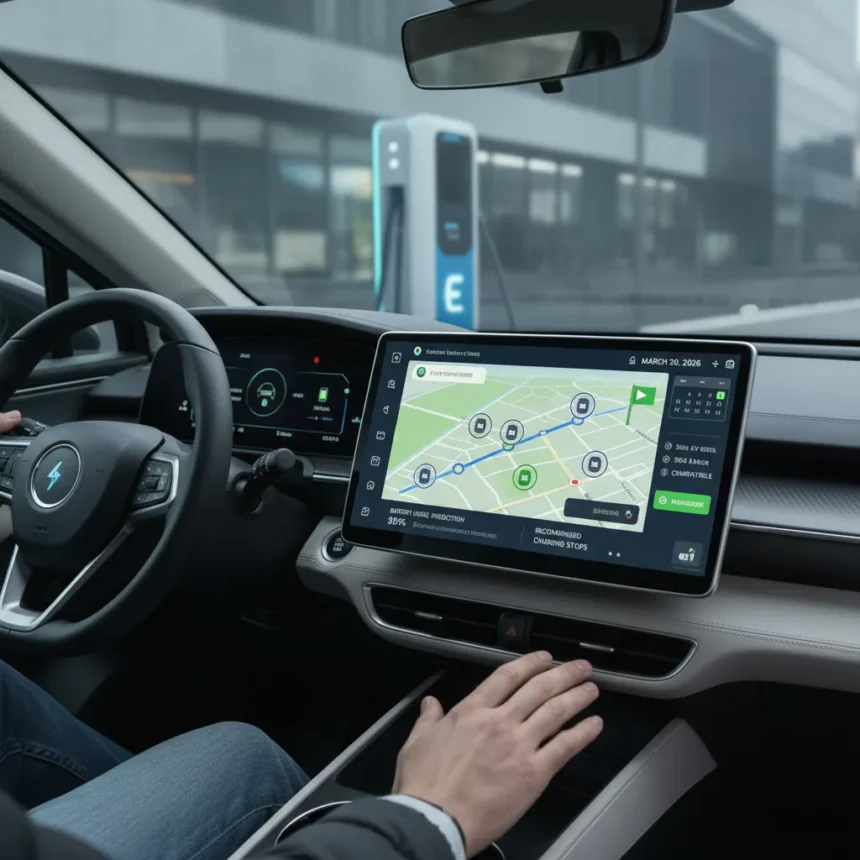
Google Maps EV trip planning is expanding to Android Auto, bringing AI-powered battery predictions and charging recommendations to over 350 electric vehicle models across 15 brands starting March 30, 2026. For EV drivers in the US, this means one less app to juggle during long trips—Maps now handles the entire range-anxiety puzzle without switching between tools.
Key Takeaways
- Google Maps EV trip planning rolls out to Android Auto on March 30, 2026, for 350+ models from 15 brands including Tesla, Hyundai, and BMW
- Feature predicts battery usage, recommends charging stops, and updates ETAs based on vehicle specs, traffic, elevation, and weather
- Setup takes two minutes: Settings > Your vehicles > Electric, then enter make, model, year, and trim
- Requires Google Maps version 25.44 or newer on Android devices
- Powered by Google AI analyzing vehicle weight, battery capacity, and real-time driving conditions
How Google Maps EV Trip Planning Works
Google Maps EV trip planning uses AI and advanced energy models to predict exactly how much battery you will use on any route. The system analyzes your vehicle’s weight, battery size, real-time traffic conditions, road elevation, and current weather to calculate consumption with precision that generic EV apps simply cannot match. When you set a destination in Android Auto or the Maps app, you enter your current battery level, and Maps immediately shows recommended charging stops, estimated arrival battery percentage, and a revised ETA that includes charging time.
The setup process is straightforward. Open Google Maps on your Android device, navigate to Settings, select Your vehicles, choose Electric, and enter your vehicle’s make, model, year, and trim. Once configured, every trip plan automatically accounts for your specific EV’s characteristics. If you want to arrive with more battery than Maps recommends, you can set a preferred arrival battery level, and Maps will add extra charging stops to meet that target. This flexibility matters because range anxiety is not just about reaching the destination—it is about feeling confident you have buffer charge left.
Which EVs Are Supported Right Now
The rollout covers over 350 car models from 15 brands: Audi, BMW, Chevrolet, FIAT, Genesis, Hyundai, Jaguar, Kia, Lexus, Lucid, Mercedes-Benz, Nissan, Porsche, Subaru, Toyota, and Volkswagen. That is a significant chunk of the EV market, though not every trim level of every model may be included. Google states that more models are coming soon, and the company has published a support page where you can check if your specific vehicle is compatible. The feature requires Google Maps version 25.44 or newer, so update your app if you have not already.


What makes this expansion noteworthy is the breadth of manufacturer participation. Google Maps EV trip planning is not locked to a single brand or ecosystem—it works across traditional automakers and EV specialists, which means the feature solves a real problem for millions of drivers regardless of which vehicle they own. Compare this to native EV systems built into individual vehicles, which vary wildly in quality and usability. Maps brings a consistent, AI-powered experience to the dashboard.
Why This Matters for EV Drivers
Range anxiety remains the top reason people hesitate to buy electric vehicles. Knowing where to charge and how much battery you will have left is not a luxury—it is a necessity on longer trips. Until now, EV drivers had to switch between Maps for navigation, their car’s native system for battery info, and third-party charging apps to plan routes confidently. Google Maps EV trip planning eliminates that friction by consolidating everything into one interface. The feature reduces the need to juggle multiple apps, which is especially valuable when you are driving and need quick answers.



The AI-powered battery predictions are the real differentiator here. Unlike static range estimates that assume ideal conditions, Google Maps accounts for traffic, weather, elevation changes, and your vehicle’s specific weight and battery size. A Porsche Taycan and a Chevy Bolt have completely different efficiency profiles—Maps understands that and calculates accordingly. This personalization is what separates a helpful feature from a gimmick.
Android Auto vs. Native EV Systems
Android Auto integration gives Google Maps a major advantage over native vehicle systems that are often outdated or clunky. Many EV manufacturers built their trip planning into the car’s infotainment system years ago, and some have not updated significantly since. Google, by contrast, pushes updates to Maps constantly and can improve the algorithm without requiring a vehicle firmware update. For drivers with older EVs or vehicles from manufacturers with weak software teams, Android Auto access to Google Maps EV trip planning is a lifeline.
That said, native systems have one advantage: they can access real-time battery data directly from the vehicle’s onboard computer. Android Auto receives battery info through a manual input step, which means you have to remember to enter your current charge level before planning a trip. It is not a dealbreaker, but it is an extra step that native systems skip.
What Happens After March 30, 2026?
The rollout begins in the US on March 30, 2026, and will expand to additional regions over time, though Google has not announced specific international timelines. The company also plans to add more vehicle models to the supported list as it completes compatibility testing. If your EV is not on the list yet, checking Google’s support page periodically is worth the effort—your model may be added within weeks.



The feature is free to all Google Maps users with compatible vehicles. There is no subscription, no premium tier, and no hidden costs. That accessibility is important because range anxiety affects EV owners across all income levels, and locking this feature behind a paywall would undermine its impact.
Is Google Maps EV trip planning available outside the US?
As of the March 30, 2026 rollout, the feature is launching in the US only. Google has not announced availability dates for Europe, Asia, or other regions, though international expansion is likely given the global EV market. Drivers outside the US should check Google’s official announcements for regional rollout timelines.
Do I need a specific Android Auto version for this feature?
You need Google Maps version 25.44 or newer on your Android device to access EV trip planning features in Android Auto. Update your Google Maps app from the Play Store if you have an older version. Android Auto itself does not require a separate update—it will display the Maps features automatically once the app is updated.
Can I use Google Maps EV trip planning with a car that is not on the supported list?
Not yet. Google Maps EV trip planning requires your specific vehicle make, model, year, and trim to calculate accurate battery predictions. If your EV is not on the supported list, the feature will not work because Google does not have the energy model data for your vehicle. However, Google is adding more models regularly, so check the support page periodically to see if your car has been added.
Google Maps EV trip planning is a rare example of a major tech company solving a real problem that affects millions of people. By bringing AI-powered battery predictions and charging recommendations to Android Auto, Google has removed a significant friction point from EV ownership. The rollout starting March 30, 2026, covers enough vehicles that most US EV drivers will find their car on the list, and the free, app-based approach means adoption should be swift. For anyone considering a long road trip in an electric vehicle, this feature just made the decision much easier.
Where to Buy
Edited by the All Things Geek team.
Source: T3