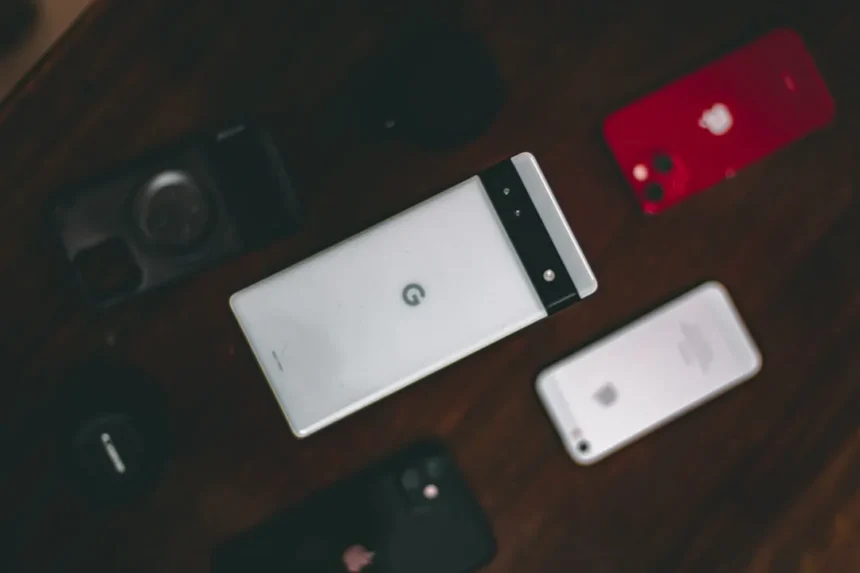
The Google Pixel 11 is expected to launch toward the end of summer 2026, marking Google’s most ambitious performance push yet. After years of playing catch-up on raw processing power, the Pixel 11 will be powered by the Tensor G6 chipset built on TSMC’s latest 2nm process—a generational leap designed to finally close the performance gap with Samsung and Apple flagships.
Key Takeaways
- Pixel 11 launches late summer 2026 with Tensor G6 on TSMC’s 2nm process
- Tensor G6 targets Snapdragon 8 Gen 3 and A-series chip performance levels
- Advanced facial recognition system (Project Toscana) in development to rival Apple Face ID
- Pixel 11 Pro expected with Tensor G6; no camera upgrades confirmed yet
- Broader 2026 lineup includes Pixel 10a, Pixel 11 Pro, and Pixel 11 Pro Fold
Tensor G6: The Performance Breakthrough Google Needs
The biggest change for the Pixel 11 Pro is the internal upgrade to Tensor G6. This is not a minor refresh. The current Pixel 9 with Tensor G4 scores 1,758 in Geekbench single-core and 4,594 in multi-core, trailing the Galaxy S24’s Snapdragon 8 Gen 3 (2,235 single-core, 6,922 multi-core) and iPhone 15’s A16 Bionic (2,518 single-core, 6,179 multi-core). The Tensor G6 on 2nm aims to eliminate those gaps entirely.
Google’s move to TSMC’s 2nm process is strategic. Samsung has struggled with its own 3nm Exynos chips, and rumors suggest Samsung’s Exynos 2600 will also move to 2nm. By adopting the same latest process, Google positions the Pixel 11 to compete directly with Apple’s A-series efficiency and performance. This is where the real battle happens—not in marketing claims, but in sustained performance under load and power efficiency across a full day of use.
The Facial Recognition significant shift: Project Toscana
Google is developing an advanced facial recognition system codenamed Project Toscana, designed to rival Apple’s Face ID. Testing has shown the system performing reliably across various lighting conditions, with infrared technology likely playing a key role—a feature Google last included on the Pixel 4. The prototype tested used an under-display IR camera despite a punch-hole design, suggesting Google is exploring multiple implementation approaches before finalizing the production version.


This is significant because facial recognition remains one of the few areas where iPhones genuinely outperform Android phones. Face ID works in near-darkness, through sunglasses, and with half your face covered—capabilities that have eluded most Android manufacturers. If Project Toscana delivers comparable reliability, it removes a major advantage Apple has held for years. However, early prototypes are not final products, and the exact implementation remains unconfirmed.
What About the Camera and Design?
Here is where expectations should be tempered. The Pixel 11 Pro’s biggest internal upgrade is the Tensor G6, but no camera upgrades have leaked yet. The Pixel 10 Pro is already described as a slightly fancier version of the Pixel 9 Pro, and the Pixel 11 Pro may follow the same incremental pattern. Google’s camera strength has always come from computational photography—software, not hardware—so a stable sensor lineup is not necessarily a weakness. Still, by 2026, readers expecting a major camera redesign should prepare for disappointment.



Design details remain sparse. Google has been unusually tight-lipped about the Pixel 11, and it is possible the company has simply kept secrets better than usual. Leaks will likely accelerate as 2026 approaches, but for now, assume the Pixel 11 will look familiar rather than radically different from its predecessors.
The Broader 2026 Pixel Lineup
The Pixel 11 is not arriving alone. Google’s 2026 strategy includes at least five handsets: the Pixel 10a (budget tier, early 2026), the Pixel 11, the Pixel 11 Pro, and the Pixel 11 Pro Fold, a tablet-phone hybrid. The Pixel 10 with improvements is also expected in August 2025 as a precursor to the Pixel 11 launch. This expansion signals Google’s commitment to capturing different market segments, though it also raises questions about differentiation between models.
How Does Pixel 11 Compare to iPhone and Samsung?
On paper, the Tensor G6 should finally put the Pixel 11 in the same performance tier as the iPhone 16 and Galaxy S25. The 2nm process is the same foundational technology both competitors rely on, eliminating the manufacturing disadvantage Google has suffered since the Tensor G4. In real-world use, this means faster app launches, smoother gaming, and better handling of demanding tasks like video editing or AI processing.
Samsung’s Snapdragon 8 Gen 3 has dominated Android performance for the past year, but the Tensor G6 is designed to close that gap. Apple’s A-series chips remain the efficiency gold standard, but if the Tensor G6 achieves comparable power management on 2nm, the Pixel 11 could finally deliver all-day battery life without sacrificing performance. That is the real promise here—not raw speed, but the balance between power and longevity that users actually care about.


When Will the Pixel 11 Actually Launch?
Expect the Pixel 11 toward the end of summer 2026, following Google’s established pattern. That means August or early September 2026, likely announced at Google’s annual hardware event. Pre-orders would follow within days, with shipping ramping up through fall. This timeline gives you roughly 18 months to decide whether to upgrade from a Pixel 9 or 10, or to jump ship to Samsung or Apple.
Is the Tensor G6 worth waiting for?
If you own a Pixel 9 or older, the Tensor G6 is worth waiting for. The performance gap between current Pixels and iPhones or Galaxy flagships is real, and the 2nm process should finally close it. If you have a Pixel 10, the upgrade is less compelling unless you care deeply about facial recognition or want the latest hardware.
Will the Pixel 11 Pro camera be better than the Pixel 10 Pro?
No confirmed camera upgrades have leaked for the Pixel 11 Pro. Google may keep the same sensors and rely on computational improvements, or it may surprise us closer to launch. Either way, do not expect a major camera redesign—the Pixel line has always competed on software, not hardware specs.
What happened to the under-display camera rumors?
Project Toscana testing used an under-display IR camera for facial recognition, but this is a prototype detail, not a confirmed final design. The punch-hole front camera may remain for regular selfies while facial recognition uses the under-display sensor. Final implementation details will emerge as 2026 approaches.
The Google Pixel 11 represents a critical moment for the company. After years of losing performance comparisons to Apple and Samsung, the Tensor G6 on 2nm finally gives Google the foundational hardware to compete. The advanced facial recognition system could eliminate another major iPhone advantage. But Google still has 18 months to execute, and execution is where most companies stumble. Watch the Pixel 10 launch in August 2025 for clues about how serious Google is about the 2026 lineup.
Edited by the All Things Geek team.
Source: Tom's Guide