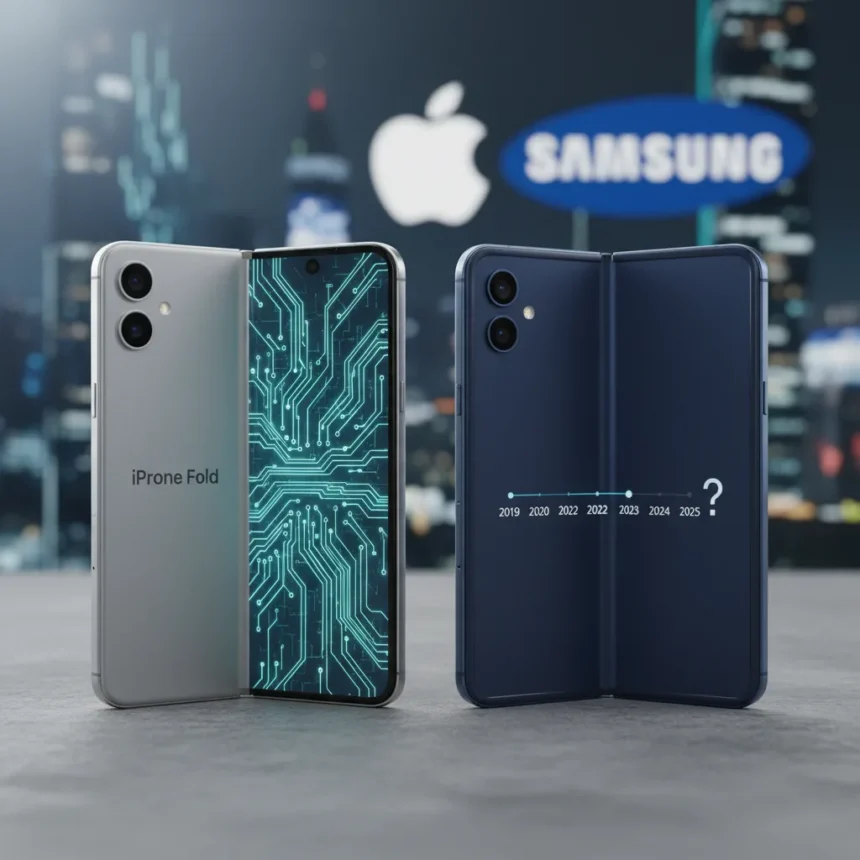
The iPhone Fold vs Galaxy Z Fold 8 battle is shaping up to be one of tech’s most anticipated matchups, even though neither device has been officially announced as of March 2026. Apple’s first foldable phone could outperform Samsung’s eighth-generation Z Fold on efficiency, crease minimization, and front-facing cameras—advantages that might surprise anyone assuming Samsung’s six-year head start guarantees dominance.
Key Takeaways
- iPhone Fold features a 7.8-inch internal display with rumored minimal crease; Galaxy Z Fold 8 offers 8.0-inch display with dual UTG for ~20% crease reduction.
- Apple’s A20 Pro chip (3nm) may outpace Exynos 2600 or Snapdragon 8 Elite Gen 5 in CPU efficiency despite Samsung’s graphics prowess.
- Galaxy Z Fold 8 leads in screen brightness (2600 nits), battery capacity (up to 5000mAh), rear camera (200MP), and IP48 water resistance.
- iPhone Fold expected to be more compact; Galaxy Z Fold 8 narrower grip from years of refinement.
- Samsung rumored to offer a “Wide Fold” variant with ~7.6-inch inner display to compete directly with iPhone Fold’s form factor.
iPhone Fold vs Galaxy Z Fold 8: The Display Showdown
Display technology reveals the core design philosophy of each phone. The iPhone Fold is expected to feature a 7.8-inch internal OLED display with 2460×2180 pixels, 424 PPI, 120Hz refresh, HDR support, Super Retina XDR, and Dolby Vision—with a rumored minimal or near-invisible crease. The Galaxy Z Fold 8 counters with an 8.0-inch Dynamic AMOLED display at 2184×1968 pixels, 367 PPI, 120Hz, and a peak brightness of 2600 nits. Samsung’s dual UTG (Ultra Thin Glass) crease reduction technology targets ~20% less visible crease than prior Z Fold models, though Apple’s rumored approach suggests an even flatter fold.
The 0.2-inch display size difference favors Samsung’s real estate, but the iPhone Fold’s higher pixel density (424 vs 367 PPI) and minimal crease could deliver a sharper, less distracting viewing experience. Samsung’s brightness advantage (2600 nits) matters outdoors and for HDR content, but Apple’s Dolby Vision integration may provide richer color grading in supported apps. Neither display is objectively superior—they reflect different priorities: Samsung emphasizes screen real estate and brightness; Apple optimizes sharpness and crease invisibility.
Processor Power and Efficiency: A20 Pro vs Exynos 2600
Apple’s rumored A20 Pro chip on a 3nm process could deliver superior single-threaded CPU performance and power efficiency compared to Samsung’s Exynos 2600 (2nm) or Snapdragon 8 Elite Gen 5 (3nm or 2nm, depending on region). In practical terms, this means the iPhone Fold may handle demanding apps, gaming, and multitasking with less battery drain—a crucial advantage in a device with a 4700mAh battery that must power a large foldable display.


Samsung’s chips, particularly the Snapdragon 8 Elite Gen 5 variant available in some regions, excel at graphics-intensive tasks and sustained performance under load. For casual users, the difference may be imperceptible. For power users running video editing, 3D rendering, or competitive gaming, Samsung’s GPU advantage could matter. Both phones support 5G, Wi-Fi 7, Bluetooth 6.0, NFC, and UWB connectivity.
Cameras and Ecosystem: iPhone’s Front Advantage, Samsung’s Rear Dominance
The iPhone Fold is rumored to feature dual front cameras (18MP each) with Center Stage support, a feature that automatically frames and follows subjects during video calls. This dual-front-camera setup is a rarity in the foldable market and signals Apple’s focus on video conferencing and content creation. The Galaxy Z Fold 8, by contrast, relies on a single front camera on the cover display and a single under-display camera on the inner screen.



Samsung’s rear camera setup dominates: a 200MP main sensor paired with ultrawide and telephoto lenses, compared to the iPhone Fold’s dual rear configuration. For photography enthusiasts, the Galaxy Z Fold 8’s 200MP sensor and multi-lens array provide more versatility. But Apple’s dual front cameras suggest the company is betting on video calls, streaming, and selfies as primary use cases for a foldable—a bet that resonates with remote work and content creation trends.
Battery, Charging, and Durability: Samsung’s Endurance Edge
The Galaxy Z Fold 8 packs a 4400mAh baseline battery, scaling up to 5000mAh in some configurations, with 45W or 60W charging speeds. The iPhone Fold’s 4700mAh battery sits in the middle but benefits from the A20 Pro’s efficiency gains, potentially extending real-world runtime despite the smaller capacity. Samsung’s IP48 water and dust resistance is a tangible advantage—the iPhone Fold’s rumored durability rating remains unconfirmed, though Apple’s Ceramic Shield frame and glass back suggest premium construction.
Samsung’s S Pen compatibility, rumored for the Galaxy Z Fold 8, remains absent from iPhone Fold leaks. For note-taking and sketching professionals, this is a meaningful differentiator. The Galaxy Z Fold 8’s narrower grip, refined hinge, and thinner body reflect six years of design iteration since Samsung’s first foldable in 2019—advantages that translate to daily comfort and durability.
Form Factor: Compact Efficiency vs. Maximum Screen Real Estate
The iPhone Fold is expected to be more compact overall, with a 5.5-inch (or 5.3-5.5-inch) external cover display, compared to the Galaxy Z Fold 8’s 6.5-inch cover screen. This design choice prioritizes one-handed usability and portability—Apple’s traditional strength. Samsung’s wider cover display and narrower grip make the Z Fold 8 feel less like a phone and more like a miniature tablet, appealing to multitaskers and media consumers.



Samsung is also rumored to launch a “Wide Fold” variant with approximately 7.6-inch inner and 5.4-inch outer displays in a 4:3 aspect ratio, directly targeting the iPhone Fold’s form factor. This suggests Samsung recognizes the compact foldable market and is hedging its bets with multiple form factors—a strategy that gives buyers more choice but complicates the product lineup.
Software and Optimization: iOS vs. One UI
Neither device has shipped, so software optimization remains speculative. Apple’s iOS is historically optimized for specific hardware, and the A20 Pro’s efficiency gains could translate to snappier performance and longer battery life in real-world use. Samsung’s One UI is mature and feature-rich, with deep Android customization and multitasking capabilities built for large inner displays. The iPhone Fold will likely introduce new iOS features tailored to the foldable form factor, while the Galaxy Z Fold 8 will refine existing Z Fold software from seven prior iterations.
Why Apple Could Win on the First Try
Apple’s advantage lies not in innovation but in execution: the A20 Pro’s efficiency, the rumored minimal crease, dual front cameras optimized for video, and a more compact form factor address genuine pain points in Samsung’s approach. Samsung’s experience is undeniable, but experience can also mean incremental refinement rather than bold rethinking. The Galaxy Z Fold 8 is the safer, more feature-rich choice. The iPhone Fold is the bet on efficiency, crease-free design, and Apple’s ecosystem lock-in.
The Real Winner? Consumers
Both phones will likely cost over $1700 (exact pricing unannounced), placing them firmly in the premium tier. The choice between them hinges on priorities: screen brightness and rear cameras favor Samsung; efficiency, front cameras, and form factor favor Apple. Neither is objectively superior—they represent different philosophies of what a foldable should be.
Will the iPhone Fold actually outperform the Galaxy Z Fold 8?
In raw specs, no. The Galaxy Z Fold 8 leads in screen size, brightness, battery capacity, rear cameras, and water resistance. But in efficiency, crease minimization, and front-facing features, the iPhone Fold’s rumored advantages could deliver a better daily experience for certain users—particularly those who prioritize video calls and compact design over maximum screen real estate.
Is the Galaxy Z Fold 8 still worth buying over the iPhone Fold?
If you need a larger inner display, S Pen support, water resistance, or superior rear cameras, yes. Samsung’s six-year design heritage also means a more refined hinge and proven durability track record. The Galaxy Z Fold 8 is the mature choice; the iPhone Fold is the ambitious newcomer.
When will the iPhone Fold actually launch?
Apple has not announced an iPhone Fold, and all specifications remain rumors from leaks and concept renders. Industry speculation points to 2026 as a possible debut year, but no official timeline exists.
The 2026 foldable war will not be won by specs alone—it will be won by the phone that feels best in hand, folds most invisibly, and integrates most smoothly into its ecosystem. On paper, both the iPhone Fold and Galaxy Z Fold 8 have compelling cases. In reality, the choice depends on whether you value Apple’s efficiency and design philosophy or Samsung’s proven experience and feature breadth. Either way, foldable technology is about to get a lot more interesting.
Edited by the All Things Geek team.
Source: Tom's Guide