





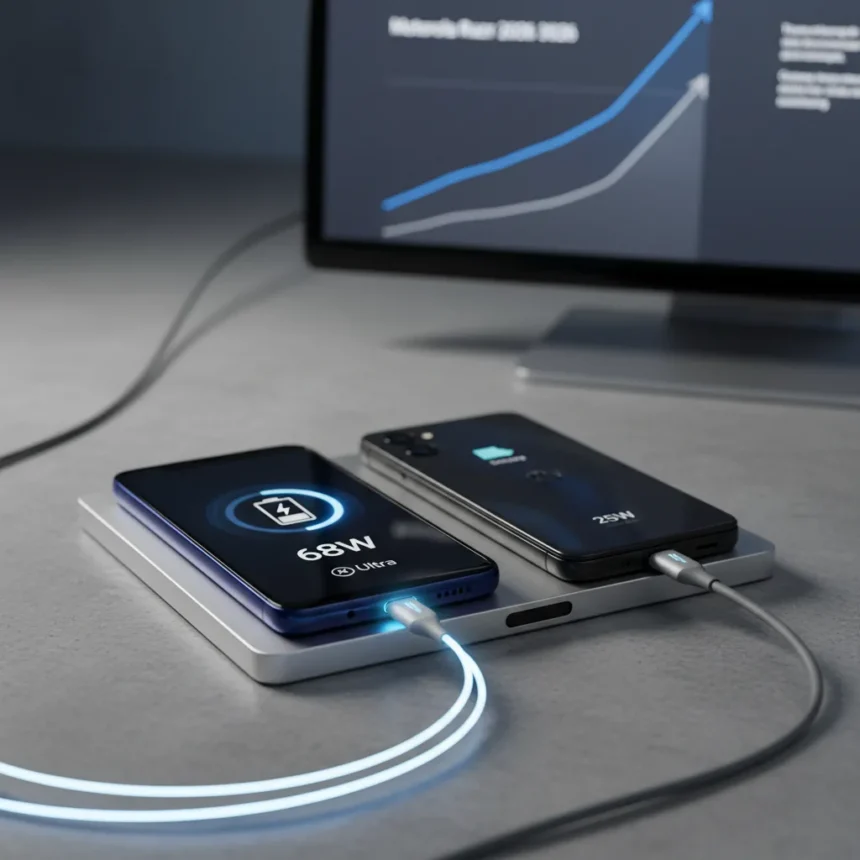
The Motorola Razr 2026 charging speed represents a substantial leap over both last year’s Razr lineup and Samsung’s upcoming Galaxy Z Flip 8. The flagship Razr Ultra 2026 delivers 68W wired charging and 30W wireless charging—speeds that dwarf the expected 25W wired and 15W wireless capabilities of Samsung’s next-generation flip phone.
Key Takeaways
- Razr Ultra 2026 charges at 68W wired, 30W wireless—fastest in the foldable category
- Base Razr 2026 offers 30W wired charging, up from previous generation
- All three 2026 models deliver a full day of power in just 8-15 minutes
- Silicon-carbon batteries enable larger capacity without increasing device thickness
- No Qi2 support on any 2026 Razr model; standard Qi chargers only
Motorola Razr 2026 Charging Speed: The Full Breakdown
Motorola’s 2026 foldable lineup splits charging capability across three distinct tiers, each addressing different user priorities. The base Razr 2026 starts at 30W wired and 15W wireless, while the Razr Plus jumps to 45W wired with the same 15W wireless. The Razr Ultra 2026, priced at $1,499, breaks away with 68W wired and 30W wireless charging—the most aggressive charging profile Motorola has ever shipped on a consumer device.
All three models support 5W reverse charging, allowing you to top up accessories or another phone from the Razr itself. This feature works across the entire lineup regardless of price tier, though it remains a niche use case for most buyers. The real story is speed: Motorola claims all 2026 Razr models deliver enough power for a full day in just 8-15 minutes of charging.
The Motorola Razr 2026 charging speed advantage stems from silicon-carbon battery technology, a breakthrough U.S. competitors have been slow to adopt. This chemistry allows Motorola to pack larger batteries without thickening the phones. The base model gets a 4,800mAh battery (up 300mAh from 2025), the Plus gets 4,500mAh (up 500mAh), and the Ultra reaches 5,000mAh (up 300mAh) while maintaining or reducing overall thickness.


How Motorola Razr 2026 Charging Speed Compares to Samsung
Samsung’s Galaxy Z Flip 8, expected to launch later in 2026, is rumored to retain the Flip 7’s 4,300mAh battery with just 25W wired and 15W wireless charging. The Razr Ultra 2026 crushes this in every metric: 5,000mAh battery capacity, 68W wired (nearly 3x faster), and 30W wireless (double Samsung’s speed). Even the base Razr 2026 at 30W wired outpaces Samsung’s expected 25W, making Motorola’s entry-level foldable a faster charger than Samsung’s flagship flip phone.
This gap matters for daily users. Faster charging means less time tethered to a wall, especially important for people who charge mid-day or travel frequently. Motorola’s silicon-carbon technology also means the Razr Ultra’s larger 5,000mAh battery doesn’t require a thicker phone to house it—a key design win over competitors juggling battery size and form factor.



What You Need to Know About Motorola Razr 2026 Charging Speed in Practice
There’s a catch: none of the 2026 Razr models ship with a charger in the box. You must buy a compatible power adapter separately to achieve the advertised charging speeds. Motorola specifies that the right wall charger is required—using a generic or undersized adapter will bottleneck the charging profile. Budget an additional $20-40 for a quality USB-C charger if you don’t already own one.
Wireless charging maxes out at 15W on the base and Plus models, 30W on the Ultra. However, Motorola has excluded Qi2 and Qi2 Ready support from all 2026 Razr devices, despite Samsung and Google embracing the standard. This means you’re stuck with standard Qi wireless chargers, though Motorola does support MagSafe accessories with a magnetic case. The omission feels like a missed opportunity, especially on the Ultra, which could theoretically support Qi2’s 15W standard and exceed it with Motorola’s 30W wireless implementation.
Battery Life and the 8-15 Minute Promise
Motorola claims all three 2026 Razr models deliver over 30 hours of battery life on a single charge. The 8-15 minute charging window that provides a full day of power is aggressive but achievable if you’re using the correct charger and cable. This assumes typical usage patterns—heavy gaming or video streaming may require longer charging windows to hit the promised runtime.
The silicon-carbon battery technology underpinning these claims is the real differentiator. By using silicon anodes instead of traditional graphite, Motorola achieves higher energy density without the thermal stress that typically limits fast charging on conventional lithium-ion cells. This is why the Razr Ultra can safely support 68W charging without degrading battery lifespan—the chemistry itself is more resilient.



Is the Motorola Razr 2026 charging speed worth the upgrade?
If you own a 2025 Razr, the charging speed improvement alone justifies the upgrade, especially if you grab the Plus or Ultra. The base 2026 model’s $100 price increase to $799 is harder to swallow given that nearly everything else mirrors last year’s Plus model, but the faster charging and larger battery offset some of that sting. For Flip 7 or Flip 8 owners, the Razr Ultra 2026 is a compelling alternative—faster charging, larger battery, and competitive pricing make it the smarter choice if you prioritize speed and endurance.
Does the Motorola Razr 2026 support Qi2 wireless charging?
No. None of the 2026 Razr models support Qi2 or Qi2 Ready, despite the Razr Ultra’s 30W wireless charging capability exceeding typical Qi2 speeds. You must use standard Qi wireless chargers. Motorola does support MagSafe accessories with a magnetic case, but this is separate from Qi2 standardization.
How long does it take to fully charge the Motorola Razr 2026?
Motorola claims 8-15 minutes of charging provides a full day of power, though a complete 0-100% charge will take longer depending on which model and charger you use. The Razr Ultra 2026 with its 68W wired charger will reach full capacity faster than the base model’s 30W, but Motorola has not published exact full-charge times for any variant.
The Motorola Razr 2026 charging speed story is ultimately one of competitive advantage. Motorola has finally built a foldable that doesn’t compromise on battery technology or charging capability to achieve a thin form factor. Whether you choose the $799 base model, the $899 Plus, or the $1,499 Ultra, you’re getting meaningfully faster charging than Samsung’s next-gen flip phone—and that’s a win worth paying attention to in a market where incremental improvements are the norm.
Edited by the All Things Geek team.
Source: Android Central




