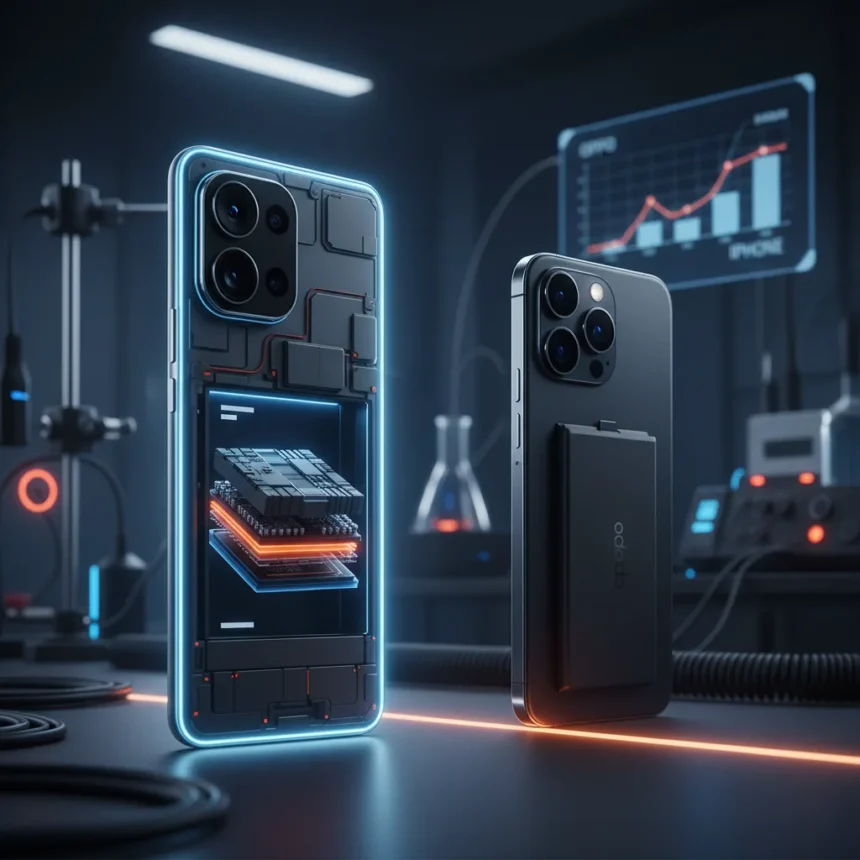
Silicon-carbon battery technology is reshaping smartphone endurance, and the Oppo Find X9 Ultra sits at the center of a quiet revolution that’s leaving Western flagships behind. After testing this device against the iPhone 17 Pro Max, the gap isn’t just noticeable—it’s embarrassing for Apple.
Key Takeaways
- Oppo Find X9 Ultra packs a 7,500 mAh silicon-carbon battery, the largest globally available in a smartphone.
- In standardized battery testing, the Find X9 Ultra lost only 10% charge over three hours of video playback at 50% brightness.
- Silicon-carbon technology achieves 30% longer cycle life than previous-generation batteries, with OnePlus guaranteeing 80% capacity retention after five years.
- iPhone flagships sacrifice battery capacity for thinness, with the iPhone Air delivering merely adequate endurance.
- Chinese manufacturers now lead smartphone battery innovation while Apple and Google prioritize design over longevity.
Why Silicon-Carbon Battery Technology Matters Now
Silicon-carbon battery technology represents the next major leap in smartphone power density. Unlike traditional lithium-ion cells, silicon-carbon designs use a biomimetic spherical honeycomb structure that suppresses silicon expansion during charge cycles, extending overall lifespan dramatically. This isn’t incremental improvement—it’s a fundamental architectural shift that Chinese manufacturers have weaponized while Western brands chase thinness.
The Oppo Find X9 Ultra exemplifies this advantage. Its 7,500 mAh silicon-carbon cell is the largest battery available on any globally distributed smartphone. That capacity alone would be meaningless without the chemistry to back it up, but the silicon-carbon design delivers real-world endurance that crushes conventional approaches.
Real-World Battery Performance: The Test That Matters
Tom’s Guide’s standardized battery test—playing 1080p YouTube video for three hours at 50% brightness—reveals the Find X9 Ultra’s true strength. The device lost only 10% battery charge over the entire test period. That’s the best result ever recorded on this benchmark. By contrast, the iPhone 17 Pro Max’s smaller conventional battery drains far more aggressively under identical conditions, exposing Apple’s design compromise: ultra-thin profile at the cost of practical endurance.


This isn’t a laboratory anomaly. The silicon-carbon structure’s 30% improvement in cycle life over previous-generation batteries means the Find X9 Ultra won’t just outlast the iPhone 17 in a single day—it will retain usable capacity years longer. OnePlus backs this confidence with an explicit guarantee: 80% battery capacity retention after five years. Apple offers no such promise because conventional lithium-ion batteries degrade far faster.
Why Apple and Google Are Falling Behind
Western flagship manufacturers have made a strategic choice: prioritize industrial design over battery longevity. The iPhone Air’s 3,190 mAh battery delivers merely adequate endurance in a paper-thin chassis. The Samsung Galaxy S25 Edge, at 3,900 mAh, makes the same trade-off. These devices are engineering marvels in thinness, but they’re battery compromises.



Meanwhile, the Honor Magic8 Pro Air proves that silicon-carbon technology works even in thin phones. Its 5,500 mAh Si-C battery easily powers the device for over a day on a charge. Oppo’s 7,500 mAh Find X9 Ultra takes this further, demonstrating that capacity and performance don’t require sacrificing thinness entirely—they require embracing better chemistry.
Apple and Google aren’t falling behind because they lack engineering talent. They’re falling behind because they’ve chosen a different product philosophy. When your brand identity rests on thinness and premium feel, a chunky battery becomes a design liability. Chinese manufacturers have decided longevity matters more than millimeters, and consumers are noticing.
The Durability Question Silicon-Carbon Still Faces
Silicon-carbon batteries will degrade over time, like all battery chemistry. The technology is proven in early deployments, but long-term reliability data remains limited. A five-year guarantee from OnePlus signals confidence, but we won’t know definitively how these cells perform across a decade of daily use until we have decade-old devices in the field.
That caveat matters. If silicon-carbon cells fail prematurely or degrade faster than expected, the entire advantage evaporates. For now, the technology shows promise, but early adoption always carries risk. Users seeking proven reliability might still prefer the iPhone’s conventional approach, even if it means charging more frequently.



Is the Oppo Find X9 Ultra worth buying over the iPhone 17?
For users prioritizing battery endurance and longevity, the Find X9 Ultra’s silicon-carbon technology delivers measurable advantages that the iPhone 17 Pro Max simply cannot match. The real-world test results speak clearly: 10% drain over three hours versus Apple’s far steeper decline. If you charge your phone daily anyway, this difference is marginal. If you want a phone that powers through two days of heavy use, the Find X9 Ultra is the clear winner.
How long does the Oppo Find X9 Ultra battery actually last on a single charge?
Real-world endurance depends on usage patterns, but the 7,500 mAh capacity combined with silicon-carbon efficiency means most users will see two full days of typical smartphone use. In the standardized video playback test, the device retained 90% capacity after three hours, suggesting exceptional efficiency across various workloads.
What makes silicon-carbon batteries better than regular lithium-ion?
Silicon-carbon batteries use a honeycomb structure that prevents silicon expansion during charging, reducing stress on the cell and extending cycle life by 30% compared to previous generations. This means the battery degrades more slowly, maintaining usable capacity longer than conventional lithium-ion designs.
The smartphone battery landscape is shifting. Chinese manufacturers have embraced silicon-carbon technology and proven it works at scale. The Oppo Find X9 Ultra’s 10% drain over three hours of continuous video playback isn’t just a number—it’s evidence that the industry’s battery leaders have moved on from the thin-phone compromise. Apple’s iPhone 17 Pro Max remains a powerful, capable device, but on the metric that matters most to daily users—how long the phone lasts—it’s no longer competitive. That’s not a small thing. That’s a fundamental reckoning with what matters in flagship design.
Where to Buy
Edited by the All Things Geek team.
Source: Tom's Guide