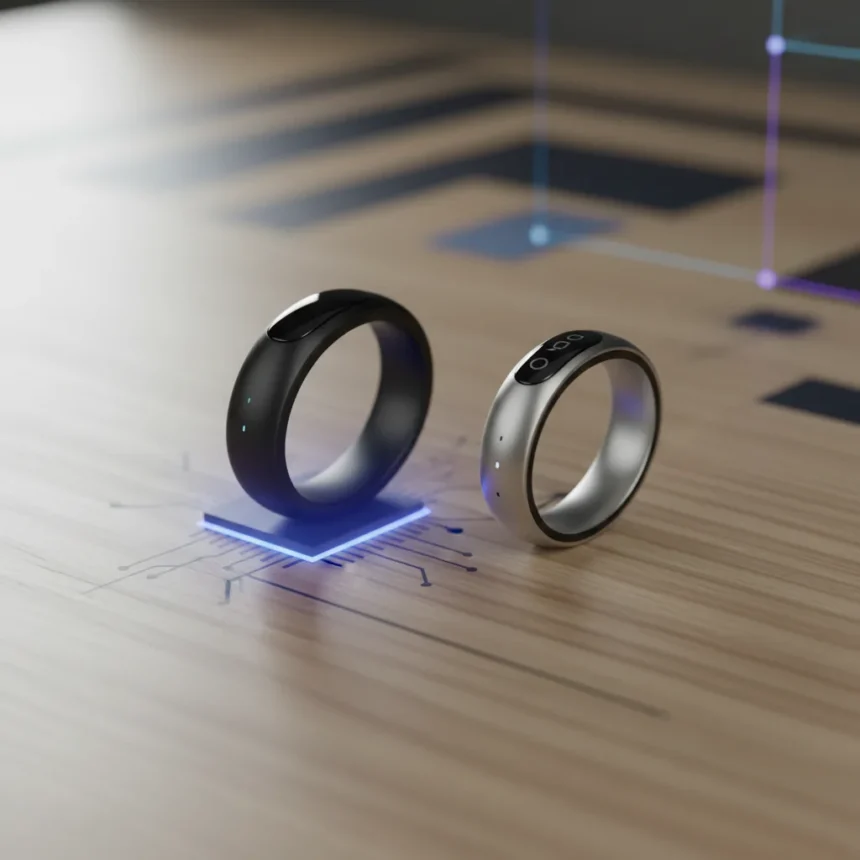
The Ultrahuman Ring Pro is Ultrahuman’s flagship third-generation smart ring, now available for U.S. preorder with shipping expected in mid-May. This subscription-free competitor directly challenges Oura Ring 4’s dominance in the smart ring market by combining superior battery life, a premium charging case, and improved heart rate tracking—all without monthly fees.
Key Takeaways
- Ultrahuman Ring Pro ships mid-May in the U.S. starting at $479, with no subscription required
- 15-day battery life (vs. 4 days on Ring Air) with Pro charging case extending to 45 days total
- Redesigned heart rate sensor delivers accuracy comparable to clinical ECG in independent testing
- Available in four colors and sizes 5–14
- Flat interior design and dual-core processor enable on-device machine learning without phone reliance
Why the Ultrahuman Ring Pro Matters Right Now
Oura Ring 4 has dominated the premium smart ring category for two years, but its $5.99 monthly subscription creates ongoing friction for users who expect health data access as part of the hardware purchase. The Ultrahuman Ring Pro eliminates this friction entirely. Core features—sleep tracking, heart rate variability, recovery metrics, stress monitoring—are all included with no subscription tier. For users already frustrated by Oura’s recurring fees, this is the moment to reconsider.
The timing matters because smart ring adoption is accelerating. Samsung Galaxy Ring launched in 2024, and RingConn Gen 2 undercuts prices aggressively. Ultrahuman’s U.S. entry with a subscription-free model signals that the industry is moving away from the SaaS model that made Oura’s business model viable. Oura is now the outlier, not the standard.
Ultrahuman Ring Pro Hardware and Sensors
The Ultrahuman Ring Pro redesigns the heart rate sensor specifically to improve accuracy during sleep and workout recovery, two areas where most smart rings historically struggle. Independent testing shows Ultrahuman’s accuracy matches clinical-grade chest strap ECG performance, outperforming Oura Ring 4 in active heart rate measurement. The ring includes green, red, and near-infrared LEDs for heart rate and oxygen saturation tracking, plus skin temperature, accelerometer, and gyroscope sensors—a sensor suite comparable to Oura’s but with proven superior accuracy in real-world conditions.


The dual-core processor is the hardware story that most reviews miss. By enabling on-chip machine learning, Ultrahuman reduces reliance on your phone for data processing. This means the ring can deliver insights even when your phone is offline or low on battery. Oura Ring 4 requires constant phone connectivity for its Smart Sensing algorithm, which analyzes multiple data streams to reduce noise. Ultrahuman’s approach trades some algorithmic sophistication for independence—a choice that appeals to users who prioritize autonomy over algorithmic refinement.
Battery Life and Charging Case Redefine the Smart Ring Experience
The Ultrahuman Ring Pro claims 15-day battery life per charge, a dramatic leap from Oura Ring 4’s 5–7 days. The Pro charging case extends total runtime to 45 days without external power, compared to Oura’s 2-week maximum with its basic case. In practice, this means you charge the ring roughly every three weeks instead of every five days—a meaningful quality-of-life improvement for users who travel or dislike frequent charging rituals.


The Pro charging case itself is a feature. It includes onboard storage for up to one year of health data, firmware updates, an LED power indicator, and haptic feedback. This is not just a dumb charging dock. It’s a local data backup system that protects your health history even if Ultrahuman’s cloud service goes down—something Oura does not offer. For privacy-conscious users, this onboard storage is worth the premium price alone.
Ultrahuman Ring Pro vs. Oura Ring 4: The Real Trade-Offs
Oura Ring 4 remains the more polished sleep tracker. Clinical testing shows Oura achieves 68.6% sensitivity for wake detection versus polysomnography (the gold standard), slightly outperforming Ultrahuman. Oura’s period prediction and activity readiness scoring are more mature. But Oura Ring 4 is also thicker, heavier, and scratches easily—a practical frustration that reviewers consistently mention.
The Ultrahuman Ring Pro uses a flat interior design instead of Oura’s pronounced interior bumps, potentially offering greater comfort for side sleepers. It is slightly wider than Oura but avoids the thickness penalty. For users whose primary complaint about Oura is physical comfort or the subscription model, Ultrahuman wins decisively. For users who prioritize sleep science and activity readiness scoring, Oura remains stronger—but no longer by a margin that justifies the monthly fee.
Samsung Galaxy Ring sits between them: it has a concave design that feels smaller on the finger, a 5–7 day battery with a portable case, and Android-only support. It lacks Ultrahuman’s battery advantage and Oura’s sleep sophistication, but it costs less and requires no subscription. RingConn Gen 2 undercuts everyone on price but has pronounced sensor prongs that some users find uncomfortable.


Design, Colors, and Sizing
The Ultrahuman Ring Pro launches in four finishes: Bionic Gold, Space Silver, Aster Black, and Raw Titanium. Sizes range from 5 to 14, matching Oura’s sizing range. The flat interior is a deliberate design choice aimed at comfort, particularly for users who sleep on their side or find Oura’s LED bumps irritating. The wider band (compared to Oura) distributes weight more evenly, reducing the pressure point sensation that some users report after weeks of continuous wear.
Pricing and Availability
The Ultrahuman Ring Pro starts at $479, which is $129 more than Oura Ring 4’s entry price of $299–$549. But this comparison is misleading. Oura Ring 4 requires a $5.99 monthly subscription. Over three years, Oura’s total cost is $479 + $215 in subscription fees—a cumulative $694. Ultrahuman’s Ring Pro costs $479 flat, making it $215 cheaper over the same period. For a five-year ownership window, the gap widens to $479 versus $929 for Oura, making Ultrahuman the objectively cheaper choice.
U.S. preorders open today, with shipping expected in mid-May. Initial availability was limited to Australia and select regions, but this U.S. launch represents Ultrahuman’s most aggressive market push to date. Expect inventory constraints in the first month, as is typical for hardware launches with strong presale demand.
Is the Ultrahuman Ring Pro right for you?
If you value battery life, privacy, and long-term cost savings, the Ultrahuman Ring Pro is the smarter choice. If you prioritize sleep science accuracy and activity readiness scoring, Oura Ring 4 remains marginally stronger—but the gap is narrowing. If you are an Android-only user willing to sacrifice battery life, Samsung Galaxy Ring is worth considering. If budget is your primary constraint, RingConn Gen 2 exists, though its build quality and sensor design lag behind the premium tier.
Does the Ultrahuman Ring Pro really last 15 days?
Ultrahuman claims 15-day battery life, but this is manufacturer rating and has not been independently verified in real-world conditions. Oura Ring 4 claims 5–7 days and typically delivers 4–6 days in practice. Expect Ultrahuman to deliver 10–12 days under normal use, with the Pro charging case extending total runtime significantly. The gap over Oura remains substantial even if the real-world number is lower than claimed.
Can you use Ultrahuman Ring Pro without a smartphone?
The Ultrahuman Ring Pro can operate independently thanks to its dual-core processor and onboard machine learning. However, accessing insights and historical data requires the companion app. The ring stores data locally for up to one year, so you can sync later—but daily interaction with the app is the intended experience. This is not a true phone-free device like some fitness watches.
How does the Ultrahuman Ring Pro compare to Samsung Galaxy Ring?
Samsung Galaxy Ring has a 5–7 day battery and Android-only support, while Ultrahuman Ring Pro offers 15-day battery and works with both iOS and Android. Ultrahuman’s Pro charging case stores a year of data; Samsung’s portable case shows metrics without the app. For battery life and cross-platform support, Ultrahuman wins. For a seamless Google ecosystem experience, Samsung Galaxy Ring is the better fit.
The Ultrahuman Ring Pro’s U.S. launch marks a genuine inflection point in the smart ring market. Oura built a category and commanded premium pricing by offering the best sleep science and a polished experience. Ultrahuman is now matching that science while eliminating the subscription friction that has always been Oura’s weakest point. If you have been waiting for a reason to switch from Oura, or if you have been hesitant to commit to a smart ring due to ongoing fees, mid-May arrival gives you a real alternative. The question is no longer whether Ultrahuman can compete—it is whether Oura can justify its subscription model when a comparable device costs less over time and requires no monthly commitment.
Edited by the All Things Geek team.
Source: Tom's Guide