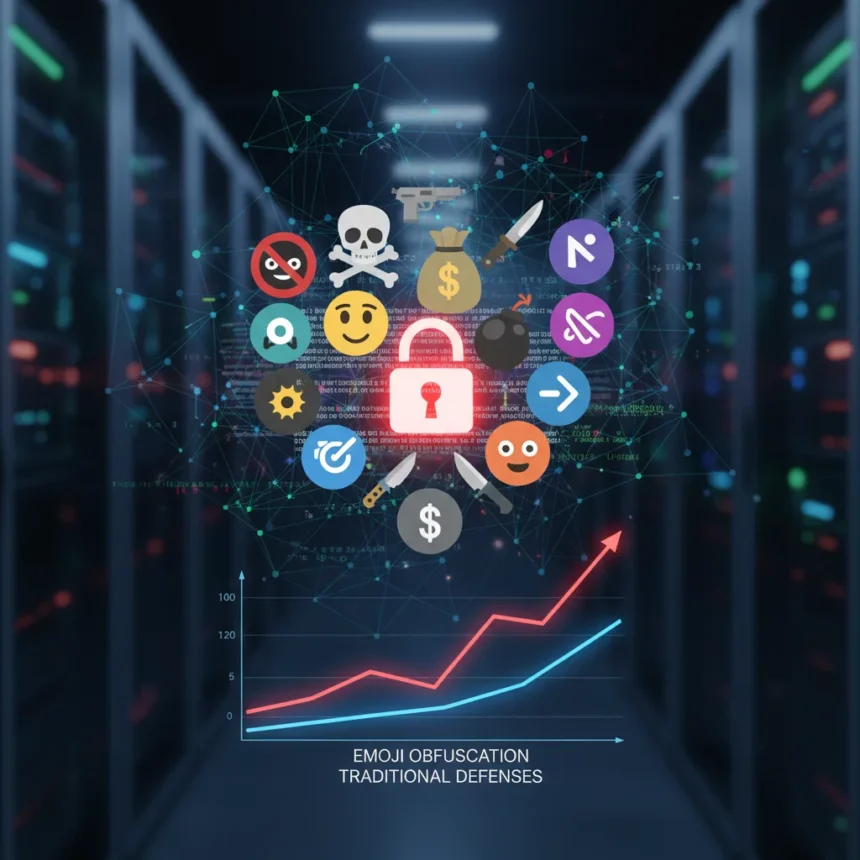
Criminals using emojis represent a growing blind spot in cybersecurity. With 3,664 emojis available for digital communication, threat actors are exploiting the fact that traditional security systems scan for keywords and text patterns, not pictograms. This creates a layered form of obfuscation that evolves faster than detection systems can adapt, allowing criminals to operate with near-impunity across dark web forums, social media, and encrypted messaging platforms.
Key Takeaways
- Criminals using emojis bypass text-based detection because security systems do not scan pictograms or Unicode exploits.
- Drug dealers use pill and maple leaf emojis; human traffickers use high heels and roses to advertise victims.
- Cybercriminals embed emojis in phishing emails and malware to circumvent antivirus and email filters.
- Emoji encoding (Unicode mapping) allows attackers to hide malicious code—fire emoji (U+1F525) mapped to “delete,” folder emoji to “file.”
- Romance scammers and fraudsters use hearts, money bags, and credit card emojis to build false trust and conduct financial crimes.
How Criminals Using Emojis Exploit Security Gaps
Criminals using emojis exploit a fundamental weakness in how security teams monitor threats. Traditional antivirus and email filters rely on keyword matching and linguistic analysis—they look for words like “cocaine,” “stolen card,” or “malware.” Emojis, by contrast, are non-linguistic symbols with ambiguous and subjective meanings. A pill emoji could represent medicine, a vitamin, or narcotics. A rose could mean romance or, in trafficking networks, a victim for sale. This ambiguity is deliberate. Because security analysts focus on text-based patterns, they miss emoji-coded conversations entirely, especially on the dark web where DarkOwl reports criminals use emojis to obfuscate content for clients and victims.
The scale of the problem is staggering. With thousands of emojis constantly evolving, detection systems cannot keep pace. Law enforcement has responded by publishing “cheat sheets” to decode drug dealer emojis—maple leaves for cannabis, pills for prescription drugs—but this reactive approach always lags behind criminal innovation. Emojis are updated regularly, and new ones provide fresh cover for illegal activity before defenders even know they exist.
Criminals Using Emojis in Specific Crime Types
Different criminal enterprises exploit emojis in distinct ways. Drug dealers use straightforward pictograms: pills 💊, marijuana leaves 🌿, and cash 💰 to advertise products and negotiate sales. Human traffickers employ high heels 👠 and roses 🌹 to advertise victims on mainstream social media platforms, hiding in plain sight among legitimate posts. Romance scammers use hearts ❤️ and kiss emojis 💋 to build false intimacy across dating apps and social networks, transcending language barriers and making their schemes harder to detect through automated moderation.


Cybercriminals take obfuscation further. They embed emojis directly into phishing emails and malware payloads to bypass email filters. Fraudsters use credit card 💳, money bag 💰, and package 📦 emojis in dark web forums to discuss money laundering and credit card theft operations. What makes this especially dangerous is that Javelin Strategy & Research notes emojis circumvent antivirus and email filters to spread malware and infostealers, creating direct risks to financial institutions and their customers.
Emoji Smuggling and Unicode Exploitation
The most sophisticated form of criminal emoji use is “emoji smuggling”—encoding malicious commands as emojis using Unicode mappings. Attackers assign functions to specific emojis: fire emoji (U+1F525) equals “delete,” folder emoji equals “file,” globe emoji equals “download,” and skull emoji equals “execute”. A seemingly innocent string like 🚗🍔🌴🕒 translates to “Meet at the beach with the package at 3 PM,” while 🌿🔫💰 signals a cannabis transaction. These encoded messages hide in plain sight, readable only to those who know the cipher.



This approach exploits the standardized Unicode encoding that allows the same emoji to function identically across platforms—from WhatsApp to Telegram to social media. A fraudster can manage multiple criminal operations simultaneously using the same emoji alphabet, scaling their business without learning new codes. Traditional security tools see only pictograms; they do not recognize them as command syntax.
Why Traditional Defenses Fail Against Emojis
Text-based security filters are fundamentally blind to emoji-based threats. Antivirus software scans for malicious code strings and known malware signatures. Email filters look for phishing keywords and suspicious URLs. Neither system evaluates emojis as potential threats because, historically, they were not threats. A security analyst reviewing a dark web conversation full of emojis sees decoration, not danger. The subjective nature of emoji meaning—a skull could mean death, a joke, or a command to execute code—makes automated detection nearly impossible without human context.
Social engineering attacks amplify this blind spot. Criminals use urgent warning emojis like ⚠️, 🆘, and 🆚 to trick users into clicking malicious links or downloading infected files. The emoji conveys urgency and authority in a way that bypasses rational skepticism. A user sees a warning symbol and reacts emotionally before thinking critically about the source.
What Security Teams Can Do
Defending against criminals using emojis requires a fundamentally different approach than traditional signature-based detection. Security teams must monitor emoji patterns in dark web forums and encrypted channels, building threat intelligence on how specific emoji combinations correlate with criminal activity. This is labor-intensive and requires human analysts who understand the evolving emoji vernacular.



Organizations should also implement behavioral analysis that flags unusual emoji usage in emails and messages—a sudden shift toward emoji-heavy communication, especially in phishing emails, warrants investigation. Email gateways need updates to scrutinize emoji-laden payloads more aggressively, even though emojis themselves are not inherently malicious. And security awareness training must address the social engineering angle, teaching users that emojis can be weaponized just like text.
Is emoji use always a sign of criminal activity?
No. Emojis are legitimate tools for digital communication. The problem is not emojis themselves but their use as deliberate obfuscation by criminals. A dating app user sending hearts and kisses is normal. A dark web forum user encoding drug transactions in emojis is criminal. Context and pattern matter.
How quickly do criminals adapt to new emoji updates?
Very quickly. Because emojis evolve constantly and outpace detection system updates, criminals can adopt newly released emojis for obfuscation before security teams even catalog them. This creates a perpetual cat-and-mouse dynamic where defenders are always playing catch-up.
Can law enforcement decode all emoji-based criminal messages?
Not reliably. While law enforcement publishes cheat sheets for common drug-related emojis, these represent only a fraction of criminal emoji use. Custom emoji ciphers, Unicode smuggling, and context-dependent meanings make comprehensive decoding nearly impossible without insider intelligence from infiltrated criminal networks.
Criminals using emojis have found a vulnerability in the security infrastructure that protects digital communication. Until detection systems evolve beyond text-based keyword matching and security teams develop emoji-aware threat intelligence, this form of obfuscation will remain effective. The challenge is not that emojis are inherently dangerous—it is that they operate in a detection blind spot that criminals have learned to exploit with precision.
Edited by the All Things Geek team.
Source: TechRadar