





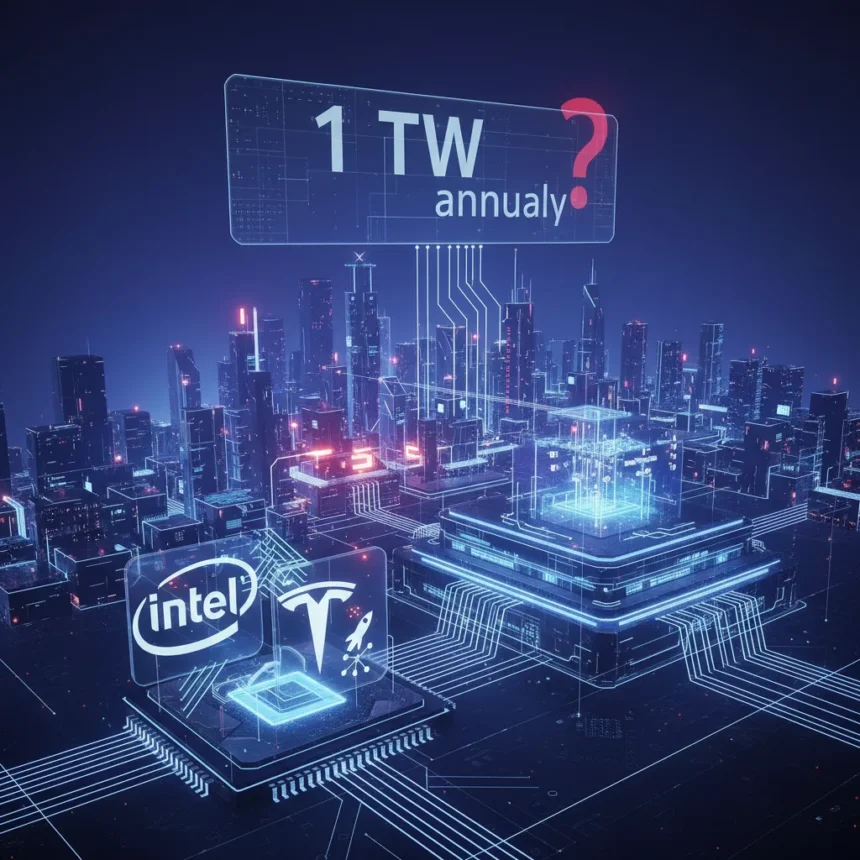
TeraFab chip manufacturing represents one of the semiconductor industry’s most audacious bets: a single mega-facility designed to produce enough processors to consume 1 terawatt of power annually, built as a partnership between Intel, Tesla, SpaceX, and xAI. The announcement signals a dramatic shift in how Elon Musk’s companies plan to secure the chips they desperately need for AI and robotics. But behind the ambition lies a troubling gap between the vision and the engineering reality.
Key Takeaways
- TeraFab aims to produce logic chips, HBM4 memory, and advanced packaging with 1 terawatt annual power consumption
- Initial investment estimated at approximately $20 billion, with full output not expected until the 2030s
- Bernstein analysis estimates TeraFab would require 142 to 358 semiconductor fabs to achieve 1 TW output
- Elon Musk’s companies need 100–200 billion AI processors annually, far exceeding current industry capacity
- Intel will handle manufacturing while Tesla, SpaceX, and xAI focus on chip design and demand
Why Intel is betting on TeraFab chip manufacturing
Intel’s decision to join TeraFab reflects the company’s desperation to stay relevant in the AI era. The chipmaker has stumbled through recent years—missing process node targets, losing market share to TSMC, and watching its manufacturing advantage evaporate. Partnering with Musk offers Intel a path back into the conversation as a latest foundry, not just a legacy x86 player. Intel highlighted its proficiency in large-scale production of ultra-high-performance chips as the foundation for TeraFab’s ambitions.
For Musk’s trio of companies, the calculus is clearer: they are drowning in chip demand. Tesla needs processors for vehicles and energy systems. SpaceX requires specialized chips for satellites and launch systems. xAI is burning through GPUs to train its Grok AI model. Collectively, these firms need 100–200 billion AI processors annually. No external foundry can guarantee that supply. Building their own fab—or at least securing a dedicated one—eliminates the middleman and guarantees allocation.
The math problem nobody wants to discuss
Here is where TeraFab’s ambition collides with reality. To achieve 1 terawatt of annual output, the project would need to produce 22.4 million Rubin Ultra GPU wafers, 2.716 million Vera CPU wafers, and 15.824 million HBM4E wafers per year. Bernstein Research estimates this would require between 142 and 358 semiconductor fabrication plants operating at full capacity. That is not one mega-fab. That is an entire global industry’s worth of manufacturing, consolidated under one roof.


For context, the entire world currently operates roughly 300 fabs across all nodes and geographies. Building 142–358 new ones, even with shared infrastructure, would cost hundreds of billions of dollars, require a workforce that does not exist, and take decades. The timeline compounds the problem: TeraFab’s full output is not expected until the 2030s. By then, chip architectures will have evolved. Demand profiles will have shifted. The competitive landscape will be unrecognizable.
TeraFab chip manufacturing versus traditional foundries
The traditional model—TSMC, Samsung, Intel as foundries serving multiple customers—has dominated for decades because it spreads massive capital costs across thousands of designs. TSMC operates roughly 14 advanced fabs globally and still struggles with utilization and profitability. TeraFab inverts that model: vertical integration for three companies with highly specialized needs. If Tesla’s demand drops, or xAI pivots to a different architecture, the facility sits underutilized. Conversely, if demand exceeds projections, the companies face the same supply crunch they are trying to escape.



Intel’s role is critical but also risky. The company gets a guaranteed customer base and the prestige of building next-generation logic and memory. But it also inherits the capital burden and the execution risk. If TeraFab’s timeline slips—which is almost guaranteed given semiconductor project histories—Intel absorbs the cost. If the project succeeds, Intel becomes a specialized foundry for Musk’s empire rather than a broad-market player.
Can TeraFab actually happen?
Skepticism is warranted. Industry analysts have described TeraFab as an unattainable dream given the scale of investment, timeline, and technical challenges. The 1 terawatt target assumes perfect execution across design, process technology, supply chain, and manufacturing—none of which are guaranteed. Elon Musk has a track record of aggressive timelines that slip (SpaceX Starship, Tesla Full Self-Driving). A semiconductor fab is exponentially more complex than either.
That said, the project is not worthless. Even a partial success—a dedicated fab producing 100–200 billion chips annually—would reshape the AI chip market and reduce Musk’s companies’ dependence on external foundries. Intel gains a customer with infinite capital and aggressive timelines. The real question is not whether TeraFab will achieve 1 terawatt by 2030, but whether it will produce enough chips to matter before then.
Is TeraFab realistic?
The 1 terawatt target appears extraordinarily optimistic given Bernstein’s estimates of 142–358 required fabs and the 2030s timeline for full output. However, even partial capacity would be transformative for Tesla, SpaceX, and xAI.


When will TeraFab start producing chips?
Full output is not expected until the 2030s. Initial production timelines have not been publicly disclosed, but semiconductor fabs typically require 3–5 years from groundbreaking to first wafer out.
Why did Intel join TeraFab instead of building its own fab?
Intel is manufacturing partner, not a primary customer. The company gains a guaranteed revenue stream and a chance to prove its foundry capabilities on latest nodes. Tesla, SpaceX, and xAI own the demand side and drive the roadmap.
Intel’s bet on TeraFab is a gamble that vertical integration for AI chip supply will reshape the industry. The math suggests the ambition exceeds what one facility can deliver. But in the race for AI dominance, even an unattainable dream is better than admitting the current system is broken.
Edited by the All Things Geek team.
Source: Tom's Hardware




