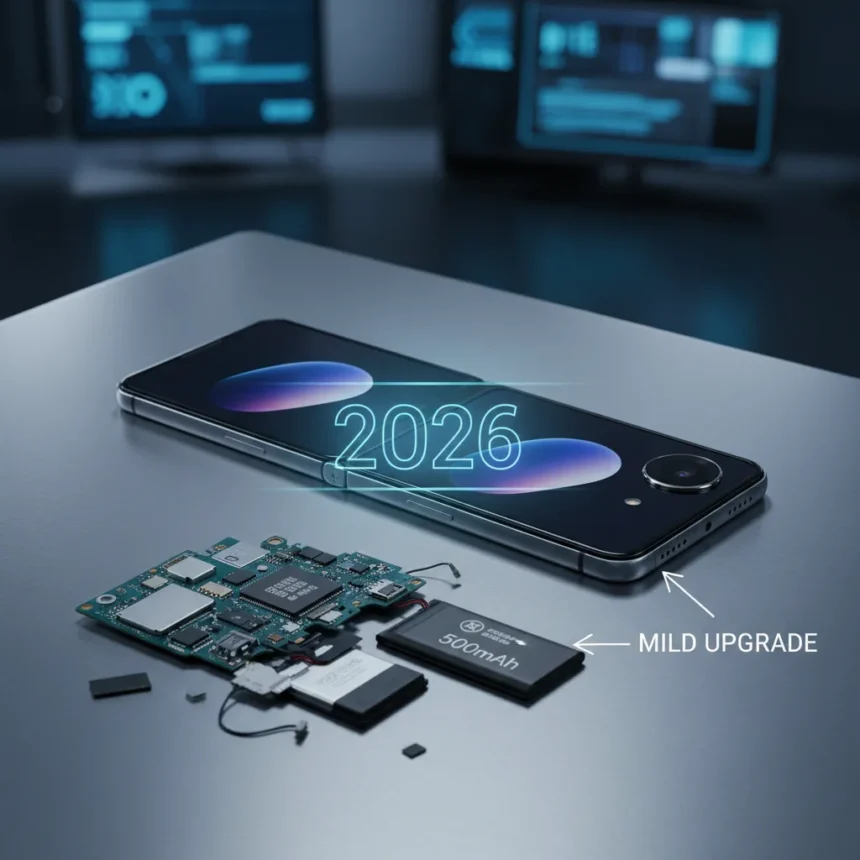
The Moto Razr Ultra 2026 is a foldable smartphone from Motorola rumored to launch in April 2026, featuring a Snapdragon 8 Elite Gen 5 chipset, 16GB RAM, and 512GB storage, with a 4,700mAh battery and 68W wired charging. But here’s the problem: leaked CAD renders and specifications suggest Motorola is playing it safe rather than pushing boundaries in a market where Samsung and others are innovating faster.
Key Takeaways
- Moto Razr Ultra 2026 keeps nearly identical design to 2025 model with 4-inch cover and 7-inch main display.
- Snapdragon 8 Elite Gen 5 chipset with 16GB LPDDR5X RAM and 512GB UFS 4.0 storage rumored for the device.
- Battery capacity and charging speeds match 2025 model (4,700mAh, 68W wired, 30W wireless), suggesting minimal performance gains.
- 165Hz refresh rate returns to both folding and cover screens, matching 2025 specs.
- Dual 50MP rear cameras support 8K video, HDR, and Dolby Vision recording capabilities.
- Rumored April 2026 launch with new finishes like Pantone Cocoa Wood and Orient Blue Alcantara.
Moto Razr Ultra 2026 design stays the course
Motorola is not reinventing the wheel here. Leaked renders show the Moto Razr Ultra 2026 retains the same horizontal dual camera array, similar hinge design, and overall silhouette as the 2025 model. The 4-inch cover display and 7-inch inner OLED screen remain unchanged in size and aspect ratio. The only visible tweaks are new color options—Pantone Cocoa Wood with a darker wood-grain finish and Orient Blue Alcantara with a blueish-purple hue and diamond grooves—but these are cosmetic variations, not functional improvements.
There is a possible thickness increase rumored to accommodate battery improvements, but the physical footprint and usability stay virtually identical. This approach mirrors Samsung’s strategy with the Galaxy Z Fold 7, which shares a similar corner design near the hinge, but Motorola’s lack of meaningful design evolution feels conservative in a category where foldables are still defining their identity.
Specs that fail to excite
The Moto Razr Ultra 2026 will run a Snapdragon 8 Elite Gen 5 processor—Qualcomm’s flagship 3nm chip—paired with 16GB LPDDR5X RAM and 512GB UFS 4.0 storage, with a 1TB option possible. On paper, this is solid flagship hardware. But the battery tells a different story: the 4,700mAh capacity and charging speeds (68W wired, 30W wireless, 5W reverse charging) are identical to the 2025 model. This means Motorola is likely betting on chipset efficiency rather than raw capacity to improve daily runtime—a gamble that rarely pays off when competitors are adding milliamp-hours alongside processor upgrades.


The display refresh rate of 165Hz on both the cover and folding screens marks a return from the 2025 model, not an advancement. Rear cameras stick with a dual 50MP setup (main and ultrawide/macro) supporting 8K video, HDR, and Dolby Vision. These specs are competent but not class-leading. The ultrawide doubling as a macro lens is a practical compromise, not an innovation.
Why the Moto Razr Ultra 2026 won’t make waves
Motorola’s incremental approach misses the moment. The foldable market is heating up with rivals pushing larger inner displays, thinner bezels, more durable materials, and battery breakthroughs. The Moto Razr Ultra 2026 appears to iterate rather than differentiate. Same design language, same battery capacity, same camera count—these are the hallmarks of a product cycle that plays defense instead of offense.



The rumored April 2026 launch timing also matters. By then, Samsung will have had months to establish the Galaxy Z Fold 7 as the foldable benchmark, and OnePlus or other competitors may have launched alternatives. Motorola’s timing and conservative specs suggest the Moto Razr Ultra 2026 will struggle to capture mindshare beyond existing Razr loyalists who value the familiar form factor.
Should you wait for the Moto Razr Ultra 2026?
If you own a 2025 Razr Ultra, there is no compelling reason to upgrade. The battery, charging, and camera capabilities are essentially the same. If you are considering a foldable for the first time, the Moto Razr Ultra 2026 might appeal if you prefer the compact form factor and new finishes, but you should compare it directly to Samsung’s Z Fold 7 and any other 2026 launches before committing.
What are the Moto Razr Ultra 2026 display specs?
The Moto Razr Ultra 2026 has a 4-inch cover display and a 7-inch inner OLED screen, both with 165Hz refresh rates. These match the 2025 model exactly, so no improvements are expected in responsiveness or visual fluidity compared to the current generation.
Does the Moto Razr Ultra 2026 have a bigger battery?
No. The Moto Razr Ultra 2026 is rumored to retain the same 4,700mAh battery capacity as the 2025 model, with identical 68W wired and 30W wireless charging speeds. Any runtime improvements would depend on the Snapdragon 8 Elite Gen 5’s power efficiency, not raw capacity gains.



What finishes will the Moto Razr Ultra 2026 come in?
Leaked renders show two new finishes: Pantone Cocoa Wood with a darker wood-grain texture and Orient Blue Alcantara with a blueish-purple hue and diamond grooves. A base Razr 2026 is also rumored with fabric and carbon-fiber textures in colors like Hematite, Bright White, Sporting Green, and Violet Ice, though these are distinct from the Ultra model.
The Moto Razr Ultra 2026 is shaping up as a safe, incremental update that plays to existing strengths rather than addressing the foldable category’s real weaknesses—battery anxiety, durability concerns, and display innovation. Unless Motorola has major surprises hidden from leakers, this phone will struggle to justify its existence in a competitive 2026 foldable landscape.
Edited by the All Things Geek team.
Source: Android Central